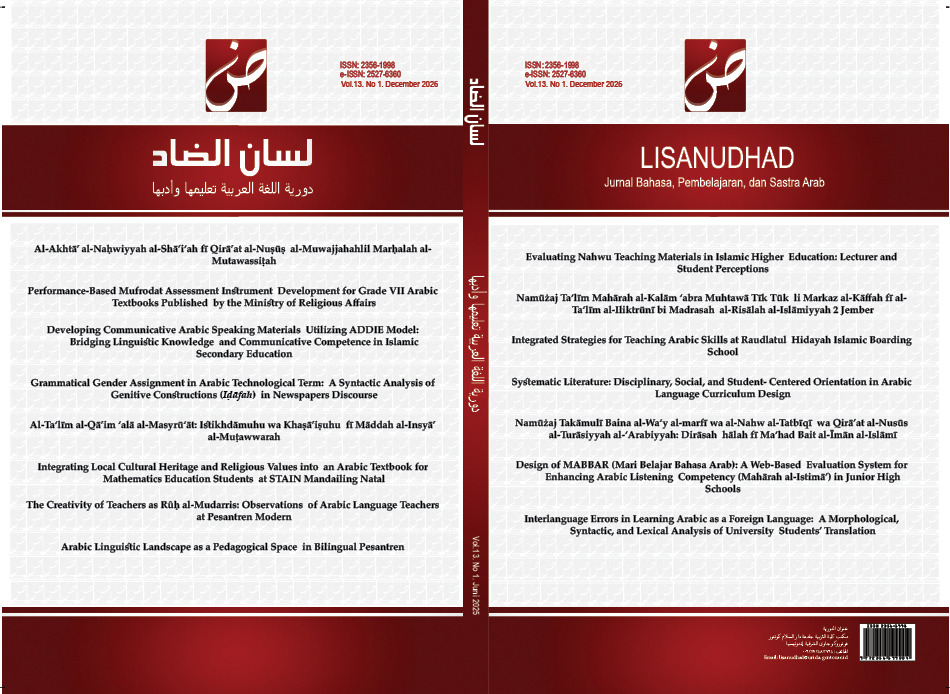
Integrated Strategies for Teaching Arabic Skills at Raudlatul Hidayah Islamic Boarding School
DOI:
https://doi.org/10.21111/lisanudhad.v13i1.51الكلمات المفتاحية:
Arabic language teaching، Arabic skills، pesantren، communicative approach، bīʾah lughawiyyahالملخص
This study examines the integrated strategies used to teach Arabic language skills at Raudlatul Hidayah Islamic Boarding School, Sulusuban, Central Lampung. The study focuses on four core skills: listening, speaking, reading, and writing. It aims to describe how these skills are developed through pesantren-based learning practices and to identify the challenges encountered in their implementation. This research employs a qualitative case study design, with data collected through observation, interviews, and documentation of Arabic learning activities. The findings show that listening skills are developed through murattal Qur’anic recitation, Arabic lectures, and dialogue recordings; speaking skills are strengthened through muhadharah, thematic conversations, and daily Arabic interaction; reading skills are taught through talaqqī, bandongan, classical texts, and selected modern materials; while writing skills are practiced through journals, summaries, and short compositions. These strategies indicate an effort to integrate traditional pesantren methods with communicative Arabic teaching. However, their implementation is still limited by inadequate learning media, uneven student proficiency, limited teacher training, and the absence of structured skill-based assessment.
المراجع
Aldhafiri, Mohammad D., ‘The Effectiveness of Using Interactive White Boards in Improving the Arabic Listening Skills of Undergraduates Majoring in Arabic Language at Kuwaiti Universities’, Education and Information Technologies, 25.5 (2020), pp. 3577–91, doi:10.1007/s10639-020-10107-5
——, ‘The Effectiveness of Using Interactive White Boards in Improving the Arabic Listening Skills of Undergraduates Majoring in Arabic Language at Kuwaiti Universities’, Education and Information Technologies, 25.5 (2020), pp. 3577–91, doi:10.1007/s10639-020-10107-5
Almelhes, Sultan, ‘Enhancing Arabic Language Acquisition: Effective Strategies for Addressing Non-Native Learners’ Challenges’, Education Sciences, 14.10 (2024), p. 1116, doi:10.3390/educsci14101116
Almelhes, Sultan A., ‘Gamification for Teaching the Arabic Language to Non-Native Speakers: A Systematic Literature Review’, Frontiers in Education, 9 (2024), p. 1371955, doi:10.3389/feduc.2024.1371955
Brown, H. Douglas, Teaching by Principles: An Interactive Approach to Language Pedagogy, 2nd edn (Longman, 2001)
Bruinessen, Martin van, Kitab Kuning, Pesantren, Dan Tarekat: Tradisi-Tradisi Islam Di Indonesia (Mizan, 1995)
Harmer, Jeremy, The Practice of English Language Teaching, 4th edn (Pearson Longman, 2007)
Hermiwati, Hermiwati, and others, ‘Enhancing Arabic Vocabulary Acquisition: Development of Learning Apps Based Interactive Learning Media’, Lisanudhad: Jurnal Bahasa, Pembelajaran Dan Sastra Arab, 12.2 (2025), doi:10.21111/lisanudhad.v12i2.30
HINKEL, E., Current Perspectives on Teaching the Four Skills, (TESOL Quarterly), 40 (2006), pp. 109–31, doi:https://doi.org/10.2307/40264513
Ibrāhīm al-Fawzān, ʿAbd al-Raḥmān ibn, Iḍāʾāt Li-Muʿallimī al-Lughah al-ʿArabiyyah Li-Ghayr al-Nāṭiqīn Bihā (Maktabat al-Malik Fahd al-Waṭaniyyah, 2011)
John W. Creswell and Cheryl N. Poth, Qualitative Inquiry and Research Design: Choosing among Five Approaches, 4th edn (SAGE, 2018)
L. S. Vygotsky, Mind in Society: The Development of Higher Psychological Processes, Ed. by Michael Cole, Vera John-Steiner, Sylvia Scribner, and Ellen Souberman (Harvard University Press., 1978)
Matthew B. Miles, A. Michael Huberman, and Johnny Saldaña, Qualitative Data Analysis: A Methods Sourcebook, 4th edn (SAGE, 2020)
Nurcholis, Ahmad, and Abduloh Safik, ‘Drama, and Sholawat in Fostering Religious Muslim’, Lisanudhad: Jurnal Bahasa, Pembelajaran Dan Sastra Arab, 12.2 (2025), pp. 3–5, doi:https://doi.org/10.21111/lisanudhad.v12i2.40
Oxford, Rebecca, ‘Integrated Skills in the ESL/EFL Classroom’, ERIC Digest (ERIC Clearinghouse on Languages and Linguistics, 2001)
Richards, Jack C., Communicative Language Teaching Today (Cambridge University Press, n.d.)
Setiyadi, Alif Cahya, and others, ‘Bi’ah Lughawiyah Programs in Arabic Language Learning to Improve Student’s Arabic Speaking Skills’, Ta’lim al-’Arabiyyah: Jurnal Pendidikan Bahasa Arab & Kebahasaaraban, 7.1 (2023), pp. 29–46, doi:10.15575/jpba.v7i1.24173
Sharan B. Merriam and Elizabeth J. Tisdell, Qualitative Research: A Guide to Design and Implementation (Jossey-Bass, 2016)
Stephen D. Krashen, The Input Hypothesis: Issues and Implications (Longman, 1985)
Ulinnuha, Inayah Fitri, and Nuril Mufidah, ‘The Use of Albert Bandura’s Method for Learning Arabic Speaking Skill Using TikTok’, Lisanudhad: Jurnal Bahasa, Pembelajaran Dan Sastra Arab, 12.2 (2025), pp. 23–50, doi:10.21111/lisanudhad.v12i2.42
Virginia Braun and Victoria Clarke, Thematic Analysis: A Practical Guide (SAGE, 2021)
Widyadhana, Ainur Rizqi, and others, ‘The Cognitive Approach in Learning to Read Arabic Texts: A Philosophical and Pedagogical Analysis’, Lisanudhad: Jurnal Bahasa, Pembelajaran Dan Sastra Arab, 12.2 (2025), pp. 161–83, doi:10.21111/lisanudhad.v12i2.41
Yin, Robert K., Case Study Research and Applications: Design and Methods, 6th edn (SAGE, 2018)
Yvonna S. Lincoln and Egon G. Guba, Naturalistic Inquiry (SAGE, 1985)
التنزيلات
مقدم
##submissions.accepted##
منشور
كيفية الاقتباس
إصدار
القسم
الرخصة
الحقوق الفكرية (c) 2026 Qulyubi Rais, Muassomah, R. Taufiqur Rochman, Rachmad Ramadhan

هذا العمل مرخص بموجب Creative Commons Attribution-NonCommercial 4.0 International License.
Authors who publish with this Journal agree to the following terms:
- Free to Share — copy and redistribute the material in any medium or format;
- Free to Adapt — remix, transform, and build upon the material,
The licensor cannot revoke these freedoms as long as you follow the license terms.
Under following terms:
- Attribution — You must give appropriate credit , provide a link to the license, and indicate if changes were made . You may do so in any reasonable manner, but not in any way that suggests the licensor endorses you or your use.
- NonCommercial — You may not use the material for commercial purposes .
No additional restrictions — You may not apply legal terms or technological measures that legally restrict others from doing anything the license permits.
Notices:
You do not have to comply with the license for elements of the material in the public domain or where your use is permitted by an applicable exception or limitation .
No warranties are given. The license may not give you all of the permissions necessary for your intended use. For example, other rights such as publicity, privacy, or moral rights may limit how you use the material.