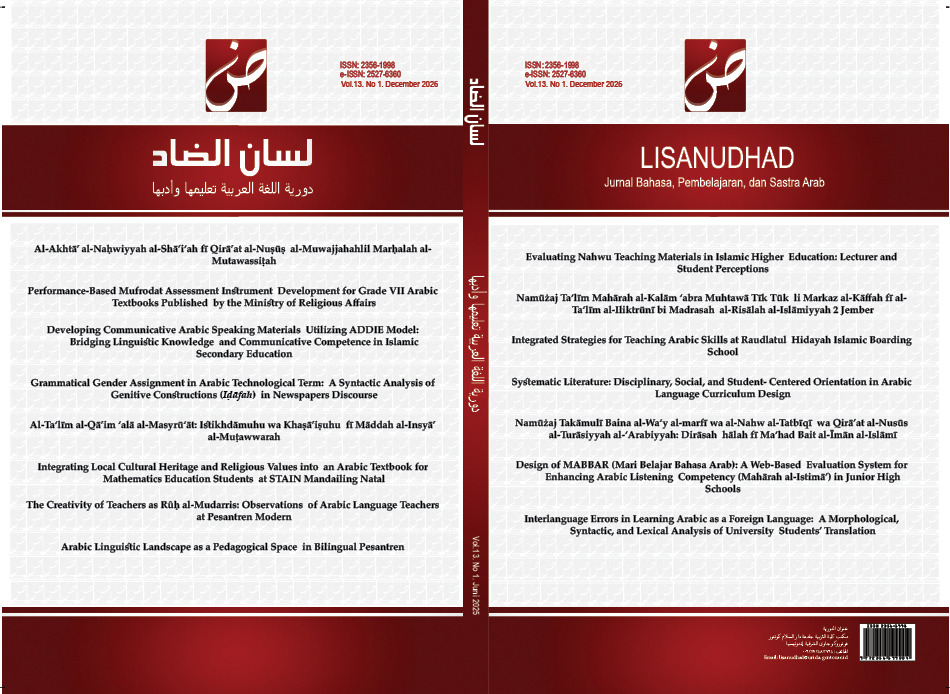
Namūdhaj Ta‘līm Mahārah al-Kalām ‘abra Muḥtawā Tīk Tūk li Markaz al-Kāfah fī al-Ta‘līm al-Iliktrūnī bi Madrasah al-Risālah al-Islāmiyyah 2 Jember
DOI:
https://doi.org/10.21111/lisanudhad.v13i1.50Keywords:
speaking skill, Arabic language teaching, TikTok, online learningAbstract
Teaching Arabic speaking skills faces various challenges, particularly the lack of practice and students’ low self-confidence, especially in online learning environments that often emphasize theoretical aspects. This study aims to describe the model of teaching speaking skills through TikTok content, analyze its implementation, and identify its impact on improving students’ speaking abilities. The study employed a descriptive qualitative method with a case study design through observation, interviews, and documentation at Madrasah Al-Risalah Al-Islamiyah 2 Jember. The findings revealed that this model, which is based on video presentation, practice, and repetition, contributes to improving pronunciation, increasing fluency, and enhancing students’ self-confidence. In addition, it increases learning motivation due to the attractiveness of the media and its easy accessibility. The study also identified several challenges, such as limited direct interaction and distraction of attention. The study concludes that the use of TikTok represents an innovative and effective educational model for developing speaking skills, provided that it is guided pedagogically to maintain a balance between technology and learning quality.
References
Agustina, R. M., & Dharmawan, Y. Pemanfaatan Media Sosial Dalam Pembelajaran Bahasa. 12, no. 2 (2025): 101–15. https://doi.org/https://doi.org/10.1234/jpb.v12i2.2025.
Bahri, A., & Alfarisy, F. Tantangan Pembelajaran Bahasa Arab Daring. 10, no. 2 (2025): 89–104. https://doi.org/https://doi.org/10.6789/jpi.v10i2.2025.
Brown, H. D. Prinsip Pembelajaran Dan Pengajaran Bahasa. Pearson Education, 2007.
Creswell, J. W. Research Design: Pendekatan Kualitatif, Kuantitatif, Dan Mixed. Pustaka Pelajar, 2014.
Deci, E. L., & Ryan, R. M. Teori Motivasi Dalam Pembelajaran. 15, no. 3 (2000): 120–34. https://doi.org/https://doi.org/10.4321/jpp.v15i3.2000.
Hidayat, A. Penggunaan Video Pendek Untuk Meningkatkan Keterampilan Berbicara. 11, no. 1 (2023): 67–80. https://doi.org/https://doi.org/10.4567/jpb.v11i1.2023.
Krashen, S. D. Principles and Practice in Second Language Acquisition. Pergamon, 1982.
Lincoln, Y. S., & Guba, E. G. Naturalistic Inquiry. Sage Publications, 1985.
Miles, Matthew B., A Michael Huberman, and Johnny Saldana. Qualitative Data Analysis. Sage, 2014.
Mufliha, N. A., & Samsuri. TikTok Sebagai Media Pembelajaran Bahasa. 5, no. 1 (2025): 12–25. https://doi.org/https://doi.org/10.3333/jpd.v5i1.2025.
Mu’izzudin, Dkk. Kesulitan Belajar Keterampilan Berbicara. 7, no. 1 (2024): 40–55. https://doi.org/https://doi.org/10.2222/jba.v7i1.2024.
Nurdini, D. Media Digital Dalam Pembelajaran Bahasa Arab. 10, no. 1 (2025): 20–35. https://doi.org/https://doi.org/10.6666/jpba.v10i1.2025.
Nurhalimah. Analisis Konten TikTok Dalam Pembelajaran Bahasa. 13, no. 2 (2024): 101–15. https://doi.org/https://doi.org/10.5555/jtp.v13i2.2024.
Rahmawati. Pengaruh TikTok Terhadap Motivasi Belajar Bahasa. 11, no. 2 (2022): 95–108. https://doi.org/https://doi.org/10.9999/jp.v11i2.2022.
Rosa, C. H., & Suhartatik, S. Media Pembelajaran Daring Di Era Digital. Jurnal Pendidikan Teknologi. 14, no. 2 (2025): 110–25. https://doi.org/https://doi.org/10.1212/jpt.v14i2.2025.
Safitri, R. Inovasi Pembelajaran Berbasis Digital. 8, no. 1 (2025): 15–30. https://doi.org/https://doi.org/10.1313/jpi.v8i1.2025.
Saputra, H., & Syukran. Efektivitas TikTok Dalam Pembelajaran. Jurnal Media Pembelajaran. 7, no. 2 (2025): 55–70. https://doi.org/https://doi.org/10.1414/jmp.v7i2.2025.
Sugiyono. Metode Penelitian Kualitatif. Alfabeta, 2019.
Ulinnuha & Mufidah. “Pembelajaran Bahasa Arab Berbasis Online.” Jurnal Pendidikan Islam, 11, no. 1 (2025): 25–40. https://doi.org/https://doi.org/10.1515/jpi.v11i1.2025.
Vygotsky, L. S. Mind in Society. Harvard University Press, 1978.
Warschauer, M., & Kern, R. Network-Based Language Teaching. Cambridge University Press, 2000.
Downloads
Submitted
Accepted
Published
How to Cite
Issue
Section
License
Copyright (c) 2026 fahmi alwan

This work is licensed under a Creative Commons Attribution-NonCommercial 4.0 International License.
Authors who publish with this Journal agree to the following terms:
- Free to Share — copy and redistribute the material in any medium or format;
- Free to Adapt — remix, transform, and build upon the material,
The licensor cannot revoke these freedoms as long as you follow the license terms.
Under following terms:
- Attribution — You must give appropriate credit , provide a link to the license, and indicate if changes were made . You may do so in any reasonable manner, but not in any way that suggests the licensor endorses you or your use.
- NonCommercial — You may not use the material for commercial purposes .
No additional restrictions — You may not apply legal terms or technological measures that legally restrict others from doing anything the license permits.
Notices:
You do not have to comply with the license for elements of the material in the public domain or where your use is permitted by an applicable exception or limitation .
No warranties are given. The license may not give you all of the permissions necessary for your intended use. For example, other rights such as publicity, privacy, or moral rights may limit how you use the material.