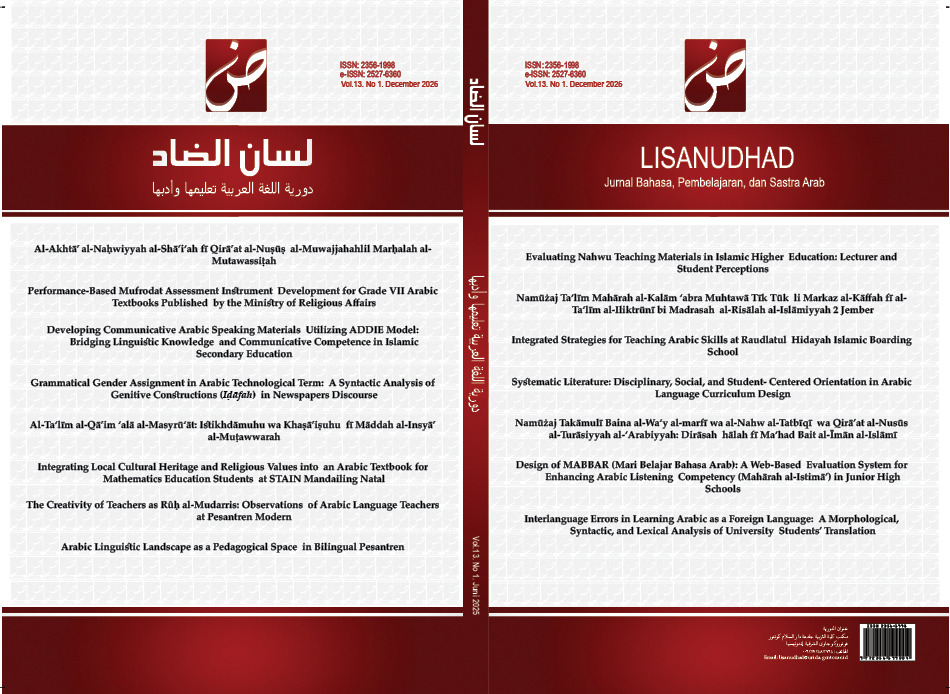
Design of MABBAR (Mari Belajar Bahasa Arab): A Web-Based Evaluation System for Enhancing Arabic Listening Competency (Mahārah al-Istimā’) in Junior High Schools
DOI:
https://doi.org/10.21111/lisanudhad.v13i1.22Keywords:
Arabic Linguistics, Arabic Teaching, Mahārah al-Istimā’, MABBAR (Mari Belajar Bahasa Arab), Web-based EvaluationAbstract
mited classroom exposure, non-interactive audio media, and conventional evaluation practices that do not provide immediate feedback. This study developed and evaluated MABBAR (Mari Belajar Bahasa Arab), a web-based evaluation system designed to support mahārah al-istimā’ through structured audio input, Text-to-Speech (TTS) support, automated scoring, and teacher-oriented learning analytics. The study employed a Research and Development (R&D) design by adapting the five-stage MANTAP model and aligning it with Borg and Gall’s development procedures. The empirical trial involved 39 eighth-grade students at SMP IT Yasalam Bogor, while product feasibility was assessed by material, media, and phonetics experts. Data were collected through expert validation rubrics, pre-test and post-test instruments, student response questionnaires, and field observations. The validation results indicate that MABBAR is highly feasible, with material validation reaching 5.00/5.00, media validation 4.87/5.00, and phonetic validation 92%. Descriptive statistics show an increase in mean listening scores from 74.64 to 84.26, with a lower standard deviation after the intervention. The paired-sample t-test further indicates a significant difference between pre-test and post-test scores. Students also gave positive responses to the system, particularly regarding ease of use, content clarity, and learning motivation. These findings suggest that MABBAR can serve as a practical digital evaluation model for Arabic listening instruction, although broader trials and offline access are recommended for future development.
References
Albantani, A. M., Madkur, A., & Rozak, A. (2022). Student Self Regulated Learning Strategy In Online Arabic Learning. Ijaz Arabi Journal of Arabic Learning, 5(1).
Aloraini, N., & Cardoso, W. (2022). Social media in language learning: A mixed-methods investigation of students’ perceptions. Computer Assisted Language Learning, 35(8), 1707–1730. https://doi.org/10.1080/09588221.2020.1830804
Anggraeni, P., Sunendar, D., Maftuh, B., & Sopandi, W. (2023). How Do 6Cs Appearance at Elementary Schools Learning? DWIJA CENDEKIA: Jurnal Riset Pedagogik, 7(2).
Borg, W. R., & Gall, M. D. (1983). Educational research: An introduction. Longman, (4).
Fatchiatuzahro, Fahmi, N., Latifah, M., & Nur Azizah. (2025). Pemanfaatan Wordwall Sebagai Media Evaluasi Pembelajaran Maharah Kitabah Pada Mahasiswa PBA IUQI Bogor. Mauriduna: Journal of Islamic Studies, 6(1), 138–155. https://doi.org/10.37274/mauriduna.v6i1.1332
Husna, M. A., Inayah, I., Mubarak, F., Taufiqurrahman, T., & Qomariyah, L. (2022). Implementasi materi mahirah al-kalim dalam transformasi kurikulum bahasa Arab perspektif ACTFL pada pondok pesantren salaf. Arabi: Journal of Arabic Studies, 7(1), 38–50.
Krug, S. (2013). Don’t Make Me Think Revisited: A Common Sense Approach.
Matthew B, M., A, M. H., & Saldana, J. (2018). Qualitative Data Analysis: A Methods Sourcebook (The Fourth Edition). SAGE Publications.
Mikita Piastou, “Comprehensive Performance and Scalability Assessment of Front-End Frameworks: React, Angular, and Vue.js,” World Journal of Advanced Engineering Technology and Sciences 9, no. 2 (2023): 366–376, https://doi.org/10.30574/wjaets.2023.9.2.0153.
Krath, J., Schürmann, L., & von Korflesch, H. F. O. (2021). Revealing the theoretical basis of gamification: A systematic review and analysis of theory in research on gamification, serious games and game-based learning. Computers in Human Behavior, 125, 106963. https://doi.org/10.1016/j.chb.2021.106963
Dash, N., & Mohapatra, L. M. (2025). Technology empowered teaching and learning in language education: A systematic review. In Technology driven language learning: Innovations and applications (pp. 127–145). Springer.
Scherer, R., Siddiq, F., & Tondeur, J. (2019). The technology acceptance model (TAM): A meta-analytic structural equation modeling approach to explaining teachers’ adoption of digital technology in education. Computers & Education, 128, 13–35. https://doi.org/10.1016/j.compedu.2018.09.009
Fred D. Davis, “Perceived Usefulness, Perceived Ease of Use, and User Acceptance of Information Technology,” MIS Quarterly 13, no. 3 (1989): 319–40.
Lythreatis, S., Singh, S. K., & El-Kassar, A. N. (2022). The digital divide: A review and future research agenda. Technological Forecasting and Social Change, 175, 121359. https://doi.org/10.1016/j.techfore.2021.121359
De Neira, A. B., Kantarci, B., & Nogueira, M. (2023). Distributed denial of service attack prediction: Challenges, open issues and opportunities. Computer Networks, 222, Article 109553. https://doi.org/10.1016/j.comnet.2022.109553
Albert Bandura, “Self-efficacy: Toward a Unifying Theory of Behavioral Change,” Psychological Review 84, no. 2 (1977): 191–215.
L. S. Vygotsky, Mind in Society: The Development of Higher Psychological Processes, ed. Michael Cole et al. (Cambridge, MA: Harvard University Press, 1978), 79–91.
Usher, E. L., & Morris, D. B. (2023). Self-efficacy. In Encyclopedia of mental health (3rd ed., pp. 117–124). Academic Press. https://doi.org/10.1016/B978-0-323-91497-0.00085-0
Haagsman, M. E., Scager, K., Boonstra, J., & Koster, M. C. (2020). Pop-up questions within educational videos: Effects on students’ learning. Journal of Science Education and Technology, 29(6), 713–724. https://doi.org/10.1007/s10956-020-09847-3
Perrotin, O., Stephenson, B., Gerber, S., Bailly, G., & King, S. (2025). Refining the evaluation of speech synthesis: A summary of the Blizzard Challenge 2023. Computer Speech & Language, 90, Article 101747. https://doi.org/10.1016/j.csl.2024.101747
Hase, A., & Kuhl, P. (2024). Teachers’ use of data from digital learning platforms for instructional design: A systematic review. Educational Technology Research and Development, 72(4), 1925–1945. https://doi.org/10.1007/s11423-024-10356-y
Downloads
Submitted
Accepted
Published
How to Cite
Issue
Section
License
Copyright (c) 2026 fatchiatuzahro fatchiatuzahro, Muhammad Ainul Haq, Ubay Abdillah, Friendis Syani Amrullah, Abdul Fatah

This work is licensed under a Creative Commons Attribution-NonCommercial 4.0 International License.
Authors who publish with this Journal agree to the following terms:
- Free to Share — copy and redistribute the material in any medium or format;
- Free to Adapt — remix, transform, and build upon the material,
The licensor cannot revoke these freedoms as long as you follow the license terms.
Under following terms:
- Attribution — You must give appropriate credit , provide a link to the license, and indicate if changes were made . You may do so in any reasonable manner, but not in any way that suggests the licensor endorses you or your use.
- NonCommercial — You may not use the material for commercial purposes .
No additional restrictions — You may not apply legal terms or technological measures that legally restrict others from doing anything the license permits.
Notices:
You do not have to comply with the license for elements of the material in the public domain or where your use is permitted by an applicable exception or limitation .
No warranties are given. The license may not give you all of the permissions necessary for your intended use. For example, other rights such as publicity, privacy, or moral rights may limit how you use the material.