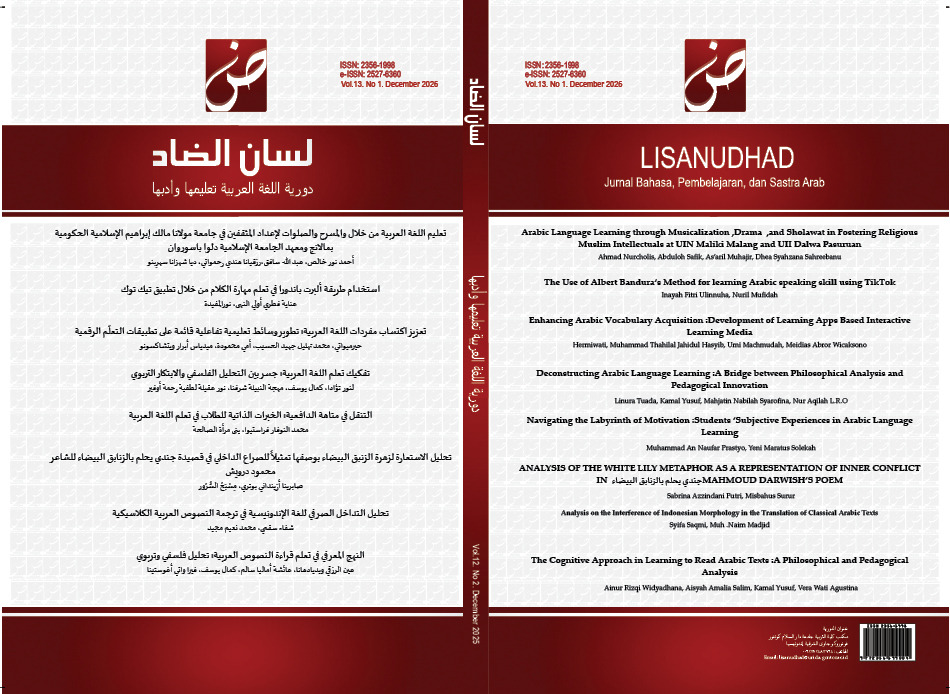
Arabic Language Learning through Musicalization, Drama, and Sholawat in Fostering Religious Muslim Intellectuals at UIN Maliki Malang and UII Dalwa Pasuruan
DOI:
https://doi.org/10.21111/lisanudhad.v12i2.40Keywords:
Musicalization, Drama, Shalawat, Arabic Language Learning, Holistic Education, Religious Muslim IntellectualsAbstract
This study analyzes the model of Arabic language learning through poetry musicalization, drama performance, and shalawat-based artistic practices in fostering religious Muslim intellectuals at UIN Maulana Malik Ibrahim Malang and UII Dalwa Pasuruan. Using a qualitative multiple-case study design, the research involved students, lecturers, santri, and pesantren leaders. Data were collected through observations, interviews, and document analysis, and were analyzed thematically. The findings reveal that the three artistic media serve distinct yet complementary pedagogical functions. At UIN Maliki, musicalization and Arabic drama enhance linguistic competence, public speaking, creativity, and digital literacy. At UII Dalwa,shalawat performances and traditional drama (tamthīliyyāt) strengthen religious identity, emotional engagement, and the preservation of pesantren cultural traditions. Across both institutions, these practices contribute to the formation of religious Muslim intellectuals, defined in this study as learners who integrate Arabic linguistic proficiency with Islamic ethical values, spiritual discipline, and cultural-literary appreciation. Theoretically, this study enriches holistic learning discourse by integrating cognitive, affective, psychomotor, cultural, and spiritual dimensions. Practically, it offers an integrative model that connects artistic performance with Arabic language mastery and character formation in both modern higher education and traditional pesantren environments
References
Abdullah, M. Amin. “Religion, Culture, and Education.” Al-Jami’ah 39, no. 2 (2001).
Al-Attas, Syed Muhammad Naquib. Islam and Secularism. Kuala Lumpur: ISTAC, 1993.
Al-Ghazali. Ihya’ Ulum al-Din. Beirut: Dar al-Kutub al-‘Ilmiyyah, 2005.
Arifin, Imron, and Imam Syafe’i. “Art-Based Arabic Pedagogy in Indonesian Islamic Schools.” Journal of Arabic Language Education 4, no. 2 (2020). Malang: UIN Press.
Azra, Azyumardi. Pendidikan Islam: Tradisi dan Modernisasi di Tengah Tantangan Milenium III. Jakarta: Kencana, 2012.
Azra, Azyumardi. Pendidikan Islam: Tradisi dan Modernisasi Menuju Milenium Baru. Jakarta: Logos Wacana Ilmu, 1999.
Bruinessen, Martin van. Kitab Kuning, Pesantren dan Tarekat. Bandung: Mizan, 1995.
Bruinessen, Martin van. Kitab Kuning, Pesantren dan Tarekat. Bandung: Mizan, 1999.
Creswell, John W. Qualitative Inquiry and Research Design: Choosing Among Five Approaches. California: Sage Publications, 2013.
Dhofier, Zamakhsyari. Tradisi Pesantren: Studi Pandangan Hidup Kyai dan Hubungannya dengan Masyarakat. Jakarta: LP3ES, 1982.
Dhofier, Zamakhsyari. Tradisi Pesantren: Studi Pandangan Hidup Kiai. Jakarta: LP3ES, 2011.
Effendy, Ahmad Fuad. Pengantar Metodologi Pengajaran Bahasa Arab. Malang: Misykat, 2015.
Hakim, Luqman. “Musik, Ritme, dan Pembelajaran Bahasa Arab.” Jurnal Arabia 12, no. 2 (2019).
Ibrahim, Sulaiman. Metodologi Pembelajaran Bahasa Arab di Indonesia. Bandung: Humaniora, 2018.
Jailani, M. Syahran. “Model Pembelajaran Bahasa Arab Berbasis Pesantren.” Arabiyat 4, no. 1 (2017).
Merriam, Sharan B. Qualitative Research: A Guide to Design and Implementation. San Francisco: Jossey-Bass, 2009.
Muqoyyidin. “Communicative Arabic Teaching in Islamic Universities.” Jurnal Pendidikan Islam 8, no. 1 (2020).
Natsir, Muhammad. Filsafat Pendidikan Islam. Jakarta: Bulan Bintang, 1973.
Schimmel, Annemarie. And Muhammad Is His Messenger: The Veneration of the Prophet in Islamic Piety. Chapel Hill: University of North Carolina Press, 1985.
Shihab, M. Quraish. Wawasan Al-Qur’an. Bandung: Mizan, 1996.
Strauss, Anselm, and Juliet Corbin. Basics of Qualitative Research: Techniques and Procedures for Developing Grounded Theory. California: Sage Publications, 1998.
Wahid, Abdurrahman. “Pesantren dan Budaya Lokal.” Basis 11–12 (1988).
Downloads
Submitted
Accepted
Published
How to Cite
Issue
Section
License
Copyright (c) 2025 Ahmad Nurcholis, Bobby Rachman Santoso, Rizqiyana Hendi Rahmawati, Dhea Syahzana Sahreebanu

This work is licensed under a Creative Commons Attribution-NonCommercial 4.0 International License.
Authors who publish with this Journal agree to the following terms:
- Free to Share — copy and redistribute the material in any medium or format;
- Free to Adapt — remix, transform, and build upon the material,
The licensor cannot revoke these freedoms as long as you follow the license terms.
Under following terms:
- Attribution — You must give appropriate credit , provide a link to the license, and indicate if changes were made . You may do so in any reasonable manner, but not in any way that suggests the licensor endorses you or your use.
- NonCommercial — You may not use the material for commercial purposes .
No additional restrictions — You may not apply legal terms or technological measures that legally restrict others from doing anything the license permits.
Notices:
You do not have to comply with the license for elements of the material in the public domain or where your use is permitted by an applicable exception or limitation .
No warranties are given. The license may not give you all of the permissions necessary for your intended use. For example, other rights such as publicity, privacy, or moral rights may limit how you use the material.