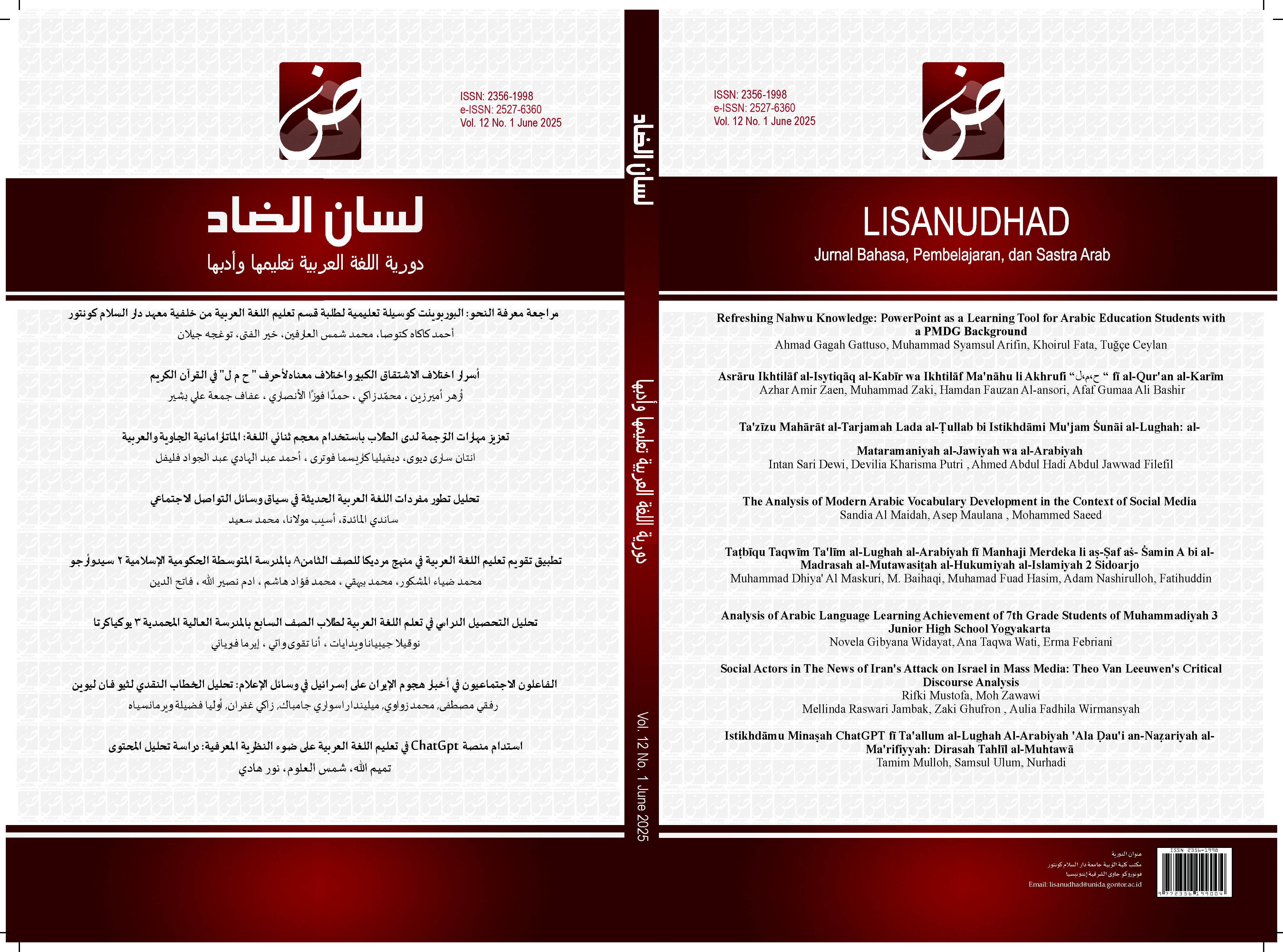
Analysis of Arabic Language Learning Achievement of 7th Grade Students of Muhammadiyah 3 Junior High School Yogyakarta
DOI:
https://doi.org/10.21111/lisanudhad.v12i1.87الملخص
This research is motivated by the number of Arabic language scores of 7th grade students of Muhammadiyah 3 Junior High School Yogyakarta in the academic year 2023/2024, which remain below the Minimum Mastery Criteria (KKM) index of 75. This study aims to analyze the achievement of Arabic learning outcomes of 7th grade students of Muhammadiyah 3 Junior High School Yogyakarta compared with the Arabic achievement index of Muhammadiyah Junior High School in Yogyakarta. This study uses a quantitative descriptive research method, and the data collection technique uses documentation. The sample in this study is 7th grade students of Muhammadiyah 3 Junior High School Yogyakarta 2023/2024 period, which totals thirty students. In this study, the researcher uses a random sampling method, and the data analysis technique used is one sample t-test. Based on the data collected and tested using SPSS version 25, it shows that the independent sample t-test produces a T-Count value of -12,961< 1.984217. Most students have not reached the Minimum Completion Criteria (KKM) set at 75, so it can be concluded that Arabic language learning needs to be evaluated and improved, both in terms of teaching methods, learning media, and student learning motivation.
المراجع
Abror, Muhammad Haikal, ‘Self-Regulated Learning Terhadap Hasil Belajar Matematika Siswa’, Plusminus: Jurnal Pendidikan Matematika, 2.2 (2022), pp. 233–42, doi:10.31980/plusminus.v2i2.1676
AH, Hanifal Fauzy, Zainal Abidin Arief, and Muhyani Muhyani, ‘Strategi Motivasi Belajar Dan Minat Belajar Dengan Hasil Belajar Bahasa Arab’, Tawazun: Jurnal Pendidikan Islam, 12.1 (2019), p. 112, doi:10.32832/tawazun.v12i1.1843
Al-Mahasneh, Omar M.K., Mohammad N.M. Ayasrah, Shima M.S. Yahyaa, Raed A. Al-Kriemeen, and Ali S. Al-Swalha, ‘Favorite Methods of Teaching and Evaluation among Students in University Colleges’, International Journal of Education and Practice, 8.2 (2020), pp. 365–78, doi:10.18488/journal.61.2020.82.365.378
Amin, Nur Fadilah, Sabaruddin Garancang, and Kamaluddin Abunawas, ‘Konsep Umum Populasi Dan Sampel Dalam Penelitian’, Jurnal Kajian Islam Kontemporer, 14 (2023)
Amril, Aysha Aulia, Siska Yulia Defitri, and Nidia Anggreni Das, ‘Pengaruh Asimetri Informasi Dan Kesesuaian Kompensasi Serta Ketaatan Aturan Akuntansi Terhadap Kecurangan Akuntansi (Studi Empiris Pada Opd Kabupaten Tanah Datar)’, OPTIMAL Jurnal Ekonomi Dan Manajemen, 2.3 (2022), pp. 239–60, doi:10.55606/optimal.v2i3.507
Annisa, Dwi, ‘Jurnal Pendidikan Dan Konseling’, Jurnal Pendidikan Dan Konseling, 4.1980 (2022), pp. 1349–58
Ansar, Ansar, Isnaeni S. Isnaeni S., Julia Julia, and Nur Hafida, ‘Pembelajaran Bahasa Arab Berbasis Multimedia’, Mujaddid: Jurnal Penelitian Dan Pengkajian Islam, 1.1 (2023), p. 29, doi:10.33096/mujaddid.v1i1.235
Ardiansyah, MSyahran Jailani, Sma Negeri, Bungo Provinsi Jambi, and Uin Sulthan Thaha Saifuddin Jambi, Teknik Pengumpulan Data Dan Instrumen Penelitian Ilmiah (3 July 2023) <http://ejournal.yayasanpendidikandzurriyatulquran.id/index.php/ihsan>
Asif, Amna, Hamid Mukhtar, Fatimah Alqadheeb, Hafiz Farooq Ahmad, and Abdulaziz Alhumam, ‘An Approach for Pronunciation Classification of Classical Arabic Phonemes Using Deep Learning’, Applied Sciences (Switzerland), 12.1 (2022), doi:10.3390/app12010238
Al Azmi Fadilah, Muassomah, Amalia Nabila Nailil, Diana Nur, ‘The Use of Quizizz as Inductive-Based Nahwu Learning Media in the Digital Age’, Lisanudhad, 10.1 (2025), pp. 5–16 <https://www.silpa-mag.com/history/article_22383>
Dr. Abdul Muhid, M.S, ‘Analisis Statistik 5 Langkah Praktis Analisis Statistik Dengan SPSS for Windows’, 2019
Farid, Muhammad, Abdul Wahab, and Ansar Ansar, ‘Analisis Kesulitan Belajar Bahasa Arab Siswa Kelas IX Di SMP IT Insan Cendikia Makassar’, Education and Learning Journal, 3.1 (2022), p. 36, doi:10.33096/eljour.v3i1.138
Gunawan, Imam, and Hasyim Hasanah, ‘Kuantitatif Imam Gunawan’, At-Taqaddum, 8.1 (2019), p. 29
Hamid, T, M Chhabra, K Ravulakollu, P Singh, S Dalal, and R Dewan, ‘A Review on Artificial Intelligence in Orthopaedics’, in 2022 9th International Conference on Computing for Sustainable Global Development (INDIACom), 2022, pp. 365–69, doi:10.23919/INDIACom54597.2022.9763178
Imran, Muhammad, Saman Hina, and Mirza Mahmood Baig, ‘Analysis of Learner’s Sentiments to Evaluate Sustainability of Online Education System during COVID-19 Pandemic’, Sustainability (Switzerland), 14.8 (2022), pp. 1–18, doi:10.3390/su14084529
Mamonto, FW, Wjfa Tumbuan, MH Rogi, Felisa Windy Mamonto, Willem JFA Tumbuan, Mirah H Rogi, and others, ‘Analysis Of Marketing Mixed Factors (4p) On Purchase Decisions At Podomoro Poigar Eating House In New Normal Era’, 9.2 (2021), pp. 110–21
Mubarok, Muslim, Mokhammad Nizam, and Fitriani Fitriani, ‘Analisis Penerapan Metode Pembelajaran Bahasa Arab Kelas IV’, Academicus: Journal of Teaching and Learning, 1.1 (2022), pp. 1–10, doi:10.59373/academicus.v1i1.2
Mustafidah, H, A Imantoyo, and S Suwarsito, Pengembangan Aplikasi Uji-t Satu Sampel Berbasis Web (Development of Web-Based One-Sample t-Test Application), 2020, VIII
Nasar, Abdul, Dimas Hadi Saputra, Mochammad Rifan Arkaan, Muhammad Bimo Ferlyando, Muhammad Teguh Andriansyah, and Putra Dena Pangestu, ‘Uji Prasyarat Analisis’, JEBI: Jurnal Ekonomi Dan Bisnis, 2.6 (2024), pp. 786–99
Oktaviano, Deri, Berlintina Permatasari, and Yusra Fernando, Pengaruh Faktor Psikologis Dan Sosiologis Terhadap Pengambilan Keputusan Pembelian Mobil (Studi Pada Konsumen Mobil Avanza Di Provinsi Lampung), 2022, II <http://jim.teknokrat.ac.id/index.php/smart/issue/archive>
Pahleviannur, Muhammad Rizal, and Saringatun Mudrikah, Penelitian Tindakan Kelas, Pradina Pustaka, 2022
Phafiandita, Adisna Nadia, Ayu Permadani, Alsa Sukma Pradani, and M. Iqbal Wahyudi, ‘Urgensi Evaluasi Pembelajaran Di Kelas’, JIRA: Jurnal Inovasi Dan Riset Akademik, 3.2 (2022), pp. 111–21, doi:10.47387/jira.v3i2.262
Rosyad, Muh Sabilar, Uril Bahruddin, and Faishol Mahmoud Adam Ibrahim, ‘The Reality of Learning Arabic Listening Skills at Pesantren-Based Universities from the Perspective of Teaching Materials’, LISHANUDHAD: Jurnal, Bahasa, Pembelajaran Dan Sastra Arab, 10.2 (2023), pp. 92–120
Saeroji, Ahmad, Rizka Andriyati, and Muhsin Muhsin, ‘Analisis Prestasi Belajar Mahasiswa Lulusan Sekolah Menengah Umum Dan Sekolah Menengan Kejuruan’, Prodi P.ADP FF UNY, 18.1 (2021), pp. 1–14
Sejati, Endah Octaningrum Wahani, and Djamilah Bondan Widjajanti, ‘Pembelajaran Kooperatif Dalam Pendekatan Penemuan Terbimbing Ditinjau Dari Prestasi Belajar, Kemampuan Berpikir Kritis, Dan Kepercayaan Diri’, Pythagoras: Jurnal Pendidikan Matematika, 14.2 (2019), pp. 150–62, doi:10.21831/pg.v14i2.26420
Siregar, Amy Fitriani, Siti Nurhasana Mokodompit, Muhajir Muhajir, and Nila Alfiroh, ‘Test Analysis of Durūs Al-Lughah Al-Arabiyyah Volume 1 by Imam Zarkasyi and Imam Syubani’, Lisanudhad: Jurnal Bahasa, Pembelajaran, Dan Sastra Arab, 11.01 (2024), pp. 153–75, doi:10.21111/lisanudhad.v11i01.11427
Sugiyono, Djoko, Metode Penelitian Kuantitatif Kualitatif Dan R&D, Penerbit Alfabeta, 2010
Syaifullah, Muhammad, and Nailul Izzah, ‘Kajian Teoritis Pengembangan Bahan Ajar Bahasa Arab’, Arabiyatuna : Jurnal Bahasa Arab, 3.1 (2019), p. 127, doi:10.29240/jba.v3i1.764
Usmadi, ‘Pengujian Persyaratan Analisis (Uji Homogenitas Dan Uji Normalitas)’, Inovasi Pendidikan, 7.1 (2020), pp. 50–62, doi:10.31869/ip.v7i1.2281
Utami, Rika Lutfiana, Universitas Islam, and Negeri Sunan, ‘Konsep Pembelajaran Bahasa Arab Dengan Pendekatan Komunikatif Di Kelas Vii Smp Muhammadiyah 1 Depok’, 8.1 (2020), pp. 64–74, doi:10.24252/saa.v8i1.12270
Wati, Ana Taqwa, and Sri Wahyuni, ‘Effectiveness of the Teams Games Tournament (TGT) Cooperative Learning Method towards the Arabic Language Learning Achievement of Students at SMP Muhammadiyah 2 Kalasan’, Maharaat: Jurnal Pendidikan Bahasa Arab, 6.1 (2024), pp. 10–25, doi:10.18196/mht.v6i1.20543
التنزيلات
مقدم
منشور
كيفية الاقتباس
إصدار
القسم
الرخصة
الحقوق الفكرية (c) 2026 Novela Gibyana Widayat, Ana Taqwa Wati, Erma Febriani

هذا العمل مرخص بموجب Creative Commons Attribution-NonCommercial 4.0 International License.
Authors who publish with this Journal agree to the following terms:
- Free to Share — copy and redistribute the material in any medium or format;
- Free to Adapt — remix, transform, and build upon the material,
The licensor cannot revoke these freedoms as long as you follow the license terms.
Under following terms:
- Attribution — You must give appropriate credit , provide a link to the license, and indicate if changes were made . You may do so in any reasonable manner, but not in any way that suggests the licensor endorses you or your use.
- NonCommercial — You may not use the material for commercial purposes .
No additional restrictions — You may not apply legal terms or technological measures that legally restrict others from doing anything the license permits.
Notices:
You do not have to comply with the license for elements of the material in the public domain or where your use is permitted by an applicable exception or limitation .
No warranties are given. The license may not give you all of the permissions necessary for your intended use. For example, other rights such as publicity, privacy, or moral rights may limit how you use the material.