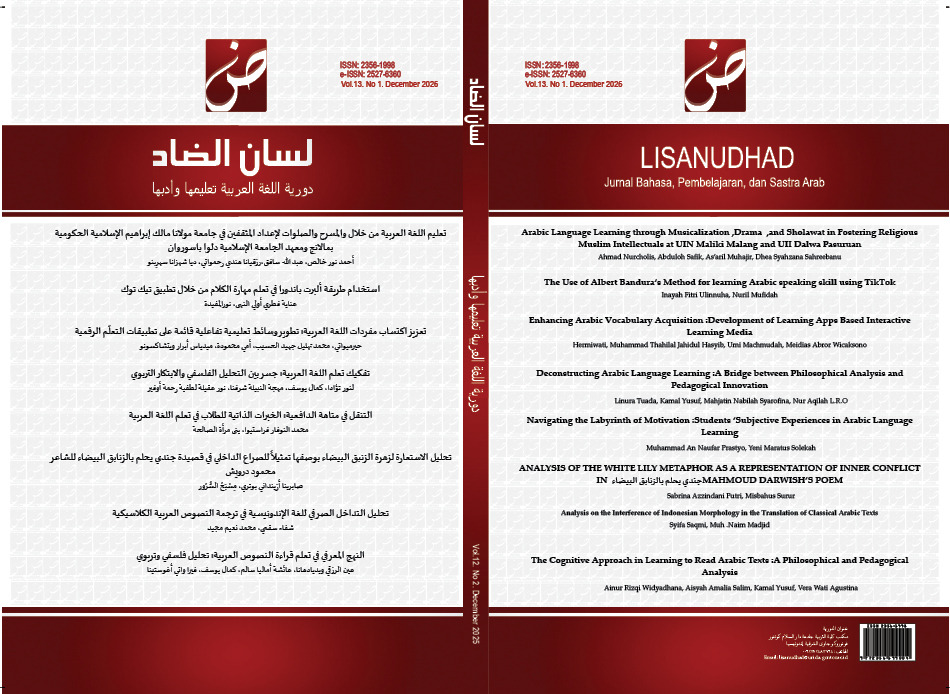
Analysis Of The White Lily Metaphor As A Representation Of Inner Conflict In جندي يحلم بالزنابق البيضاء Mahmoud Darwish’s Poem
DOI:
https://doi.org/10.21111/lisanudhad.v12i2.45الكلمات المفتاحية:
Mahmoud Darwish، defamiliarization، metaphor، Arabic poetry، inner conflictالملخص
This article analyzes Mahmoud Darwish’s poem جندي يحلم بالزنابق البيضا through Viktor Shklovsky’s concept of defamiliarization within the framework of Russian Formalist theory. The poem reveals the inner conflict of a weary soldier who dreams of peace symbolized by the white lily. Using a qualitative descriptive approach, this study explores how Darwish’s poetic language—rich in metaphors, paradoxes, and imagery—transforms conventional meanings of purity and heroism into reflections on trauma, loss, and existential struggle.The white lily, which traditionally represents innocence and peace, becomes a contradictory symbol bridging beauty and suffering, life and death. The findings indicate that Darwish employs defamiliarization techniques to challenge familiar discourses of nationalism and war, compelling readers to reinterpret universal concepts such as “homeland” and “victory” in more personal and human terms. Ultimately, Darwish’s aesthetic strategy not only deepens the reader’s emotional engagement but also encourages critical reflection on the human condition amid conflict.
المراجع
Abrams, M. H., & Harpham, G. G. (1999). A Glossary of Literary Terms. Wadsworth Cengage Learning. https://books.google.co.id/books?id=KyOBPQAACAAJ
Akastangga, M. D. B. (2020). Metafora Dalam Tarjuman Al-Ashwaq Karya Ibnu ‘ Arabi (Kajian Semiotik-Pragmatik). Jurnalistrendi : Jurnal Linguistik, Sastra, Dan Pendidikan, 5(1), 27–46. http://ejournal.unwmataram.ac.id/trendi/article/view/208
Alandira, P. (2025). Analisis semiotika Riffatere pada Syi’ir كبحأ ال وأ كبحأ karya Mahmoud Darwish. Ajamiy: Jurnal Bahasa Dan Sastra Arab, January. https://doi.org/10.31314/ajamiy.13.2.482-500.2024
Anderson, B. M., & Iversen, S. (2018). This is the accepted version of the following article: Anderson, M., & Iversen, S. (2018). Immersion and defamiliarization: experiencing literature and world. 39, 1–22.
Culler, J. (2011). Literary Theory: A Very Short Introduction. OUP Oxford. https://books.google.co.id/books?id=2lk7LH1_bjgC
Eagleton, T. (1996). Literary Theory: An Introduction. University of Minnesota Press. https://books.google.co.id/books?id=QNmFm4M_RXkC
Emzir, M. P. (2017). Metodologi Penelitian Pendidikan Kuantitatif & Kualitatif. Rajawali Pers. https://books.google.co.id/books?id=s6jvzwEACAAJ
Jakobson, R. (1960). Linguistics and Poetry. English Journal, 59(7), 947–953. https://doi.org/10.58680/ej197019826
Kupchyshyna, Y., & Davydyuk, Y. (2017). From defamiliarization to foregrounding and defeated expectancy: Linguo-stylistic and cognitive sketch. Lege Artis, 2(2), 149–184. https://doi.org/10.1515/lart-2017-0015
Langer, S. K. K. (1953). Feeling and Form: A Theory of Art Developed from Philosophy in a New Key. Routledge & Kegan Paul. https://books.google.co.id/books?id=tRsqAAAAYAAJ
Nazar, Z., Tasnimah, T. M., & Burhani, M. I. (2023). Perkembangan Kritik Sastra Arab Pada Masa Kontemporer: Faktor Kemakmuran, Metode Kritik, dan Kritikus. Jurnal Adabiya, 25(2), 160. https://doi.org/10.22373/adabiya.v25i2.17165
Prasetyo, E. Y., & Hermansah, T. (2023). Religiusitas Puisi Penyatuan Karya Abdullah Wong. Komunika, 10(1), 60–71. https://doi.org/10.22236/komunika.v10i1.10079
Ramadhani, L., Hikam, A. I., & Husnawiyah, I. (2025). Representasi Konflik Batin dan Identitas Diri dalam Tokoh Haia Novel Laut Tengah Melalui Pendekatan Psikologi Sastra Sigmund Freund.
Riffaterre, M. (1978). Semiotics of Poetry. Indiana University Press. https://books.google.co.id/books?id=_OZrAAAAIAAJ
Salbiah, R. (2022). Gaya Bahasa dalam Puisi Aḥinnu ilá Khubzi Ummī Karya Mahmoud Darwish. Al-Ma‘Rifah, 19(1), 83–94. https://doi.org/10.21009/almakrifah.19.01.07
Salsabilah, H. (2024). Analisis Teori Semiotika Riffatere p ada Puisi “ Ma Huwa Illa Lahu ةيفيكلا ةيفصولا بيلاسلأا مادختسبا ساون بيلأ “ ببس هل لاإ وه ام “ ةديصق ليلتح لىإ ثحبلا اذه فدهي في يجهنم لكشب تاراشلإاو زومرلا فصول ةقيرطلا هذه مدختس ُ ت . يرتافيرل ةيئايميسلا ةيرظنلا جهنب. KNM BSA (Konferensi Nasional Mahasiswa Bahasa Dan Sastra Ara, 228–241. http://ejournal.unwmataram.ac.id/trendi/article/view/208
Shklovski. (1917). A Sentimental Journey: Memoirs, 1917-1922.
Shklovsky, V. (1998). Theory of Prose. Dalkey Archive Press. https://books.google.co.id/books?id=CI31iJEmuYoC
Wellek, R., & Warren, A. (1949). Theory of Literature. Cape. https://books.google.co.id/books?id=DuVYAAAAMAAJ
Widiastuti, S. (2024). “Makna Perdamaian di Balik Keindahan Bunga Lili.” Radio Republik Indonesia. https://www.rri.co.id/bukittinggi/lain-lain/1137049/makna-perdamaian-di-balik-keindahan-bunga-lili
Wimsatt, W. K., & Beardsley. (1954). The Verbal Icon: Studies in the Meaning of Poetry. Noonday Press. https://books.google.co.id/books?id=KmrUKcU2JUoC
التنزيلات
مقدم
##submissions.accepted##
منشور
كيفية الاقتباس
إصدار
القسم
الرخصة
الحقوق الفكرية (c) 2025 Sabrina Azzindani Putri, Misbahus Surur

هذا العمل مرخص بموجب Creative Commons Attribution-NonCommercial 4.0 International License.
Authors who publish with this Journal agree to the following terms:
- Free to Share — copy and redistribute the material in any medium or format;
- Free to Adapt — remix, transform, and build upon the material,
The licensor cannot revoke these freedoms as long as you follow the license terms.
Under following terms:
- Attribution — You must give appropriate credit , provide a link to the license, and indicate if changes were made . You may do so in any reasonable manner, but not in any way that suggests the licensor endorses you or your use.
- NonCommercial — You may not use the material for commercial purposes .
No additional restrictions — You may not apply legal terms or technological measures that legally restrict others from doing anything the license permits.
Notices:
You do not have to comply with the license for elements of the material in the public domain or where your use is permitted by an applicable exception or limitation .
No warranties are given. The license may not give you all of the permissions necessary for your intended use. For example, other rights such as publicity, privacy, or moral rights may limit how you use the material.