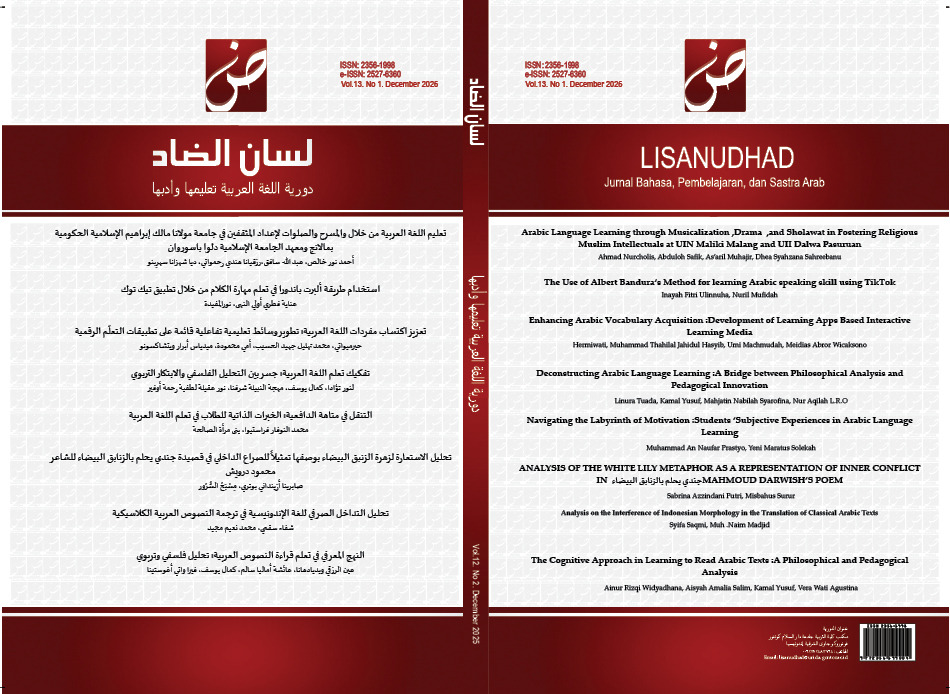
Analysis on the Interference of Indonesian Morphology in the Translation of Classical Arabic Texts
DOI:
https://doi.org/10.21111/lisanudhad.v12i2.43الكلمات المفتاحية:
Morphological interference، Classic Arabic Text، Translationالملخص
This study analyzes the phenomenon of morphological interference from Indonesian in the translation of Classical Arabic texts. It examines how Indonesian morphological structures, such as affixation, compounding, and reduplication, affect meaning transfer and grammatical equivalence in Arabic-Indonesian translation. Using a descriptive-analytical approach, the study synthesizes findings from previous research on morphological transfer, interference, and translation strategies in second-language contexts. The results show that learners often unconsciously apply Indonesian morphological patterns during translation, causing mistranslation, redundancy, or distortion of Arabic word forms. These findings indicate that interference arises not only from linguistic differences between Arabic and Indonesian but also from cognitive and cultural factors influencing the translation process. The study concludes that integrating contrastive and contextual approaches in Arabic morphology and translation pedagogy can reduce interference and enhance students’ linguistic awareness and translation accuracy.
المراجع
Akmalul Mubarok, Tadakkhul Annahwi Al Indunisiyy Fi Al Muhadatsah Al Arabiyyah Al Yaumiyyah Li Thullab Al Ma’had Al Asrii Dar Al Hikmah Tulung Agung, 2024
Alluhaybi, Maram, ‘Lost in Translation : Error Analysis of Texts Translated from Arabic into English by Saudi Translators’, 2024.November (2024), pp. 1–8, doi:10.3389/feduc.2024.1428690
Almurashi, Wael, ‘Exploring the Lexical Influence of Arabic on Bahasa Indonesia: Phonetically Transcribed’, 8.4 (2024), pp. 20–30
B, Muassomah Muassomah, Arief Rahman Hakim, and Eva Laily Salsabila, Arabic Learning Challenges Student Experiences in Islamic Higher Education (Atlantis Press SARL, 2023), doi:10.2991/978-2-38476-002-2
Catford, J., ‘A Linguistic Theory of Translation: An Essay in Applied Linguistics. London: Oxford University Press.’, 1965, p. 1
Kimani, Everlyne Nyambura, ‘Automated Interventions for Public Speaking Anxiety’ (Northeastern University, 2021), doi:10.17760/D20439207
Kusuma, Eka Dian, and Fatma Yulia, ‘ANALYSIS OF ARABIC - INDONESIAN TRANSLATION ERRORS ON GOOGLE TRANSLATE’, 5.2 (2023), pp. 1–13, doi:10.37680/scaffolding.v5i1.2722
Lalu Muhammad Arifrabbani, and Muhsinin, ‘Analisis Kontrastif Pembentukan Verba Bahasa Arab Dan Indonesia Serta Implikasinya Dalam Pembelajaran Bahasa Arab’, BLAZE : Jurnal Bahasa Dan Sastra Dalam Pendidikan Linguistik Dan Pengembangan, 1.4 (2023), pp. 140–55, doi:10.59841/blaze.v1i4.684
Madjid, Muh Naim, ‘Translation Analysis of Figurative Language in the Novel of Khān Al - Khalīlī By Naguib Mahfouz’, no. May (2025), doi:10.7187/GJAT122021-2
Marhamah, Aulia, and others, ‘ANALISIS KESALAHAN LINGUISTIK DALAM PENERJEMAHAN TEKS BAHASA ARAB PADA GOOGLE TRANSLATE’, 07.01 (2025), pp. 122–36
Megarezky, Universitas, ‘Students ’ Perception s of Using Machine Translation Tools In the EFL Classroom’, 5 (2020), pp. 230–41
Muh. Naim Madjid, ‘Translation Analysis of Figurative Language in the Novel of Khān Al- Khalīlī By Naguib Mahfouz’, Global Journal Al-Thaqafah, 11.2 (2021), doi:10.7187/gjat122021-2
Muid, Abdul, Salman Jufri, and Salman Hasani, ‘The Impact of Jambi Malay Interference on Arabic Language Students in Indonesia’, 2023
Newmark, Peter, A TextNewmark, P. (1988). A Textbook of Translation. In Text.Book of Translation, Text, 1988
Ruhmadi, Abdul, and Mohamad Zaka Al Farisi, ‘Analisis Kesalahan Morfologi Penerjemahan Arab–Indonesia Pada ChatGPT’, Aphorisme: Journal of Arabic Language, Literature, and Education, 4.1 (2023), pp. 55–75, doi:10.37680/aphorisme.v4i1.3148
Samsul Bahri, Muh. Naim Madjid, Muh. Syifa Amin Widigdo, ‘Strategi Pembelajaran Terjemahan Al-Quran Dengan Pendekatan Metode Tamyiz Pada Santri MBS Pleret’, G-COUNS: Jurnal Bimbingan Dan Konseling, 7.3 (2023), pp. 730–38
Selinker, Larry, ‘Interlanguage’, Selinker’s Interlanguage Theory, 1 (1972), p. 4
——, ‘Selinker’s Interlanguage Theory’
Solehudin, Muhamad, and Yusuf Arisandi, ‘Al- Ta ’ Rib Language Interference in Arabic Learning : A Case Study of Islamic Boarding Schools in Indonesia’, 2.2 (2024), pp. 423–38
Yuslizar, Firsa Afra, and Zakiyah Arifa, ‘Interferensi Morfologi Dan Sintaksis Bahasa Indonesia Dalam Berbicara Bahasa Arab Komunitas Al-Kindy Uin Malang’, Lisanul Arab: Journal of Arabic Learning and Teaching, 10.2 (2021), pp. 1–11, doi:10.15294/la.v10i2.51931
Zhang, Jia, ‘Exploring Undergraduate Translation Students ’ Perceptions towards Machine Translation : A Qualitative Questionnaire Survey’, 2 (2023), pp. 1–10
Zulharby, Puti, Zainal Rafli, and Samsi Setiadi, ‘Interferensi Morfologi Bahasa Pertama Terhadap Keterampilan Berbicara Bahasa Arab’, Diglosia: Jurnal Kajian Bahasa, Sastra, Dan Pengajarannya, 5.4 (2022), pp. 749–62, doi:10.30872/diglosia.v5i4.510
التنزيلات
مقدم
##submissions.accepted##
منشور
كيفية الاقتباس
إصدار
القسم
الرخصة
الحقوق الفكرية (c) 2025 Syifa Saqmi, Muh. Naim Madjid

هذا العمل مرخص بموجب Creative Commons Attribution-NonCommercial 4.0 International License.
Authors who publish with this Journal agree to the following terms:
- Free to Share — copy and redistribute the material in any medium or format;
- Free to Adapt — remix, transform, and build upon the material,
The licensor cannot revoke these freedoms as long as you follow the license terms.
Under following terms:
- Attribution — You must give appropriate credit , provide a link to the license, and indicate if changes were made . You may do so in any reasonable manner, but not in any way that suggests the licensor endorses you or your use.
- NonCommercial — You may not use the material for commercial purposes .
No additional restrictions — You may not apply legal terms or technological measures that legally restrict others from doing anything the license permits.
Notices:
You do not have to comply with the license for elements of the material in the public domain or where your use is permitted by an applicable exception or limitation .
No warranties are given. The license may not give you all of the permissions necessary for your intended use. For example, other rights such as publicity, privacy, or moral rights may limit how you use the material.