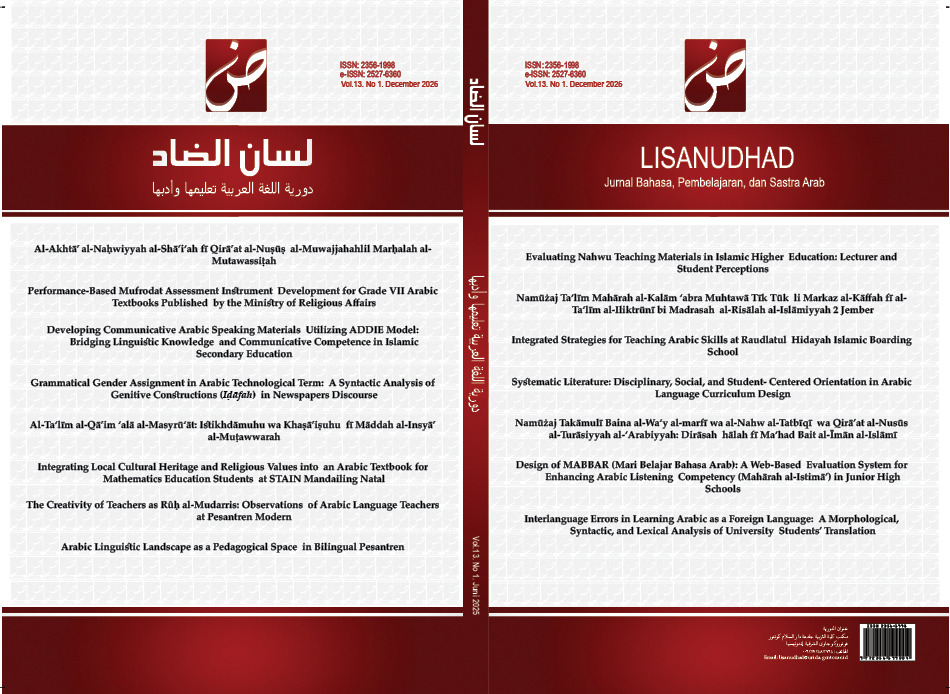
Arabic Linguistic Landscape as a Pedagogical Space in Bilingual Pesantren
DOI:
https://doi.org/10.21111/lisanudhad.v13i1.37الكلمات المفتاحية:
Linguistic Landscape، Arabic Language، Bilingual Education، Language Environment، Pesantrenالملخص
Linguistic Landscape (LL) studies examine the visibility of language in public spaces through signs, symbols, and written displays that shape social interaction and meaning-making. Although LL research has expanded considerably in educational contexts, limited scholarly attention has been directed toward the pedagogical functions of Arabic Linguistic Landscapes within pesantren as bilingual Islamic learning environments. This article delves into investigation on how Arabic linguistic signs operate not only as institutional markers but also as pedagogical resources in Pesantren Modern Al-Amanah Junwangi, Indonesia. Adopting a descriptive qualitative design, data were collected through observation and documentation of Arabic linguistic displays across the pesantren environment, including slogans, informational boards, directional signs, and other visual texts. The data were analyzed to identify the forms, distribution, and educational functions of Arabic signs within students’ everyday linguistic practices. The findings reveal that the Arabic Linguistic Landscape performs multiple interconnected roles: representing institutional identity, reinforcing language policy, and facilitating informal language acquisition beyond classroom settings. Continuous exposure to Arabic signage contributes to vocabulary development, habituates students to authentic linguistic expressions, and strengthens the implementation of language activities in daily interaction. More importantly, the study demonstrates that the integration of Arabic signs into the pesantren environment constructs an immersive and socially embedded language-learning ecology that bridges formal instruction and authentic communicative practice. By situating Arabic Linguistic Landscape as a pedagogical mediator within bilingual Islamic education, this study extends current LL scholarship beyond symbolic representation toward its role in sustaining environment-based language learning.
المراجع
Abdurahman, M., Rahman, R., & Sa’diah, E. (2018). Teaching Arabic in the Dormitory of Ma’had Jami’i of State Islamic University in Bandung: Toward a Total Immersion. EDUCARE, 10(2). DOI: https://doi.org/10.2121/edu-ijes.v10i2.946
Borrego, M. M. (2025). Linguistic landscape and pragmatic competence development: Towards an integrative pedagogical model. Porta Linguarum Revista Interuniversitaria de Didáctica de las Lenguas Extranjeras, (XII), 137-152.
DOI: https://doi.org/10.30827/portalin.viXII.33268
Hamid, M. A., Murtadho, M. A. C., Firdaus, A. Y., & Masturi, M. (2024). Language Environment and Acquisition Dynamics of Arabic in Pesantren: Perspectives on Islamic Education and Learning Tradition. International Journal of Islamic Thought and Humanities, 3(2), 387-400.
DOI: https://doi.org/10.54298/ijith.v3i2.608
Hermiwati, H., Hasyib, M. T. J., Machmudah, U., & Wicaksono, M. A. (2025). Enhancing Arabic Vocabulary Acquisition: Development of Learning Apps Based Interactive Learning Media. Lisanudhad: Jurnal Bahasa, Pembelajaran dan Sastra Arab, 12(2).
DOI: https://doi.org/10.21111/lisanudhad.v12i2.30
Jamil, A., & Kausar, G. (2021). Code preference in linguistic landscape: A forensic approach to the top-down signboards. Pakistan Journal of Social Research, 3(4), 446–455.
Jundi, M., Hasibuan, R., & Kadir, S. D. (2023). Probing the Fusion of Arabic and Gorontalo Dialect in the Daily Linguistic Landscape of Students at Al-Falah Islamic Boarding School. Kitabina: Jurnal Bahasa dan Sastra Arab, 4(02), 97-106. DOI: https://doi.org/10.19109/kitabina.v4i02.20255
Karimah, F. I., Putri, A. K. S., & Ridho, A. (2024). The Arabic Language Learning Curriculum in Modern Islamic Boarding Schools in Gontor Indonesia. Journal of Arabic Language Studies and Teaching, 4(2), 201-214.
DOI: https://doi.org/10.15642/jalsat.2024.4.2.201-214
Landry, R., & Bourhis, R. Y. (1997). Linguistic landscape and ethnolinguistic vitality: An empirical study. Journal of Language and Social Psychology, 16(1), 23–49.
Lazuardi, A. M. (2025). Contemporary Arabic Vocabulary Acquisition in Pesantren: Challenges and Pedagogical Innovations. Al-Muhawaroh: Jurnal Pendidikan Bahasa Arab, 1(2), 96–110.
DOI: https://doi.org/10.38073/almuhawaroh.v2i1.3673
Malinowski, D. (2008). Authorship in the linguistic landscape: A multimodal-performative view. In Linguistic landscape (pp. 147–165). Routledge.
Marzuq, A., & Iskandar, I. (2025, December). Nilai-Nilai Ekoteologis dalam Lanskap Linguistik di Pondok Pesantren. In Proceeding of International Conference on Innovation, Reflection, and Creativity in Arts, Literature, and Language Education (Vol. 1, No. 1, pp. 145-157).
DOI: https://doi.org/10.1234/ic.v1i1.61908
Murtadho, M. A. C., & Taufiq, M. A. (2025). Linguistic Landscape of Pesantren Modern Al-Amanah Junwangi: It's Role In Arabic Acquisition. JALIE: Journal of Applied Linguistics and Islamic Education, 9(2), 189–212.
DOI: https://doi.org/10.33754/jalie.v9i2.1461
Murtadho, M. A. C., Thohir, M., Yusuf, K., & Rif’at, A. D. (2025). Breaking Language Barriers: Amplifying Arabic Proficiency in Bilingual Environment through Immersive Learning. Insyirah: Jurnal Ilmu Bahasa Arab Dan Studi Islam, 8(1), 153–171. DOI: 10.26555/insyirah.v8i1.13174
Muslimah, K. C., Huda, M., Taufiqurrochman, R., & Affan, M. (2024). Linguistic landscape in arabic writing skills learning: Project-based learning approach. Izdihar: Journal of Arabic Language Teaching, Linguistics, and Literature, 7(2), 231-248. DOI: https://doi.org/10.22219/jiz.v7i2.31848
Nur Annisa, M., Arista, D., Udin, Y. L., & Wargadinata, W. (2023). Pemerolehan bahasa Arab sebagai bahasa kedua (kajian psikolinguistik). A Jamiy: Jurnal Bahasa dan Sastra Arab, 12(2), 468-484.
DOI: http://dx.doi.org/10.31314/ajamiy.12.2.468-484.2023
Putra, M. F. B., Ghufron, B., & Akbar, I. A. (2024). Life-Cycle Management of Arabic Learning Programs in Pesantren. Journal of Arabic Language Studies and Teaching, 4(1), 1-21.
DOI: https://doi.org/10.15642/jalsat.2024.4.1.1-21
Spolsky, B., & Shohamy, E. (2000). Language practice, language ideology, and language policy. Language Policy and Pedagogy: Essays in Honour of A. Ronald Walton, 1–41.
Subakir, F., Rochma, S. N., Khalifah, N. F., Rahmawati, N., & Izzati, A. R. (2025). Language Environment as an Invisible Curriculum: Rethinking Arabic Learning Through Ali Al-Hadidi's Lens Jurnal Manajemen Pendidikan, 10(4), 3358-3370. DOI: https://doi.org/10.34125/jmp.v10i4.2301
Syamsurijal, S., & Iswary, E. (2023). Language use in public space (Linguistic landscape study in shopping centers in Makassar City). International Journal of Social Science, 3(2), 113–122. DOI: https://doi.org/10.53625/ijss.v3i2.6295
Tuada, L., Yusuf, K., Syarofina, M. N., & LRO, N. A. (2025). Deconstructing Arabic Language Learning: A Bridge between Philosophical Analysis and Pedagogical Innovation. Lisanudhad: Jurnal Bahasa, Pembelajaran dan Sastra Arab, 12(2), 81-100.
DOI: https://doi.org/10.21111/lisanudhad.v12i2.47
Yanow, D. (2015). How built spaces mean: A semiotics of space. In Interpretation and method (pp. 368–386). Routledge.
التنزيلات
مقدم
##submissions.accepted##
منشور
كيفية الاقتباس
إصدار
القسم
الرخصة
الحقوق الفكرية (c) 2026 Nasikul Mustofa Efendi, Kamal Yusuf, Nasaruddin, Muflihah, Muhammad Alfa Choirul Murtadho

هذا العمل مرخص بموجب Creative Commons Attribution-NonCommercial 4.0 International License.
Authors who publish with this Journal agree to the following terms:
- Free to Share — copy and redistribute the material in any medium or format;
- Free to Adapt — remix, transform, and build upon the material,
The licensor cannot revoke these freedoms as long as you follow the license terms.
Under following terms:
- Attribution — You must give appropriate credit , provide a link to the license, and indicate if changes were made . You may do so in any reasonable manner, but not in any way that suggests the licensor endorses you or your use.
- NonCommercial — You may not use the material for commercial purposes .
No additional restrictions — You may not apply legal terms or technological measures that legally restrict others from doing anything the license permits.
Notices:
You do not have to comply with the license for elements of the material in the public domain or where your use is permitted by an applicable exception or limitation .
No warranties are given. The license may not give you all of the permissions necessary for your intended use. For example, other rights such as publicity, privacy, or moral rights may limit how you use the material.