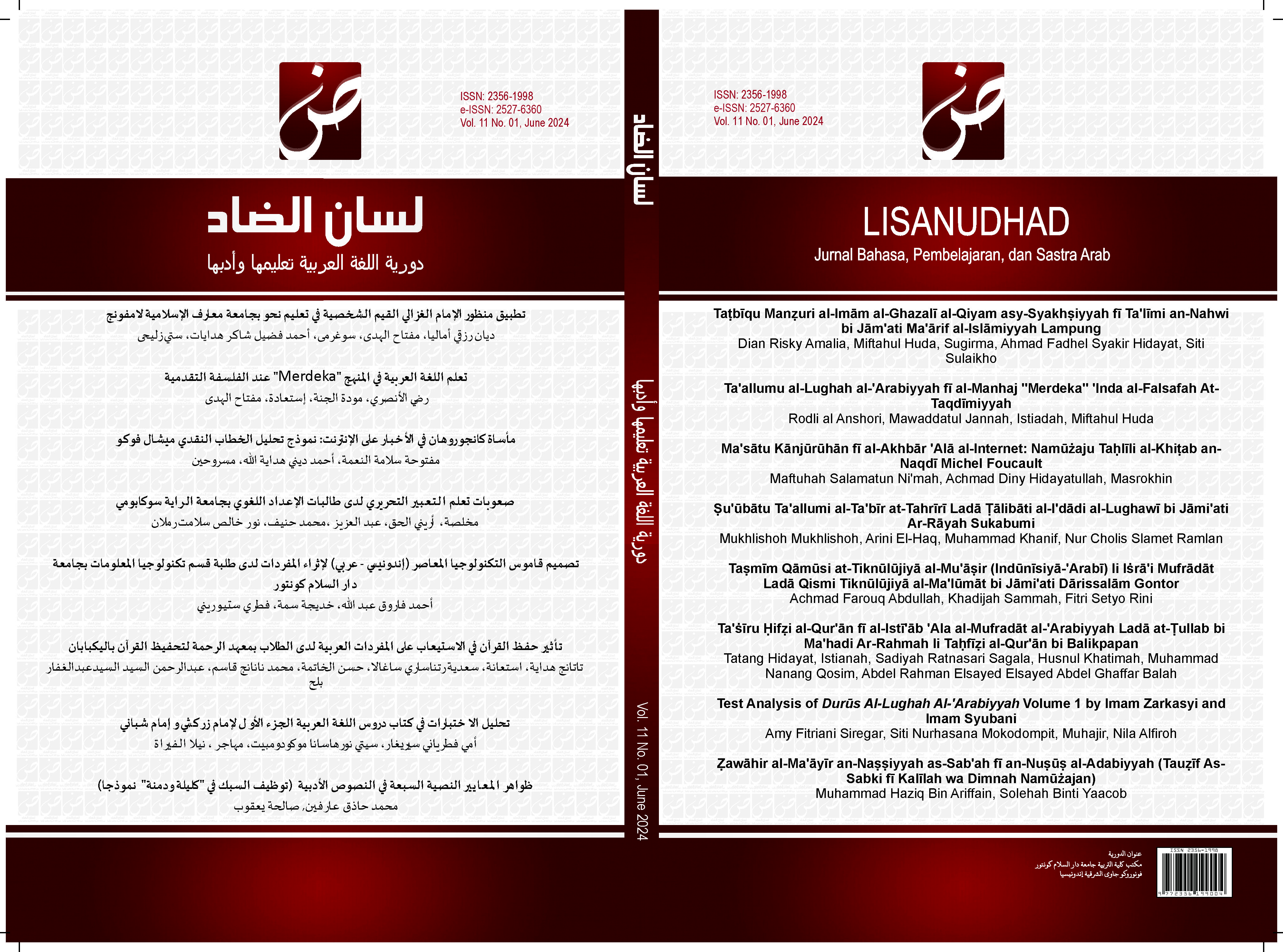
The Effectiveness of Memorizing The Qur’an on Arabic Vocabulary Mastery Among Students at Ar-Rahmah Baording School for Tahfīdz Qur’an Balikpapan
DOI:
https://doi.org/10.21111/lisanudhad.v11i1.102الملخص
This research aims to find out the influence of the ability to memorize the Qur'an on the Arabic vocabulary mastery among students of the boarding school for tahfīdz Qur’an Balikpapan, and follows the analytical descriptive approach to this goal. The methods used by the researcher to collect data are testing, observation and documentation. It is quantitative research with the design of causal association research with a sample of 31 students from the second stage in the preservation of the Qur'an. For data analysis, the researcher used regression equation, selection factors and importance testing. The results of this research show that there is a significant impact of the preservation of the Qur'an with the mastery of Arabic vocabulary. By calculating the importance test analysis that indicates that tvalue (7,482) is greater than ttable (2,045), H0 was rejected and H1 was accepted, which means that there is a significant influence between the ability to memorize the Qur’an to the Arabic vocabulary mastery. The percentage of the influence of Qur'anic memorization ability on the ruling of Arabic vocabulary is 65.9%, and 34.1% by other factors.
المراجع
Abdussalam, Aam, Tedi Supriyadi, Udin Supriadi, Aep Saepudin, and Muhamad Imam Pamungkas. “Exegetical Translation of the Qur’an: An Action Research on Prospective Islamic Teachers in Indonesia.” Indonesian Journal of Applied Linguistics 11, no. 2 (2021): 254–68.
“Aplikasi Quran in Word Versi 3.0,” 2018.
Asaf, Shalih Ahmad Al. Al Madkhal Ila Al Bahs Fi Al Ulum As Sulukiyyah. Riyadh: Maktabah Al Abikan, 1990.
Ashfahani, Ar Ragib Al. Al Mufradāt Fĭ Garĭb Al Qur’ān. Mecca: Mustafa al Hubla, 1961.
Balikpapan, Tim Penyusun Lembaga Tahsin Tahfizhil Quran Ar-Rahmah. “Rumah Tahfiz Al Quran Ar Rahmah.” Ar Rahmah Balikpapan, 2020.
Dalimi, Akram Ad. Jam‘u Al Qur’ān Dirasah Taḥlĭliyyah Li Marwiyyātihi. Beirut: Dar al Kutub al Ilmiyyah, 2006.
Darmawan, Deni. Metode Penelitian Kuantitatif. Bandung: PT Remaja Rosdakarya, 2014.
Duwidari, Raja Wahid. Al Bahs Al Ilmy Wa Asasiyyatuhu An Nazhariyyah Wa Mumarasatihi Al Ilmiyyah. Damaskus: Dar Al Fikri, 2000.
Hajar, Ibnu. Dasar-Dasar Metodologi Kuantitatif Dalam Penelitian. Jakarta: PT Grafindo Persada, 1996.
Hidayat, Ipan, Nurul Al Fudiah, and Tatang Hidayat. “دور اللغة العربية في تطبيقات الذكاء الاصطناعي لتقدم الحضارة العالمية الحديثة.” Lisanudhad: Jurnal Bahasa, Pembelajaran Dan Sastra Arab 10, no. 1 (2023): 116–26.
Irfan. “Korelasi Antara Hafalan Quran Dan Penguasaan Mufradat Dalam Pembelajaran Bahasa Arab Di Mahad Al-Izzah IIBS.” UIN Maulana Malik Ibrahim Malang, 2020.
Istianah, and Maslamah. “Tanfiż Taḥfīẓ Al-Qur´ān Bi Ma’had Al-Raḥmah Bi Bālikpāpān Fī Tanmiyah Istī’āb Al-Mufradāt Al-Lugah Al-‘Arabiyyah.” ZAD Al-Mufassirin 5, no. 2 (2023): 372–94.
Jannah, Ida Miftakhul, Umi Hanifah, and Mohamad Thohir. “The Implementation of Mind Mapping in Arabic Speaking Skills for University Students.” Lisanudhad: Jurnal Bahasa, Pembelajaran Dan Sastra Arab 10, no. 2 (2023): 45–68.
Kasiram, Mohammad. Metodologi Penelitian Kuantitatif. Malang: UIN Malang Press, 2008.
Lail, Harisma Nafilatul. “Aṡar Taḥfiẓ Al Qur’ān ‘Ala Qudrah Ḥifẓi Mufradāt Al Lugah Al ‘Arabiyyah Ladā Ṭullab Al Ṣaf Al Ṡaliṡ Bi Al Madrasah Al Ibtidā’iyyah Al Islāmiyyah Al Mutakāmilah ‘Al Islām.’” UIN Salatiga, 2016.
Masrai, A., & Milton, J. How many words do you need to speak Arabic? An Arabic vocabulary size test. The Language Learning Journal, 47(5), (2019)519-536
Muslim, Buhori, Zikrina, and Mukhlisah. “Taṭwîr Kitāb Al-Qirā’at Al-Rasyîdah Li Tarqiyyah Mahārah Al-Qirā’ah ‘Inda Al-Ṭālibah Bi Istikhdām Al-Kitāb Al-Elektrûny Al-Tafā’uliy Fi Al-Madrasah Al-Mutawassiṭah Insān Qur’āny Aceh Besar.” Jurnal Ilmiah Islam Futura 2, no. 2 (2023): 347–59.
Nawabuddin, Abdurrabb. Kaifa Tahfaz Al-Qur’an Al-Kariim. Riyadh: Dar Thawiq, 2001.
Nurcholis, Agung, and Qudwatun Hasanah. "Anāshir An-Nadzariyyah As-Sulukiyyah fī Ta’līm al-Mufradāt (Dirāsah Tahlīliyyah Washfiyyah)." Lisanudhad: Jurnal Bahasa, Pembelajaran, dan Sastra Arab 7, no. 1 (2020): 13-31.
Ratnasari, Sadiyah. “Wawancara Dosen STIBA Ar-Raayah Sukabumi.” Sukabumi, 2020.
Rosyad, Muh Sabilar, Uril Bahruddin, and Faishol Mahmoud Adam Ibrahim. “The Reality of Learning Arabic Listening Skills at Pesantren-Based Universities from the Perspective of Teaching Materials.” LISHANUDHAD: Jurnal, Bahasa, Pembelajaran Dan Sastra Arab 10, no. 2 (2023): 92–120.
Rudisunhaji, Muhamad Asngad, Intan Sari Dewi, Ahmad Nurcholis, and Syaikhu Ihsan Hidayatullah. “Competency-Based Arabic Language Learning In Madrasah Aliyah.” Ijaz Arabi: Journal of Arabic Learning 7, no. 1 (2024): 180–95.
Rūmi, Fahd Ibn ‘Abd al Raḥman Ibn Sulaimān Al. Dirāsāt Fĭ ‘Ulūmi Al Qur’ān Al Karĭm. Riyadh: Jami‘ah al Malik Su‘ud, 2003.
Sugiono. Metode Penelitian Pendidikan. Bandung: Alfabeta, 2012.
Thibl, Thariq As Sayyid. “Min Asrar Al Kalimat Fi Al Quran Al Karim.” 7 July, 2009.
Wirawan. Manajemen Sumber Daya Indonesia. Jakarta: PT Raja Grafindo Persada, 2015.
Zubaidillah, Muh. Haris. “Hubungan Kemampuan Bahasa Arab Dengan Prestasi Hafalan Al Quran.” Al Mi’yar: Jurnal Iimiah Pembelajaran Bahasa Arab Dan Kebahasaaraban 1, no. 2 (2018).
مقدم
منشور
كيفية الاقتباس
إصدار
القسم
الرخصة
الحقوق الفكرية (c) 2026 Tatang Hidayat, Istianah, Sadiyah Ratnasari Sagala, Husnul Khatimah, Muhammad Nanang Qosim, Abdel Rahman Elsayed Elsayed Abdel Ghaffar Balah

هذا العمل مرخص بموجب Creative Commons Attribution-NonCommercial 4.0 International License.
Authors who publish with this Journal agree to the following terms:
- Free to Share — copy and redistribute the material in any medium or format;
- Free to Adapt — remix, transform, and build upon the material,
The licensor cannot revoke these freedoms as long as you follow the license terms.
Under following terms:
- Attribution — You must give appropriate credit , provide a link to the license, and indicate if changes were made . You may do so in any reasonable manner, but not in any way that suggests the licensor endorses you or your use.
- NonCommercial — You may not use the material for commercial purposes .
No additional restrictions — You may not apply legal terms or technological measures that legally restrict others from doing anything the license permits.
Notices:
You do not have to comply with the license for elements of the material in the public domain or where your use is permitted by an applicable exception or limitation .
No warranties are given. The license may not give you all of the permissions necessary for your intended use. For example, other rights such as publicity, privacy, or moral rights may limit how you use the material.