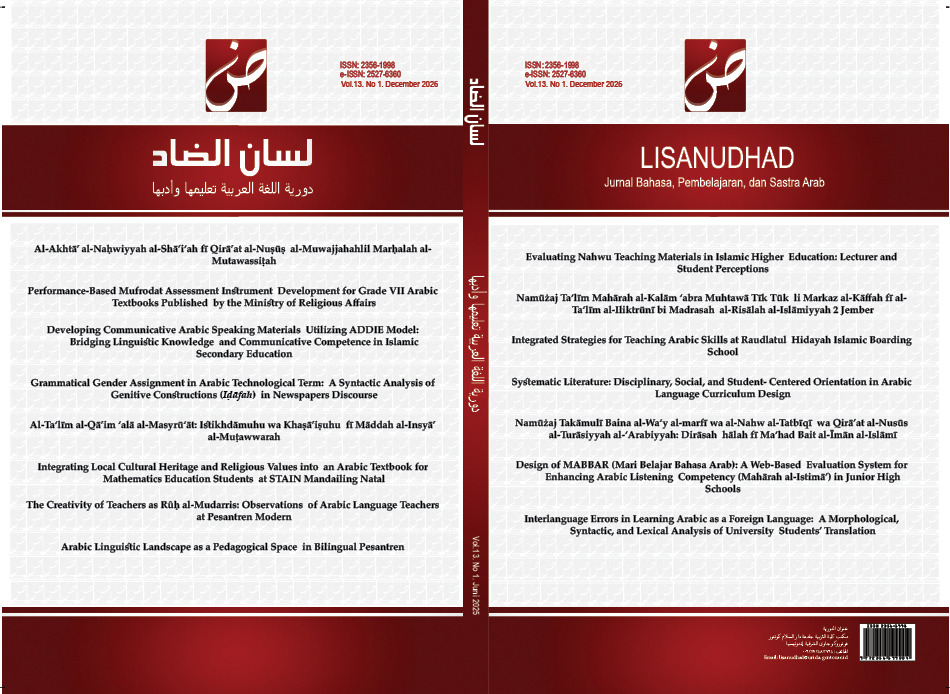
Interlanguage Errors in Learning Arabic as a Foreign Language: A Morphological, Syntactic, and Lexical Analysis of University Students’ Translation
DOI:
https://doi.org/10.21111/lisanudhad.v13i1.66Keywords:
inter language, Arabic as a foreign language, error analysis, interlingual transfer, Indonesian higher educationAbstract
Empirical research on inter language development among Arabic-as-a-foreign-language (AFL) learners in Indonesian higher education remains scarce. This study investigates inter language phenomena among fourth- and sixth-semester students through translation error analysis, contributing empirical evidence from this underexplored institutional context. Adopting a descriptive qualitative design grounded in Corder’s (1982) error analysis framework and Selinker’s (1972) inter language theory, the data comprised Indonesian-to-Arabic translation texts produced by 34 purposively selected students at STAIN Mandailing Natal. Errors were identified, described, and classified by linguistic aspect and inter language source through a five-step procedure. The findings show that learners have reached an intermediate inter language stage, marked by adequate receptive vocabulary and a basic command of Arabic morphology and simple sentence structures, yet apply these competencies inconsistently in complex rules, exceptions, and authentic Arabic style (uslub). Of 21 errors across 16 sentences, inter lingual transfer was the most dominant source (11; 52%), followed by simplification and overgeneralization (5 each; 24%), distributed across morphological, syntactic, and lexical dimensions. These results carry direct pedagogical implications: contrastive analysis, targeted drilling on morphological exceptions, and inter language-informed sequencing are recommended to guide learners toward greater accuracy. The study advances AFL pedagogy in Indonesia through context-specific, empirically grounded evidence.
References
Ahibalova, T. “Fossilization in Adult Second Language Acquisition.” Naukovi Zapysky Natsionalnoho Universytetu «Ostrozka Akademiia», Seriia «Filolohiia» 5, no. 73 (2019): 150–53. https://doi.org/10.25264/2519-2558-2019-6(74)-150-153.
Ahmad, L. M. I. “The Development of Interlanguage in the Written Production of Arabic Foreign Language Learners.” The University of Texas at Austin, 2017.
Al-kaosari, M., M. Al-kaosari, and M. Al-kaosari. “Analisis Kesalahan Berbahasa Dalam Pembelajaran Bahasa Arab: Kajian Literatur.” AL-AFKAR: Journal for Islamic Studies 8, no. 2 (2025): 2090–102. https://doi.org/10.31943/afkarjournal.v8i2.2246.
Al-khresheh, M. H. “Interlanguage Theory and Second Language Acquisition: A Review Study.” International Journal of Applied Linguistics and English Literature 10, no. 1 (2021): 1–8. https://doi.org/10.7575/aiac.ijalel.v.10n.1p.1.
Brown, K., ed. Encyclopedia of Language and Linguistics. 2nd ed. Elsevier, 2006.
Corder, S. P. Error Analysis and Interlanguage. Oxford University Press, 1982.
Corder, S. P. “The Significance of Learners’ Errors.” International Review of Applied Linguistics 5, no. 4 (1967): 161–70.
Creswell, J. W. Research Design: Qualitative, Quantitative, and Mixed Methods Approaches. 4th ed. SAGE Publications, 2014.
Dimyaty, M. “Tahlil Akhtha’ Kitabah al-Lughah al-’arabiyyah Lada Thulab Syu’bah Ta’lim al-Lughah al-’arabiyyah Bi al-Jami’ah al-Islamiyyah Dar al-Salam.” UIN Kiai Haji Achmad Shiddiq Jember, 2018.
Dosh, R. R. A., and Y. S. Al-Mahameed. “Cross-Linguistic Interference in the Syntactic and Semantic Acquisition of Arabic Language.” International Journal of Linguistics, Literature and Translation 3, no. 11 (2020): 55–67. https://doi.org/10.32996/ijllt.2020.3.11.7.
Ellis, R. The Study of Second Language Acquisition. Oxford University Press, 1999.
Frith, M. B. “Interlanguage Theory: Implications for the Classroom.” McGill Journal of Education, n.d., 155–65.
Himami, M. A., and U. Manshur. “Analisis Kesalahan Bahasa Arab Pada Siswa Kelas 3 Language Intensive Program.” Shaut Al-’Arabiyah 14, no. 1 (2026): 91–107.
Lakshmanan, U., and L. Selinker. “Analysing Interlanguage: How Do We Know What Learners Know?” Second Language Research 17, no. 4 (2001): 393–420. https://doi.org/10.1177/026765830101700406.
Lubis, R. H., A. N. Silny, A. Jariah, N. J. Karlina, and N. A. Mardhatillah. “Tahlil Al-Akhtha’ ‘ala Kitabat al-Jumlah al-Fi’liyyah Fi Ad-Darsi l-Insya’ Bima’hadi Darissalam Gontor Lil-Banat.” Jurnal Pendidikan Bahasa Arab 4, no. 2 (2024): 1–20.
Luna, R. M. “Interlanguage in Undergraduates’ Academic English: Preliminary Results from Written Script Analysis.” Revista Alicantina de Estudios Ingleses 23 (2010): 60–73.
Miles, M. B., A. M. Huberman, and J. Saldaña. Qualitative Data Analysis: A Methods Sourcebook. 3rd ed. SAGE Publications, 2014.
Nasirudeen, A. I. “Interlanguage Analysis as a Tool for Improving Instruction for Arabic Language Learners.” International Journal of Academic Research in Progressive Education and Development 14, no. 4 (2025): 2403–10. https://doi.org/10.6007/ijarped/v14-i4/27105.
Qiaolan, G. “Interlanguage and Its Implications to Second Language Teaching and Learning.” Pacific International Journal 5, no. 4 (2022): 8–14. https://doi.org/10.55014/pij.v5i4.223.
Richards, J. C. “A Non-Contrastive Approach to Error Analysis.” English Language Teaching Journal 25, no. 3 (1971): 204–19.
Rohman, A., A. Maksum, W. Wargadinata, and A. Taufiq. “Local Language Interference on Non-Native Arabic Speaker in Rural Santri Communities: Sociolinguistic Study.” Langkawi: Journal of The Association for Arabic and English 11, no. 1 (2025): 76–90. https://doi.org/10.31332/lkw.v11i1.11078.
Samir, H. E. D., N. B. Haidara, F. Alghazali, and M. A. Badran. “The Impact of Language Immersion on Arabic Language Acquisition for Speakers of Other Languages.” Journal of Posthumanism 5, no. 3 (2025). https://doi.org/10.63332/joph.v5i3.919.
Selinker, L. “Interlanguage.” International Review of Applied Linguistics in Language Teaching 10, no. 3 (1972): 209–31.
Song, L. “On the Variability of Interlanguage.” Theory and Practice in Language Studies 2, no. 4 (2012): 778–83. https://doi.org/10.4304/tpls.2.4.778-783.
Yasih, Y., D. Ismatullah, and A. M. R. S. Rohman. “Interferensi Bahasa Indonesia Dalam Bahasa Inggris.” Jurnal Bastra (Bahasa Dan Sastra) 10, no. 3 (2025): 1043–51.
Downloads
Submitted
Accepted
Published
How to Cite
Issue
Section
License
Copyright (c) 2026 Isra Hayati Darman, Rani Ismil Hakim, Wa Muna, Adri Adri

This work is licensed under a Creative Commons Attribution-NonCommercial 4.0 International License.
Authors who publish with this Journal agree to the following terms:
- Free to Share — copy and redistribute the material in any medium or format;
- Free to Adapt — remix, transform, and build upon the material,
The licensor cannot revoke these freedoms as long as you follow the license terms.
Under following terms:
- Attribution — You must give appropriate credit , provide a link to the license, and indicate if changes were made . You may do so in any reasonable manner, but not in any way that suggests the licensor endorses you or your use.
- NonCommercial — You may not use the material for commercial purposes .
No additional restrictions — You may not apply legal terms or technological measures that legally restrict others from doing anything the license permits.
Notices:
You do not have to comply with the license for elements of the material in the public domain or where your use is permitted by an applicable exception or limitation .
No warranties are given. The license may not give you all of the permissions necessary for your intended use. For example, other rights such as publicity, privacy, or moral rights may limit how you use the material.