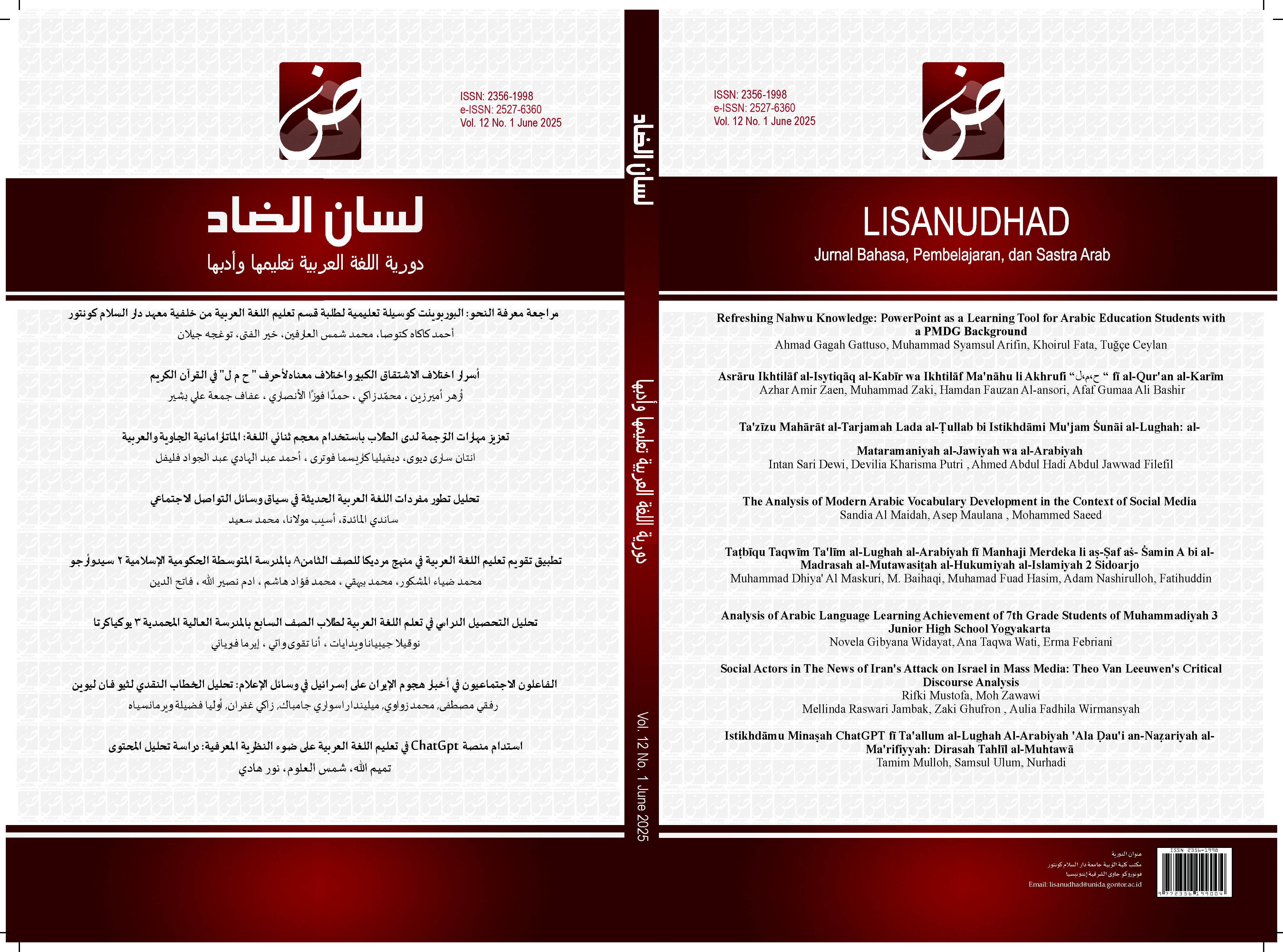
Taṭbīqu Taqwīm Ta’līm al-Lughah al-Arabiyah fī Manhaji Merdeka li aṣ-Ṣaf aṡ- Ṡamin A bi al-Madrasah al-Mutawasiṭah al-Hukumiyah al-Islamiyah 2 Sidoarjo
DOI:
https://doi.org/10.21111/lisanudhad.v12i1.86Abstract
The researcher discusses evaluating the learning of the Arabic language in the Merdeka curriculum for the eighth grade A at the State Middle School 2 Sidoarjo. This research aims to: 1) Determine the evaluation of learning the Arabic language in the independent curriculum in the eighth grade A at the Government Middle School 2 Sidoarjo. 2) Knowing the supporting and hindering factors in evaluating learning the Arabic language in the independent curriculum in the eighth grade A, Metson 2, Sidoarjo. This study used a descriptive qualitative approach. Primary and secondary data sources in this research included an Arabic language teacher, some 8th grade A students, the Vice President of Curriculum, and the Vice President of Facilities and Infrastructure. Data collection techniques and tools are interviews, observation and documentation. Data analysis techniques by presenting data and drawing conclusions. The results of this research are: 1) The teacher is good at conducting Arabic language learning assessments in implementing the independent curriculum in Grade 8A using different techniques and different forms of assessment tools and aligned with the learning objectives. 2) There are various factors that support the assessment process, among others: Adequate facilities and infrastructure, the teacher provides constructive feedback and the teacher never provides destructive feedback, and there are disciplined students when carrying out assessments. Factors that hinder assessment include: Sometimes there is still a lack of facilities and infrastructure provided by the school and there is a lack of student discipline in conducting and collecting assessments.
References
Akmalia, Rizki, Dina Oktapia, Elsa Elitia Hasibuan, Irma Tussa’diyah Hasibuan, Nindya Azzahrah, and Tri Suci Apriani Harahap. “Pentingnya Evaluasi Peserta Didik Dalam Proses Pembelajaran.” Jurnal Pendidikan Dan Konseling (JPDK) 5, no. 1 (2023): 4089–92. http://journal.universitaspahlawan.ac.id/index.php/jpdk/article/view/11661.
Albar, Joni, and Mastiah Mastiah. “Analisis Penerapan Kurikulum Merdeka Terhadap Kecerdasan Interpersonal Siswa Sekolah Dasar.” Jurnal Pendidikan Dasar 10, no. 2 (2022): 273–79. https://pdfs.semanticscholar.org/f9d9/a45662a432aa3c76ec7feeda59ad50f9dd9a.pdf.
Andayani, Triasari, and Faisal Madani. “Peran Penilaian Pembelajaran Dalam Meningkatkan Prestasi Siswa Di Pendidikan Dasar.” Jurnal Educatio FKIP UNMA 9, no. 2 (2023): 924–30. https://ejournal.unma.ac.id/index.php/educatio/article/view/4402.
Angga, Angga, Cucu Suryana, Ima Nurwahidah, Asep Herry Hernawan, and Prihantini Prihantini. “Komparasi Implementasi Kurikulum 2013 Dan Kurikulum Merdeka Di Sekolah Dasar Kabupaten Garut.” Jurnal Basicedu 6, no. 4 (2022): 5877–89. https://jbasic.org/index.php/basicedu/article/view/3149.
Azhar, Muhammad, Hakmi Wahyudi, Promadi Promadi, and Masrun Masrun. “Penggunaan Teknologi Dalam Pembelajaran Bahasa Arab Di Indonesia.” Jurnal Review Pendidikan Dan Pengajaran (JRPP) 6, no. 4 (2023): 3160–68. http://journal.universitaspahlawan.ac.id/index.php/jrpp/article/view/20984.
Chasanah, Uswatun, and Andi Prastowo. “Evaluasi Kurikulum Pembelajaran Bahasa Arab Untuk Perbaikan Mutu Akademik Di Mi Mambaul Ma’Arif.” Ta’allum: Jurnal Pendidikan Islam 9, no. 2 (2021): 272–99. https://ejournal.uinsatu.ac.id/index.php/taalum/article/view/4426.
Choiroh, Muhimmatul. “Evaluasi Pembelajaran Bahasa Arab Berbasis Media E-Learning.” Naskhi: Jurnal Kajian Pendidikan Dan Bahasa Arab 3, no. 1 (2021): 41–47. https://journal.uiad.ac.id/index.php/naskhi/article/view/554.
Farid, Edi Kurniawan, and Moch Yunus. “Pengembangan Kurikulum Bahasa Arab:(Studi Tentang Manajemen Mutu Kurikulum Pembelajaran Bahasa Arab).” BAHTSUNA: Jurnal Penelitian Pendidikan Islam 3, no. 2 (2021): 308–29. https://www.lp3mzh.id/index.php/bahtsuna/article/view/52.
Fitri, Zahra Maulida, and Ahmad Rizki Nugrahawan. “تطبيق التقويم تطبيق التقويم تعلم اللغة العربية في منهج مرديكا في المدرسة العالية الحكومية 4 جاكرتا الجنوبية: تطبيق التقويم تعلم اللغة العربية في منهج مرديكا في المدرسة العالية الحكومية 4 جاكرتا الجنوبية.” Riyahuna: Jurnal Pendidikan Bahasa Arab 3, no. 1 (November 30, 2023): 56–84. https://doi.org/10.22236/jpba/3113292.
Furtak, Erin Marie. Formative Assessment for Secondary Science Teachers. Corwin Press, 2009.
Gardner, John. Assessment and Learning. SAGE, 2006.
Gozali, Gozali, Imam Sibaweh, Dede Indra Setiabudi, Jaja Jahari, and Mohamad Erihadiana. “Perspektif Baru Kurikulum Merdeka Dalam Peningkatan Mutu Pendidikan.” Jurnal Educatio FKIP UNMA 10, no. 2 (2024): 652–58. http://www.ejournal.unma.ac.id/index.php/educatio/article/view/7750.
Hagger, Martin, and Nikos Chatzisarantis. The Social Psychology of Exercise and Sport. McGraw-Hill Education (UK), 2005.
Hartati, Suci. “Evaluasi Kinerja Kepemimpinan Kepala Sekolah Dalam Nenerapkan Konsep Manajemen Mutu, Sebagai Upaya Meningkatkan Mutu Pendidikan.” Jurnal Pendidikan Dan Konseling (JPDK) 4, no. 6 (2022): 13422–33. https://journal.universitaspahlawan.ac.id/index.php/jpdk/article/view/13559.
Haryadi, Didit, and Fitri Mahmudah. “Implementasi Kurikulum Darurat Covid-19.” Journal EVALUASI 5, no. 2 (2021): 94. https://scholar.archive.org/work/drpfgzmnlner5o64lv7pwid6z4/access/wayback/https://e-journal.staima-alhikam.ac.id/evaluasi/article/download/595/pdf.
Idris, Wonadi. “Peran Guru Pendidikan Agama Islam (PAI) Dalam Kurikulum Merdeka.” Jurnal Pendidikan Dosen Dan Guru 3, no. 1 (2023). http://jurnal.pcpergunubatanghari.com/index.php/jurpendig/article/download/27/24.
Indrawari, Karliana, Intan Berlian, Nadia Obella, and Novan Dwi Putra. “Peran Guru PAI Dalam Pengimplementasian Kurikulum Merdeka Di SD N 77 Desa ℡Adan.” Jurnal Ilmiah Pendidikan Kebudayaan Dan Agama 1, no. 4 (2023): 67–81. https://jurnal.alimspublishing.co.id/index.php/JIPA/article/view/365.
Jannah, Mawaddahtul, Rodli Al Anshori, Istiadah Istiadah, and Miftahul Huda. “Arabic Language Learning in The Merdeka Curriculum From the Perspective of Progressivism Philosophy.” Lisanudhad: Jurnal Bahasa, Pembelajaran, dan Sastra Arab 11, no. 01 (June 25, 2024): 32–51. https://doi.org/10.21111/lisanudhad.v11i01.10787.
Jannati, Putri, Faisal Arief Ramadhan, and Muhamad Agung Rohimawan. “Peran Guru Penggerak Dalam Implementasi Kurikulum Merdeka Di Sekolah Dasar.” Al-Madrasah: Jurnal Pendidikan Madrasah Ibtidaiyah 7, no. 1 (2023): 330–45. https://www.jurnal.stiq-amuntai.ac.id/index.php/al-madrasah/article/view/1714.
Magdalena, Ina, Nurul Hidayati, Ratri Hersita Dewi, Sabgi Wulan Septiara, and Zahra Maulida. “Pentingnya Evaluasi Dalam Proses Pembelajaran Dan Akibat Memanipulasinya.” Masaliq 3, no. 5 (2023): 810–23. https://ejournal.yasin-alsys.org/index.php/masaliq/article/view/1379.
Magdalena, Ina, Alvi Ridwanita, and Bunga Aulia. “Evaluasi Belajar Peserta Didik” 2 (2020).
Mahirah, B. “Evaluasi Belajar Peserta Didik (Siswa).” Idaarah: Jurnal Manajemen Pendidikan 1, no. 2 (2017). https://journal3.uin-alauddin.ac.id/index.php/idaarah/article/view/4269.
Mahmudi, Muhammad Imam. “تطبيق التقييم الواقعي في المنهج الدراسي 2013 لتعليم اللغة العربية في الصف الحادي عشر بالمدرسة العالية الإسلامية الحكومية 2 بوجونكارا السنة الدراسية 2016/2017.” Undergraduate, UIN Sunan Ampel Surabaya, 2017. http://digilib.uinsa.ac.id/18964/.
Mallu, Satriawaty, Effendi Effendi, Jahring Jahring, Riska Yulianti, Salam Salam, Soraya Soraya, Runi Rulanggi, Ike Kurniawati, Siti Nurul Hidayah, and Adi Warma. “Problem-Based Learning Dalam Kurikulum Merdeka.” Penerbit Mifandi Mandiri Digital 1, no. 01 (2024). http://jurnal.mifandimandiri.com/index.php/penerbitmmd/article/view/58.
Masturoh, Fitri, and Ihwan Mahmudi. “The Implementasi Kurikulum Merdeka Belajar Dalam Pembelajaran Bahasa Arab.” Kalamuna: Jurnal Pendidikan Bahasa Arab Dan Kebahasaaraban 4, no. 2 (2023): 207–32. http://e-jurnal.staimuttaqien.ac.id/index.php/kalamuna/article/view/1202.
Maulia, Safira. “Peran Komunikasi Efektif Guru Dalam Meningkatkan Motivasi Belajar Siswa Sekolah Dasar (SD).” Elementa: Jurnal Pendidikan Guru Sekolah Dasar 5, no. 1 (2023). http://jurnal.stkipbjm.ac.id/index.php/pgsd/article/download/2310/1136.
Mulyana, Nur. “Penguatan Kompetensi Paedagogik Guru Dalam Meningkatkan Kualitas Pembelajaran (Studi Kasus Terhadap Guru PPKn Di SMP Negeri 3 Banjar),” 2024. http://repository.unigal.ac.id/handle/123456789/5280.
Nashir, Ahmad, and Sandi Pratama. “Peran Guru Ismuba Dalam Pembinaan Akhlak Pada Elemen Profil Pelajar Pancasila Implementasi Kurikulum Merdeka.” HIKMAH: Jurnal Pendidikan Islam 11, no. 2 (2022): 80–90. https://ojs.staituankutambusai.ac.id/index.php/hikmah/article/view/358.
Oktavia, Putri, and Khusnul Khotimah. “Pengembangan Metode Pembelajaran Pendidikan Agama Islam Di Era Digital.” An Najah (Jurnal Pendidikan Islam Dan Sosial Keagamaan) 2, no. 5 (2023): 66–76. https://journal.nabest.id/index.php/annajah/article/view/167.
Purnasari, Pebria Dheni, and Yosua Damas Sadewo. “Pemanfaatan Teknologi Dalam Pembelajaran Sebagai Upaya Peningkatan Kompetesnsi Pedagogik.” Publikasi Pendidikan 10, no. 3 (2020): 189–96. https://core.ac.uk/download/pdf/388995085.pdf.
Rahmawati, Afina. “تطبيق منهج مستقل في تعليم اللغة العربية بالفصل العشرة من المدرسة الثانوية الحكومية الثانية كديري.” Undergraduate, IAIN Kediri, 2023. https://etheses.iainkediri.ac.id/10026/.
Resya, Kusuma Ningtyas Pramita. “Evaluasi Pembelajaran Dalam Ranah Aspek Kognitif Pada Jenjang Pendidikan Dasar Pada MI Assalafiyah Timbangreja.” Jurnal Review Pendidikan Dan Pengajaran (JRPP) 6, no. 2 (2023). https://journal.universitaspahlawan.ac.id/index.php/jrpp/article/view/18247.
Sulindawati, Ni Luh Gede Erni. “Analisis Unsur-Unsur Pendidikan Masa Lalu Sebagai Dasar Penentuan Arah Kebijakan Pembelajaran Pada Era Globalisasi.” Jurnal Ilmiah Ilmu Sosial 4, no. 1 (July 23, 2018). https://doi.org/10.23887/jiis.v4i1.14363.
Umi Isna, Nur Laeli. “Evaluasi Pembelajaran Bahasa Arab Di Ma Ma’arif Nu 1 Cilongok Banyumas.” Skripsi, UIN Prof. K.H. Saifuddin Zuhri Purwokerto, 2023. https://repository.uinsaizu.ac.id/18104/.
Downloads
Submitted
Published
How to Cite
Issue
Section
License
Copyright (c) 2026 Muhammad Dhiya’ Al Maskuri , M. Baihaqi, Muhamad Fuad Hasim, Adam Nashirulloh; Fatihuddin

This work is licensed under a Creative Commons Attribution-NonCommercial 4.0 International License.
Authors who publish with this Journal agree to the following terms:
- Free to Share — copy and redistribute the material in any medium or format;
- Free to Adapt — remix, transform, and build upon the material,
The licensor cannot revoke these freedoms as long as you follow the license terms.
Under following terms:
- Attribution — You must give appropriate credit , provide a link to the license, and indicate if changes were made . You may do so in any reasonable manner, but not in any way that suggests the licensor endorses you or your use.
- NonCommercial — You may not use the material for commercial purposes .
No additional restrictions — You may not apply legal terms or technological measures that legally restrict others from doing anything the license permits.
Notices:
You do not have to comply with the license for elements of the material in the public domain or where your use is permitted by an applicable exception or limitation .
No warranties are given. The license may not give you all of the permissions necessary for your intended use. For example, other rights such as publicity, privacy, or moral rights may limit how you use the material.