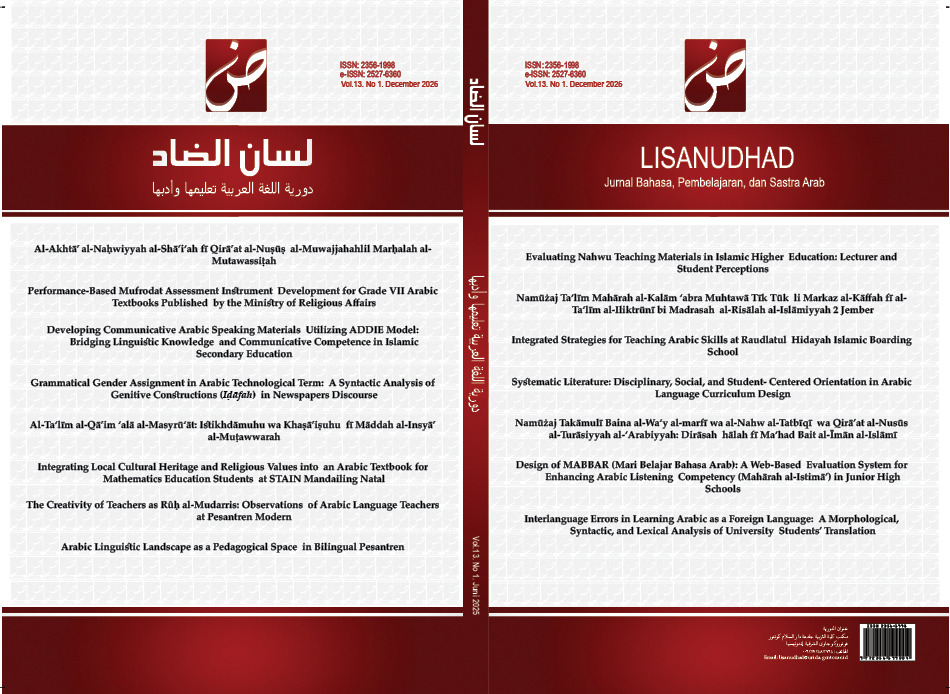
The Creativity of Teachers as Rȗḥ al-Mudarris: Observations of Arabic Language Teachers at Pesantren Modern
DOI:
https://doi.org/10.21111/lisanudhad.v13i1.36Keywords:
Teacher Creativity, Rūḥ al-Mudarris, Arabic Language Education, Pesantren, Professionalism developmentAbstract
This study examines teachers' creativity as rūḥ al-mudarris, specifically in Arabic Language Teaching at Pesantren Ar-Raudlatul Hasanah. Based on the conceptual framework of KH Imam Zarkasyi, which emphasizes the teacher's spirits over methods and materials, this study aims to explore how Arab teachers practice creativity not merely as a technical skill but as a living commitment to teaching. Using a qualitative-descriptive approach, data were collected through classroom observations, semi-structured interviews, and document analysis with the participation of teachers, supervisors, and stakeholder. The findings show that teachers' creativity manifests in three main forms: (1) thorough and flexible appropriation of the subject matter; (2) adaptive and participatory classroom management; and (3) intuitive and empathetic interpersonal interactions with students, colleagues, and parents. These forms of creativity emerge from teachers' awareness of their role as educators, mentors, and facilitators of meaningful learning. This study concludes that teacher creativity, based on the ruḥ al-mudarris, is not an added value, but rather a fundamental force that enlivens the learning environment and fosters a collaborative educational ecosystem. These findings underscore the importance of strengthening teachers' creativity through institutional culture, professional development, and pedagogical leadership in Pesantren.
References
Calafato, Raees. “Literature in Language Education: Exploring Teachers’ Beliefs, Practices, Creativity, and Literary Competence.” Pedagogies: An International Journal 19, no. 1 (January 2024): 80–98. https://doi.org/10.1080/1554480X.2022.2164500.
Clemente, Noel L. “Pedagogical Virtues: An Account of The Intellectual Virtues of a Teacher.” Episteme 21, no. 2 (2024): 683–97.
Durroh, Nice. “Wakaf Diri Di Pondok Modern Darussalam Gontor Dalam Perspektif Fiqh Dan UU No. 41 Tahun 2004.” Ejournal INSKLUSIF 1 (2016): 41.
Fauzi, Muhammad Ridwan. “Implementasi Metode Langsung Dalam Pembelajaran Bahasa Arab Di Pondok Pesantren Syamsul ‘Ulum Sukabumi.” Tarbiyatu Wa Ta’lim: Jurnal Pendidikan Agama Islam 1, no. 01 (2019): 1–13.
Feng, Xiaoqi, Sara Figueiredo, Pauliina Mattila, Marko Keskinen, and Tua Björklund. “Navigating Dilemmas: University Educators’ Journeys in Creativity Teaching.” Teaching in Higher Education 30, no. 5 (July 2025): 1235–55. https://doi.org/10.1080/13562517.2024.2436359.
Ginting, Evarianta. “Pengaruh Sikap Dan Perilaku Persuasif Guru Terhadap Motivasi Berbahasa Arab Santri Di Pesantren Ar Raudlatul Hasanah Medan.” Doctoral Dissertation, Universitas Medan Area, 2021.
Harahap, Arridha. “Dars Naqd: Strategi Peningkatan Mutu Guru Di Pondok Pesantren.” Bahsun Ilmy: Jurnal Pendidikan Islam 1, no. 1 (2020): 25–32.
Harahap, Radinal Mukhtar. “Idealisme, Keikhlasan, Dan Komitmen: Pemaknaan Profesi Guru Di Lingkungan Pesantren Modern.” Idrak: Journal of Islamic Education 4, no. 2 (2022): 357–70.
Harahap, Radinal Mukhtar, and Abdullah Sani Ritonga. “Manajemen Profesi Guru Berbasis Kaderisasi: Konsepsi Dan Aplikasi Di Pesantren Ar-Raudlatul Hasanah Medan.” Bidayah: Studi Ilmu-Ilmu Keislaman, 2023, 221–29.
Hinton, Leanne. “Language Revitalization and Language Pedagogy: New Teaching and Learning Strategies.” Language and Education 25, no. 4 (July 2011): 307–18. https://doi.org/10.1080/09500782.2011.577220.
Jones, Rodney H., and Jack C. Richards, eds. Creativity in Language Teaching: Perspectives Form Research and Practice. New York: Routledge, 2016.
Kaiser, Zachary. “Creativity as Computation: Teaching Design in the Age of Automation.” Design and Culture 11, no. 2 (May 2019): 173–92. https://doi.org/10.1080/17547075.2019.1609279.
Luk, Jasmine. “Bilingual Language Play and Local Creativity in Hong Kong.” International Journal of Multilingualism 10, no. 3 (August 2013): 236–50. https://doi.org/10.1080/14790718.2013.808200.
Manshuruddin, Manshuruddin, Tumiran Tumiran, and Muhammad Yunan. “Application Values of Character Education in the Modern Pesantren System and Culture (Study at Pondok Pesantren Modern Ar-Raudlatul Hasanah Medan).” International Journal of Multicultural and Multireligious Understanding 8, no. 12 (2021): 295–307.
Masqon, Dihyatun. “Muassasah Dâr Al-Salâm Gontor Wa Dauruhâ Fî T a’lîm al-Ghah al-’Arabiyah Li-al-Nâtiqîn Bi Ghairihâ Bi Ma’ad Gontor Namudhajan.” TSAQAFAH 10, no. 1 (2014): 167–200.
Nurcholis, Ahmad, Bobby Rachman Santoso, Rizqiyana Hendi Rahmawati, and Dhea Syahzana Sahreebanu. “Arabic Language Learning through Musicalization, Drama, and Sholawat in Fostering Religious Muslim Intellectuals at UIN Maliki Malang and UII Dalwa Pasuruan.” Lisanudhad: Jurnal Bahasa, Pembelajaran Dan Sastra Arab 12, no. 2 (2025): 1–22. https://doi.org/https://doi.org/10.21111/lisanudhad.v12i2.40
Rahmi, Wiza Novia, and Asti Nazhyfa. “Educational Transformation: From Boarding School to Pesantren with Bi’ah Arabiyah.” Al-Masail: Journal of Islamic Studies 2, no. 1 (2024): 49–60.
Rasyidin, Rasyidin, and Radinal Mukhtar Harahap. “Digitalisasi Pembelajaran Bahasa Arab: Gerakan Peningkatan Antusias Santri Dan Narasi Adaptasi Pesantren Terhadap Perkembangan Teknologi.” Journal on Education 6, no. 2 (2024): 12976–84.
———. “Guru Dalam Pembelajaran Bahasa Arab: Studi Penerapan Metode Keteladanan.” AT TARAKIB: Jurnal Bahasa Arab 1, no. 1 (2023): 35–47.
Saputra, Kurniawan Dwi. “The Teacher’s Spirit as The Core: The Philosophy of Professionalism in Imam Zarkasyi’s Thought.” At-Ta’dib 17, no. 1 (2022): 1–17.
Sunyol, Andrea, and Peter Browning. “The ‘Pedagogy of Personality’: Becoming Better People in The English Language Teaching and Learning Space.” International Journal of the Sociology of Language 2024, no. 285 (2024): 133–53.
Tuada, Linura, Kamal Yusuf, Mahjatin Nabilah Syarofina, and Nur Aqilah LRO. “Deconstructing Arabic Language Learning: A Bridge between Philosophical Analysis and Pedagogical Innovation.” Lisanudhad: Jurnal Bahasa, Pembelajaran Dan Sastra Arab 12, no. 2 (2025): 81–100. https://doi.org/https://doi.org/10.21111/lisanudhad.v12i2.47
Ulinnuha, Inayah Fitri, and Nuril Mufidah. “The Use of Albert Bandura’s Method for Learning Arabic Speaking Skill Using TikTok.” Lisanudhad: Jurnal Bahasa, Pembelajaran Dan Sastra Arab 12, no. 2 (2025): 23–50. https://doi.org/https://doi.org/10.21111/lisanudhad.v12i2.40
Utari, Dalia, Radinal Mukhtar Harahap, and Abdullah Sani Ritonga. “Kompetensi Guru Pesantren Modern (Studi Tentang Pedagogical Content Knowledge).” Nuris Journal of Education and Islamic Studies 3, no. 2 (2023): 139–46.
Widyadhana, Ainur Rizqi, Aisyah Amalia Salim, Kamal Yusuf, and Vera Wati Agustina. “The Cognitive Approach in Learning to Read Arabic Texts: A Philosophical and Pedagogical Analysis.” Lisanudhad: Jurnal Bahasa, Pembelajaran Dan Sastra Arab 12, no. 2 (2025): 161–83. https://doi.org/https://doi.org/10.21111/lisanudhad.v12i2.41
Yoyo, Yoyo, Mohamad Hussin, Arif Rahman, Abdul Razif Zaini, and R. Sutipyo. “Cultural Perceptions of Santri on Arabic Language Learning.” Jurnal Pendidikan Islam 9, no. 2 (2023): 187–98. https://doi.org/https://doi.org/10.15575/jpi.v9i2.24103.
Yusuf, Kamal, Muhammad Al-Mubassyir, and Taufiqurrohman Taufiqurrohman. “Arabic in the Linguistic Landscape of Indonesian Pesantren: A Symbol of Religious Moderation/اللغة العربية من منظور المشهد اللغوي في المعاهد الإسلامية بإندونيسيا: رمز للوسطية الدينية.” ALSUNIYAT: Jurnal Penelitian Bahasa, Sastra, Dan Budaya Arab 8, no. 1 (n.d.): 137–59. https://doi.org/https://doi.org/10.17509/alsuniyat.v8i1.80292.
Zarkasyi, Imam. Al-Tarbiyah al-Amaliyah. Gontor: Pondok Modern Darussalam Gontor, 2014.
Zhang, Yuejiao, and Karla Saari Kitalong. “Influences on Creativity in Technical Communication: Invention, Motivation, and Constraints.” Technical Communication Quarterly 24, no. 3 (July 2015): 199–216. https://doi.org/10.1080/10572252.2015.1043028.
Downloads
Submitted
Accepted
Published
How to Cite
Issue
Section
License
Copyright (c) 2026 Radinal Mukhtar Harahap, Rasyidin; Azra Syahira Faisal

This work is licensed under a Creative Commons Attribution-NonCommercial 4.0 International License.
Authors who publish with this Journal agree to the following terms:
- Free to Share — copy and redistribute the material in any medium or format;
- Free to Adapt — remix, transform, and build upon the material,
The licensor cannot revoke these freedoms as long as you follow the license terms.
Under following terms:
- Attribution — You must give appropriate credit , provide a link to the license, and indicate if changes were made . You may do so in any reasonable manner, but not in any way that suggests the licensor endorses you or your use.
- NonCommercial — You may not use the material for commercial purposes .
No additional restrictions — You may not apply legal terms or technological measures that legally restrict others from doing anything the license permits.
Notices:
You do not have to comply with the license for elements of the material in the public domain or where your use is permitted by an applicable exception or limitation .
No warranties are given. The license may not give you all of the permissions necessary for your intended use. For example, other rights such as publicity, privacy, or moral rights may limit how you use the material.