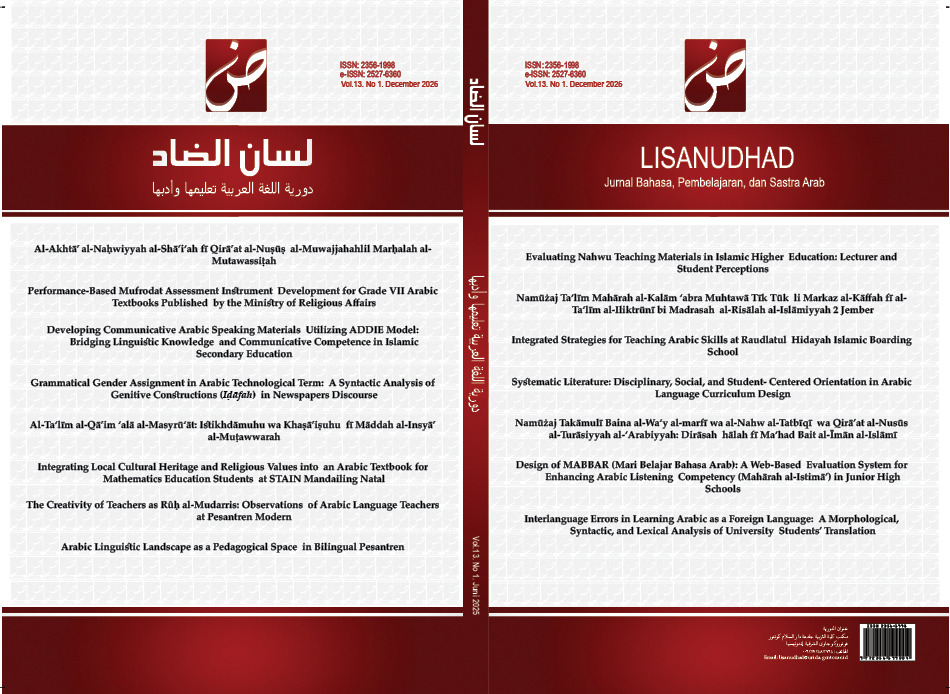
Systematic Literature: Disciplinary, Social, and Student-Centered Orientation in Arabic Language Curriculum Design
DOI:
https://doi.org/10.21111/lisanudhad.v13i1.28Keywords:
Arabic Language Curriculum, Curriculum Orientation, Student-Centered, PRISMA 2020Abstract
Curriculum design in Arabic language education is currently characterized by the dominance of traditional disciplinary approaches, alongside emerging demands for social relevance and student-centered learning. These differing orientations reflect ongoing tensions between epistemological foundations, contextual needs, and pedagogical transformation toward more participatory learning models. This study aims to explore and synthesize disciplinary, social, and student-centered orientations in Arabic curriculum design, as well as to develop an integrative conceptual framework that connects these three orientations in a complementary and balanced manner. This study employed a Systematic Literature Review (SLR) approach guided by the PRISMA 2020 protocol. From an initial pool of 120 articles, 18 articles were selected based on predefined inclusion and exclusion criteria. Data analysis was conducted thematically through coding processes focusing on curriculum orientation, educational ideology, and learning strategies. The results indicate that disciplinary orientation remains the dominant epistemic foundation in Arabic curriculum design. However, social and student-centered orientations have increasingly emerged in response to contemporary educational demands. Despite this development, the integration of the three orientations in curriculum practice remains limited and fragmented. The synthesis of findings leads to the formulation of an integrative conceptual framework that connects disciplinary, social, and student-centered dimensions. The study concludes that Arabic curriculum design requires a more balanced integration of disciplinary, social, and student-centered orientations to enhance its relevance and effectiveness in modern educational contexts.
References
Abusamra, Asmaa, Khawla Muhtaseb, and Razan Awawdeh. “Social Sciences & Humanities Open How Should E-Learning Be Conceptualized in the Context of Higher Education in MENA Region ?” Social Sciences & Humanities Open 12, no. July (2025): 101808. https://doi.org/10.1016/j.ssaho.2025.101808.
Akmalia, Frida, Erna Andriyanti, and Sulis Triyono. “Rethinking Technology-Driven CPD ( Continuing Professional Development ) for Arabic Language Teachers in Indonesia Meninjau Ulang Pengembangan Keprofesian Berkelanjutan ( PKB ) Berbasis Teknologi Bagi Guru Bahasa Arab Di Indonesia” 09, no. 01 (2025): 157–78. https://doi.org/10.30762/asalibuna.v9i01.5208.
Alkasasbeh, Khaled Abdelmahdi, Yahia Mohammad, Nabeeh Abdelmahdi Kasasbeh, and Abdelaziz Hussien. “Cultivating Critical Reading Skills in a Cultural Context: Investigating Reciprocal Teaching in Arabic Language Education,” 2025.
Alsalem, Abeer Saleh. “Curriculum Orientations and Educational Philosophies of High School Arabic Teachers” 11, no. 4 (2018): 92–95. https://doi.org/10.5539/ies.v11n4p92.
Alyaqoubi, Khalid, Fareed Awae, and Ahmad Bin Yussuf. “Mapping Two Decades of Research on Arabic Language Teaching : A Bibliometric Analysis in the Fields of Social Sciences and Arts” 15, no. 10 (2025): 385–404.
Creswell, John W., and J. David Creswell. Research Design: Qualitative, Quantitative, and Mixed Methods Approaches. 5th ed., 2023.
Farisi, Mohammad Zaka Al, Mujahid Asy’ari, and Hamdan Hasan. “Integrasi Nilai-Nilai Islam Dalam Pembelajaran Bahasa Arab Di Pondok Pesantren.” Jurnal Pendidikan Agama Islam 19, no. 1 (2022): 87–102.
Fauzi, Ahmad, and Siti Aisyah. “Efektivitas Pembelajaran Bahasa Arab Berbasis Pendekatan Realitas Sosial Di Ma’had Al Jamiah.” Arabiyat: Jurnal Pendidikan Bahasa Arab 9, no. 2 (2022): 145–60.
Flick, Uwe. An Introduction to Qualitative Research. 7th ed. London: Sage Publications, 2022.
Hakim, Arif Rahman, and Muhammad Yusuf. “Tren Penelitian Kurikulum Bahasa Arab Di Indonesia: Analisis Bibliometrik 2015-2024.” Jurnal Pendidikan Bahasa Arab Dan Kebahasaaraban 8, no. 2 (2024): 150–72.
Hanifah, Ummi, and Ahmad Zaki. “Systematic Literature Review Dalam Penelitian Pendidikan Bahasa Arab: Peluang Dan Tantangan.” Arabiyat: Jurnal Pendidikan Bahasa Arab Dan Kebahasaaraban 9, no. 1 (2022): 40–58.
Kitchenham, Barbara, and Stuart Charters. “Guidelines for Performing Systematic Literature Reviews in Software Engineering.” In EBSE Technical Report. Keele: Keele University, 2007.
Makdisi, George. The Rise of Colleges: Institutions of Learning in Islam and the West. Edinburgh University Press, 1981.
Miles, Matthew B., A. Michael Huberman, and Johnny Saldaña. Qualitative Data Analysis: A Methods Sourcebook. 4th ed. California: SAGE Publications, 2020.
Muttaqin, Zainal, Kisno Umbar, Farha Fuada, Andini Nuraisyah, and Husnul Hafiza Rahma. “Development of Outcome-Based Education ( OBE ) Framework in Arabic Education in Indonesia.” Jurnal Alsuniyat: Jurnal Penelitian Bahasa, Sastra, Dan Budaya Arab 8, no. 2 (2025).
Nasution, Sahkholid, Muhammad Roihan, and M. Yusuf. “Rekonstruksi Sosial Dalam Pembelajaran Bahasa Arab Di Madrasah Aliyah.” Arabi: Journal of Arabic Studies 6, no. 2 (2021): 187–200.
Page, Matthew J, Joanne E Mckenzie, Patrick M Bossuyt, Isabelle Boutron, Tammy C Hoffmann, Cynthia D Mulrow, Larissa Shamseer, et al. “The PRISMA 2020 Statement : An Updated Guideline for Reporting Systematic Reviews Systematic Reviews and Meta-Analyses.” BMJ Publishing Group 372, no. 71 (2021): 3. https://doi.org/10.1136/bmj.n71.
Patton, Michael Quinn. Qualitative Research & Evaluation Methods. 4th ed. Sage Publications, 2015.
Rosidah, Ali Maksum, and Siti Tutiawati. “Implementing Merdeka Belajar – Kampus Merdeka in Arabic Language Education : A Qualitative Case Study on Curriculum Transformation and Graduate Readiness” 04, no. 05 (2025): 2553–64.
Saldaña, Johnny. The Coding Manual for Qualitative Researchers. 4th ed. London: Sage Publications, 2021.
Samin, Saproni Muhammad, Gamal Abdul, Nasir Zakaria, and Rojja Pebrian. “Outcome-Based Arabic Language Education : Leveraging Learning Analytics for Graduate Success.” Arabiyat: Jurnal Pendidikan Bahasa Arab Dan Kebahasaaraban 12, no. 2 (2025): 243–59.
Schiro, Michael. Curriculum Theory: Conflicting Visions and Enduring Concerns. Los Angeles: Sage Publications, 2013.
Siregar, Rahmat Sapaat. “Principles of Subject-Based Arabic Curriculum Development : Language Skills Integration and Contextual Relevance.” DEEP LEARNING: Journal of Educational Research 1, no. 2 (2025): 55–67.
Snyder, Hannah. “Literature Review as a Research Methodology : An Overview and Guidelines.” Journal of Business Research 104 (2019): 333–39. https://doi.org/10.1016/j.jbusres.2019.07.039.
Taufiqurrahman, Muhbib Abdul Wahab, and N. L. Hamidah. “Diglosia Bahasa Arab Dan Implikasinya Terhadap Pengembangan Kurikulum Bahasa Arab Di Indonesia.” Lisanan Arabiya: Jurnal Pendidikan Bahasa Arab 6, no. 1 (2022): 23–42.
Zulkifli, Muhammad, and Rahma Ningsih. “Integrasi Teknologi Digital Dalam Pembelajaran Bahasa Arab Di Era Society 5.0.” Arabiyat: Jurnal Pendidikan Bahasa Arab Dan Kebahasaaraban 10, no. 1 (2023): 112–26.
Downloads
Submitted
Accepted
Published
How to Cite
Issue
Section
License
Copyright (c) 2026 Robi Irawan, Annisa Rahmawati, Dika Syam El-Fatony, Agus Pahrudin, Erlina

This work is licensed under a Creative Commons Attribution-NonCommercial 4.0 International License.
Authors who publish with this Journal agree to the following terms:
- Free to Share — copy and redistribute the material in any medium or format;
- Free to Adapt — remix, transform, and build upon the material,
The licensor cannot revoke these freedoms as long as you follow the license terms.
Under following terms:
- Attribution — You must give appropriate credit , provide a link to the license, and indicate if changes were made . You may do so in any reasonable manner, but not in any way that suggests the licensor endorses you or your use.
- NonCommercial — You may not use the material for commercial purposes .
No additional restrictions — You may not apply legal terms or technological measures that legally restrict others from doing anything the license permits.
Notices:
You do not have to comply with the license for elements of the material in the public domain or where your use is permitted by an applicable exception or limitation .
No warranties are given. The license may not give you all of the permissions necessary for your intended use. For example, other rights such as publicity, privacy, or moral rights may limit how you use the material.