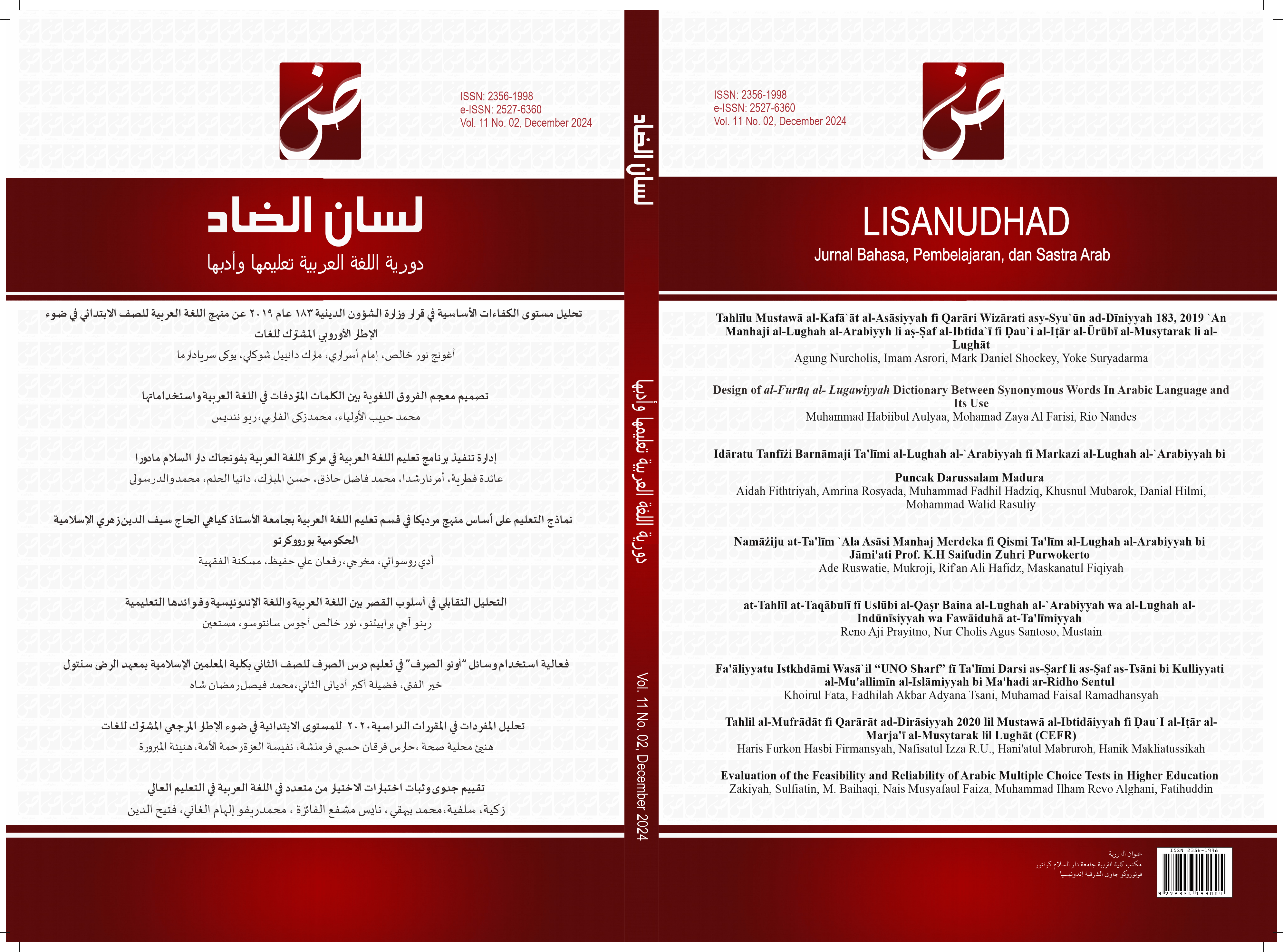
Idāratu Tanfīżi Barnāmaji Ta’līmi al-Lughah al-`Arabiyyah fi Markazi al-Lughah al-`Arabiyyah bi Puncak Darussalam Madura
Keywords:
Management of the Implementation of the Program, Markaz Lughah Arabiyah, Arabic Language Learning.Abstract
This study aims to determine the management of the implementation of the Arabic language learning program at Markaz Lughah Arabiyah Puncak Darussalam Madura and also to find out the problems faced in the implementation of the program. This research uses descriptive qualitative method. Data collection through observation techniques, semi-structured interviews and documentation. While analyzing the data through the analysis theory of Miles, Huberman, and Saldana which consists of data condensation, data presentation and conclusion drawing. The results showed that the management of the implementation of the Arabic language learning program at Markaz Lughah Arabiyah Puncak Darussalam Madura went well, seen from the activities of the students were very enthusiastic in participating in the program, namely the students could follow the activities until the specified time limit. In order to maximize language learning, Arabic is used as a daily communication tool. The problems faced by the markaz are the lack of teaching staff, limited facilities and learning resources, and limited learning time which affects the effectiveness of the learning process. Despite the shortcomings, the learning program held by the markaz can still run smoothly and well, where within the specified time (two semesters / one year), the students have been able to master Arabic well.
References
Ahmad, Dimas Zuhri, Abdulloh Muqofie, Khairunnisa Khairunnisa, Eman Sulaeman, Sarta Sarta, Fajar Shihab, and Yuyun R. Uyuni. “Manajemen Program Bahasa Arab Dalam Pelaksanaan Wajib Berbahasa.” Jurnal Pendidikan Islam Al-Ilmi 6, no. 2 (2023): 183. https://doi.org/10.32529/al-ilmi.v6i2.2540.
Aidah, Adhe Nor, Ahmad Fadhel, Syakir Hidayat, Maryam Nur Annisa, Universitas Islam, Negeri Sultan, Aji Muhammad, and Idris Samarinda. “Pengaruh Metode Tamyiz Terhadap Penguasaan Kosakata Mata Pelajaran Bahasa Arab Siswa Kelas V SDI Al-Azhar 47 Samarinda.” Borneo Journal of Islamic Education 3, no. 1 (2023): 101–16. https://doi.org/https://doi.org/10.21093/bjie.v3i1.6468.
Aldzakhiroh, Nilna, Beri Nopriansyah, and Zakiyah Arifa. “Al Mi’yar: Jurnal Ilmiah Pembelajaran Bahasa Arab Dan Kebahasaaraban” 7, no. 2 (2020): 643–56. https://doi.org/http://dx.doi.org/10.35931/am.v7i2.3745.
Burhanuddin, and Saepul Ramdani. “Tantangan Dan Prospek Studi Bahasa Arab Dalam Pengembangan Dakwah Islam Di Indonesia.” ARIMA: Jurnal Sosial Dan Humaniora 1, no. 3 (2024): 180–90. https://doi.org/https://doi.org/10.62017/arima.v1i3.709.
Dian Ahmad Jufrih, Abdul Wahab Rosyidi, and Usfiyatur Rusul. “Manajemen Program Bahasa Arab Di Pondok Pesantren Daarul Ukhuwwah Putri 2 Malang.” Jurnal Mu’allim 5, no. 1 (2023): 172–88. https://doi.org/10.35891/muallim.v5i1.3474.
Dunan, Hendri, and Rahmat Mulia. “Analisis Strategi Inovasi Berkelanjutan Untuk Meningkatkan Daya Saing Pada Organisasi Nirlaba (Yayasan Pondok Modern Daarul Ikrom Kedondong).” Journal of Education Research 5, no. 3 (2024): 3600–3612. https://doi.org/10.37985/jer.v5i3.924.
Farras Fadhilah, Amiruddin, Saila Rahma Annisa Nasution, Eka Satya. “Garapan Administrasi Dan Manajemen Pesantren: Menuju Pendidikan Islam Yang Berkualitas.” Pendas: Jurnal Ilmiah Pendidikan Dasar 09 (2024): 278–93. https://doi.org/https://doi.org/10.23969/jp.v9i2.15827.
Fazis, Muhammad, Bedjo Sujanto, and Makruf Akbar. “Changed Management of Islamic Boarding Schools (Phenomenology Study at the Sumatra Thawalib Parabek Islamic Boarding School).” International Journal of Innovative Technology and Exploring Engineering (IJITEE) 8, no. 6 (2019): 104–10. https://doi.org/https://doi.org/10.35940/ijitee.
Haerana. Manajemen Pembelajaran Berbasis Standar Proses Pendidikan; Teori Dan Aplikasinya. Yogyakarta: Media Akademi, 2016.
Hasan, Agus Wahid, and Danial Hilmi. “Manajemen Pelaksanaan Program Pembelajaran Bahasa Arab Di Pondok Pesantren Sunan Kalijogo Surabaya.” Tarbiyatuna: Jurnal Pendidikan Ilmiah 7, no. 1 (2022): 75–90. https://doi.org/10.55187/tarjpi.v7i1.4602.
Hidayat, Tatang, Ahmad Syamsu Rizal, and Fahrudin Fahrudin. “Peran Pondok Pesantren Sebagai Lembaga Pendidikan Islam Di Indonesia.” Ta’dib: Jurnal Pendidikan Islam 7, no. 2 (2018): 1–10. https://doi.org/10.29313/tjpi.v7i2.4117.
Imran, Ali. Manajemen Peserta Didik Berbasis Sekolah. Jakarta: Bumi Aksara, 2020.
Jahari, J. & Syarbini, A. Manajemen Madrasah Teori, Strategi Dan Implementasi. Bandung: Alfabeta, 2013.
Lexy J. Moleong. Metodologi Penelitian Kualitatif. Bandung: PT. Remaja Rosdakarya Offset, 2006.
Mariati, Mariati. “Penerapan Alat Evaluasi Pembelajaran Bertingkat Berdasarkan Taksonomi Bloom Dalam Meningkatkan Kemampuan Berfikir Mahasiswa.” Liabilities (Jurnal Pendidikan Akuntansi) 1, no. 2 (2018): 95–111. https://doi.org/10.30596/liabilities.v1i2.2328.
Miles, M.B, A.M Huberman, and J Saldana. Qualitative Data Anlysis, A Methods Sourcebook, Edition 3. USA: SAGE Publications, 2014.
Patricia Adekugbe, Arenike, and Chidera Victoria Ibeh. “Innovating Service Delivery For Underserved Communities: Leveraging Data Analytics And Program Management In The U.S. Context.” International Journal of Applied Research in Social Sciences 6, no. 4 (2024): 472–87. https://doi.org/10.51594/ijarss v664.986.
Rokim, Rokim, Nur Khozim Muhlis, and Muhammad Amin Fathih. “Manajemen Program Pembelajaran Markas Bahasa Arab Di Pondok Pesantren Al-Khoirot Malang.” Idaarah: Jurnal Manajemen Pendidikan 7, no. 2 (2023): 281–90. https://doi.org/10.24252/idaarah.v7i2.35486.
Sagala, Syaiful. Manajemen Strategik Dalam Peningkatan Mutu Pendidikan. Bandung: Alfabeta, 2017.
Sugiyono. Metode Penelitian Kuantitatif Kualitatif Dan R&D. Bandung: Alfabeta, 2017.
Suharsimi Arikunto. Prosedur Penelitian Suatu Pendekatan Praktik. Jakarta: Aneka Cipta, 2006.
Sulthonul Fata, Muhammad Riki, Muhammad Bagus Ainun Najib, and Khowarizmi Abdul Karim. “Idārah Tarsyīh Nādy Al-Kindī Fī Taṭwīr Al-Kafā-Ah Al-Lugawiyyah Al-‘Arabiyyah.” Lisanudhad 06, no. 01 (2019): 69–94. https://doi.org/https://doi.org/10.21111/lisanudhad.v6i1.311.
Sumantri, Afrilys, Tamyis, and Endang Ekowati. “Penerapan Metode Pembelajaran Berbasis Teknologi Terhadap Peningkatan Pemahaman Materi Pendidikan Agama Islam.” Unisan Jurnal 3, no. 1 (2024): 299–311. https://doi.org/https://journal.an-nur.ac.id/index.php/unisanjournal/article/view/2089.
Thoha, Mohammad. “Pembelajaran Bahasa Arab Dengan Pendekatan Manajemen Berbasis Sekolah.” Okara I, no. 79–90 (2012): 12. https://doi.org/https://doi.org/10.19105/ojbs.v6i1.420.
Downloads
Submitted
Published
How to Cite
Issue
Section
License
Copyright (c) 2026 Aidah Fithtriyah, Amrina Rosyada, Muhammad Fadhil Hadziq; Khusnul Mubarok; Danial Hilmi; Mohammad Walid Rasuliy

This work is licensed under a Creative Commons Attribution-NonCommercial 4.0 International License.
Authors who publish with this Journal agree to the following terms:
- Free to Share — copy and redistribute the material in any medium or format;
- Free to Adapt — remix, transform, and build upon the material,
The licensor cannot revoke these freedoms as long as you follow the license terms.
Under following terms:
- Attribution — You must give appropriate credit , provide a link to the license, and indicate if changes were made . You may do so in any reasonable manner, but not in any way that suggests the licensor endorses you or your use.
- NonCommercial — You may not use the material for commercial purposes .
No additional restrictions — You may not apply legal terms or technological measures that legally restrict others from doing anything the license permits.
Notices:
You do not have to comply with the license for elements of the material in the public domain or where your use is permitted by an applicable exception or limitation .
No warranties are given. The license may not give you all of the permissions necessary for your intended use. For example, other rights such as publicity, privacy, or moral rights may limit how you use the material.