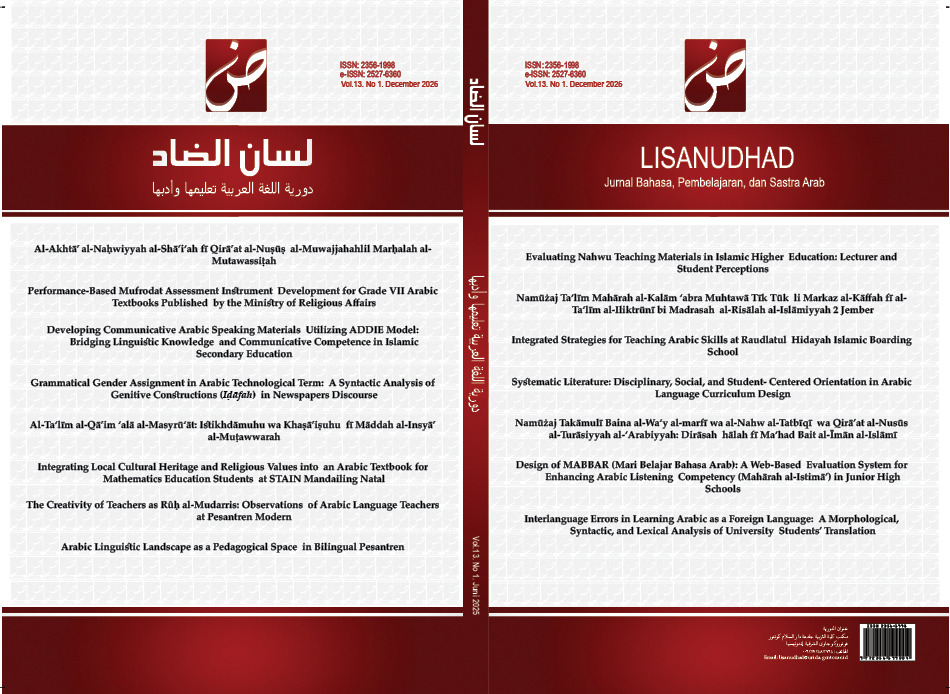
Evaluating Nahwu Teaching Materials in Islamic Higher Education: Lecturer and Student Perceptions
DOI:
https://doi.org/10.21111/lisanudhad.v13i1.38Keywords:
Nahwu materials, Arabic grammar, evaluation, lecturers’ perceptions, students’ perceptionsAbstract
The evaluation of Nahwu teaching materials in Islamic State Higher Education Institutions requires further attention, particularly regarding their alignment with the demands of twenty-first-century learning and educational technology development. Therefore, this study aims to evaluate the Nahwu teaching materials used in Arabic Education Study Programs at Islamic State Higher Education Institutions in Bengkulu Province based on lecturers’ and students’ perceptions. A mixed methods approach with an embedded design was employed, utilizing questionnaires as the primary data source and documentation as supporting data. The respondents consisted of 4 Nahwu lecturers and 251 students from IAIN Curup and UIN Fatmawati Sukarno Bengkulu. The results indicate that 62.50% of lecturers and 48.36% of students perceived the existing Nahwu teaching materials as less appropriate or inappropriate. Most materials are classical textbooks published no later than 2011 and lack integration with Education 4.0 and 5.0 learning technologies. Although some materials support grammatical comprehension, limitations in innovation, learning motivation, and higher-order thinking skills remain evident. Therefore, this study recommends developing more adaptive, contextual Nahwu teaching materials integrated with the TPACK framework to enhance effective learning in this Institutions
References
Abdou, Ashraf. “Integrating Grammar in the Arabic Curricula.” Teaching and Learning Arabic Grammar: Theory, Practice, and Research, 2022. https://doi.org/10.4324/9781003034209-11.
Aflisia, Noza, Raisha Febyola, and Karima Tussa’diah. “An Evaluative Analysis of TPACK Based Nahwu Teaching Materials Oriented Toward Higher Order Thinking Skills.” Al Ibrah: Journal of Arabic Language Education 9, no. 1 (June 10, 2026): 220–30. https://doi.org/10.24256/JALE.V9I1.10653.
Aflisia, Noza, Hendrianto, Nurwadjah Ahmad E.Q, and Andewi Suhartini. “Komparasi Pembelajaran Nahwu Di Pesantren Dan Madrasah.” Al-Fathin: Jurnal Bahasa Dan Sastra Arab 5, no. 1 (2022): 97–110.
Afriati, Intan, Zuhir Ratmansyah, Ardiman Fadhil, and Yudistira Iriandi Lesmana. “Grammar and Translation Methods in Arabic Language Learning: Theory and Practice.” MADINA : Journal of Islamic Studies 2, no. 1 (June 30, 2025): 1–8. https://doi.org/10.62945/madina.v2i1.741.
Ardiansyah, Ade Arip, and Azhar Muhammad. “Implementation of Integrative Arabic Grammar (Nahwu & Sharaf) Curriculum in Islamic Boarding School.” Izdihar : Journal of Arabic Language Teaching, Linguistics, and Literature 3, no. 3 (December 31, 2020): 211–28. https://doi.org/10.22219/jiz.v3i3.13264.
Az-Zahra, Keysha Aurellia, Kristina Imron, Bambang Prasetyo, Dinda Sayyidah ’Afifah, Dwi Indah Fajriyah, and Yunisa Isnaini. “Development of Contrast-Based Nahwu Teaching Materials Using Macromedia Flash.” Educatione, 2025, 154–62. https://doi.org/10.59397/edu.v3i2.70.
Bagas Purnama, Boby, Noor Auliya Huda, Siska Nanda Safitri, and Universitas Islam Negeri Sunan Kalijaga Yogyakarta. “Analysis of the Book Ilmu Nahwu Untuk Pemula: A Perspective from Mackey and Thu’aimah.” Didaktika: Jurnal Kependidikan 14, no. 1 Februari (2025): 783–98. https://mail.jurnaldidaktika.org/contents/article/view/1906.
Bisri Mustofa, Nur Ali, and Inayatur Rosyidah. “Improving Students’ Reading Skills Through the Development of Digital Nahwu Materials.” Journal of Information Systems Engineering and Management 10, no. 3 (2025): 888–94. https://doi.org/10.52783/jisem.v10i3.6405.
Firdaus, Mochammad, and Ahmad Fatoni. “Student Perceptions of the Use of the Nahwu Mabda’i Book in Nahwu Learning in the Arabic Language Education Study Program FAI-UMM.” Al-Afkar, Journal For Islamic Studies 7, no. 1 (January 11, 2024): 427–37. https://doi.org/10.31943/AFKARJOURNAL.V7I1.1042.
Hamid, Mohd Fauzi Abdul, Zulazhan A. Halim, and Muhammad Sabri Sahrir. “An Insight on Needs Analysis towards the Development of Animated Infographic Module in Arabic Grammar Learning.” Journal of Language and Linguistic Studies 16, no. 3 (2020): 1387–1401. https://doi.org/10.17263/jlls.803813.
Hamid, Mohd Fauzi Abdul, Muhammad Sabri Sahrir, Ahmad Zaki Amiruddin, Mohd Firdaus Yahaya, and Shaferul Hafes Sha’ari. “Evaluating Student Acceptance of Interactive Infographics Module for Arabic Grammar Learning Using the Technology Acceptance Model (TAM).” International Journal of Learning, Teaching and Educational Research 23, no. 9 (2024): 121–40. https://doi.org/10.26803/ijlter.23.9.7.
Hamid, Mohd Fauzi Abdul, Muhammad Sabri Sahrir, Mohd Firdaus Yahaya, and Muassomah. “Development of a Web-Based Interactive Infographic Module for Learning Arabic Grammar at a Malaysian University.” Journal of Education and Learning 19, no. 4 (2025): 2302–12. https://doi.org/10.11591/edulearn.v19i4.22258.
Hanifa, Zahra Aulia, and Asep Sopian. “Mapping Technology, Impact, and Challenges in Nahwu Learning: A Systematic Review (2020–2025).” Aphorisme: Journal of Arabic Language, Literature, and Education 6, no. 1 (2025): 149–63. https://doi.org/10.37680/aphorisme.v6i1.7225.
Hassan, Mona Kamel. Keda Mazbuut: A Grammar Book of EGYPTIAN COLLOQUIAL Arabic with Exercises. Keda Mazbuut: A Grammar Book of EGYPTIAN COLLOQUIAL Arabic with Exercises, 2020. https://api.elsevier.com/content/abstract/scopus_id/105019735968.
Hermiwati, Hermiwati, Muhammad Thahilal Jahidul Hasyib, Umi Machmudah, and Meidias Abror Wicaksono. “Enhancing Arabic Vocabulary Acquisition: Development of Learning Apps Based Interactive Learning Media.” Lisanudhad: Jurnal Bahasa, Pembelajaran Dan Sastra Arab 12, no. 2 (December 30, 2025). https://doi.org/10.21111/LISANUDHAD.V12I2.30.
Jarrah, Marwan, Jaradat Abdulazeez, and Linda Alkhawaja. “The Position of the Broken Plural in the Grammar: Rural Jordanian Arabic as a Case Study.” Lingua 265 (2022). https://doi.org/10.1016/j.lingua.2021.103165.
Khirani, Salim. “The Role Of Grammatical Evidence In Facilitating The Teaching Of Arabic Grammar.” Ta’limiah 15, no. 1 (June 1, 2025): 965. https://doi.org/10.52127/2240-015-001-071.
Leung, Tommi Tsz Cheung, Dimitrios Ntelitheos, and Meera Al Kaabi. Basic Emirati Arabic: A Grammar and Workbook. Basic Emirati Arabic: A Grammar and Workbook, 2024. https://doi.org/10.4324/9781003320241.
Majadly, Haifaa, and Aharon Geva-Kleinberger. “Arabic Grammar Curricula for Primary Schools in Middle Eastern Countries a Comparative Study.” Journal of Educational Media, Memory, and Society 12, no. 2 (2020): 1–29. https://doi.org/10.3167/jemms.2020.120201.
Masnun, Segaf Baharun, and Sultan Abdus Syakur. “Interactive Whiteboard as a Medium for Nahwu Learning: Bridging Technology and Arabic Grammar Education.” International Journal of Arabic Language Teaching 7, no. 01 (January 7, 2025): 1–20. https://doi.org/10.32332/IJALT.V7I01.9977.
Mohammed, Ruaa Jassim, and Nawar Hussein Rdhaiwi Al-Marsumi. “A Systemic Functional Grammar Approach to the Study of Emphatic Constructions in English and Arabic Scientific Texts.” Arab World English Journal 13, no. 2 (2022): 364–85. https://doi.org/10.24093/awej/vol13no2.25.
Pasani, Chairil Faif. “TPACK Untuk Mengembangkan HOTS Dan Berbagai Literasi.” In SENPIKA I. Banjarmasin: FKIP ULM, 2018.
Putra, A, M Ritonga, and HW Triana. “Optimizing Arabic Grammar Learning: Combination of Electronic and Conventional Mind Mapping.” Thariqah Ilmiah: Jurnal Ilmu-Ilmu Kependidikan Dan Bahasa Arab 11, no. 2 (2025). https://www.academia.edu/download/120650653/5293.pdf.
Rosyadi, Ahmad Mizan, Abdul Jalil Mannan, and Muhammad Shokhibul Hidayah. “Pendampingan Pembelajaran Kaidah Nahwu Dengan Kitab Al-Ajurumiyyah Di Pondok Pesantren Darus Sibyan Jombang Jember.” An-Nuqthah: Journal of Research& Community Service 2, no. 1 (2022): 46–51. https://doi.org/https://doi.org/10.1234/an-nuqtah.v1i3.886.
Siti Faizah Munawaroh, and Ahmad Fawaid. “Persepsi Mahasiswa Pendidikan Bahasa Arab Kelas A-K Semester V Terhadap Penggunaan Kitab Kifayatul Ashhab Untuk Pembelajaran Nahwu Iv.” Ma’arif Journal of Education, Madrasah Innovation and Aswaja Studies 1, no. 2 (2024). https://doi.org/10.69966/mjemias.v1i2.61.
Soliman, Rasha K. “Learners’ Perception of Arabic Grammar.” In Teaching and Learning Arabic Grammar: Theory, Practice, and Research, 122–49. Taylor and Francis, 2022. https://doi.org/10.4324/9781003034209-8.
Ulinnuha, Inayah Fitri, and Nuril Mufidah. “The Use of Albert Bandura’s Method for Learning Arabic Speaking Skill Using TikTok.” Lisanudhad: Jurnal Bahasa, Pembelajaran Dan Sastra Arab 12, no. 2 (December 15, 2025): 23–50. https://doi.org/10.21111/LISANUDHAD.V12I2.42.
Wahba, Kassem M., Zeinab A. Taha, and Manuela E.B. Giolfo. Teaching and Learning Arabic Grammar: Theory, Practice, and Research. Teaching and Learning Arabic Grammar: Theory, Practice, and Research, 2022. https://doi.org/10.4324/9781003034209.
Widyadhana, A R, and A A Salim. “The Cognitive Approach in Learning to Read Arabic Texts: A Philosophical and Pedagogical Analysis.” Lisānunā: Jurnal Bahasa Dan Pembelajaran Bahasa Arab 12, no. 2 (December 15, 2025): 161–83. https://doi.org/10.21111/LISANUDHAD.V12I2.41.
Yasmadi, Y, I Husna, … SI Lestari - Al-Ta’rib: Jurnal, and Undefined 2025. “Development of Innovative Teaching Materials: Transformation of Nahwu Textbooks in Interactive Digital.” E-Journal.Iain-Palangkaraya.Ac.Id 13, no. 2 (2025): 249–70. https://doi.org/10.23971/altarib.v13i2.9852.
Yusuf Salam, Muhammad, Hasan Basri, Abdullah Umar Al Haj Ibrahim, Mahmud Yunus Batusangkar, and Universitas Islam Negeri Syekh Ali Hasan Ahmad Addary Padangsidimpuan. “Realizung Inclusive Nahwu Learning Amid Student Diversity.” Jurnal.Uinsyahada.Ac.Id 13, no. 2 (2025). https://doi.org/10.24952/thariqahilmiah.v13i2.17230.
Zaenuri, Muhammad, and R. Umi Baroroh. “Developing An Integrated Nahwu Textbook For Kitab Kuning Reading Skills.” Ijaz Arabi Journal of Arabic Learning 8, no. 2 (2025). https://doi.org/10.18860/ijazarabi.v8i2.31175
Downloads
Submitted
Accepted
Published
How to Cite
Issue
Section
License
Copyright (c) 2026 Noza, Abdiel Faiz Abbasyah, Jilan Jauza, Erda Anggelia

This work is licensed under a Creative Commons Attribution-NonCommercial 4.0 International License.
Authors who publish with this Journal agree to the following terms:
- Free to Share — copy and redistribute the material in any medium or format;
- Free to Adapt — remix, transform, and build upon the material,
The licensor cannot revoke these freedoms as long as you follow the license terms.
Under following terms:
- Attribution — You must give appropriate credit , provide a link to the license, and indicate if changes were made . You may do so in any reasonable manner, but not in any way that suggests the licensor endorses you or your use.
- NonCommercial — You may not use the material for commercial purposes .
No additional restrictions — You may not apply legal terms or technological measures that legally restrict others from doing anything the license permits.
Notices:
You do not have to comply with the license for elements of the material in the public domain or where your use is permitted by an applicable exception or limitation .
No warranties are given. The license may not give you all of the permissions necessary for your intended use. For example, other rights such as publicity, privacy, or moral rights may limit how you use the material.