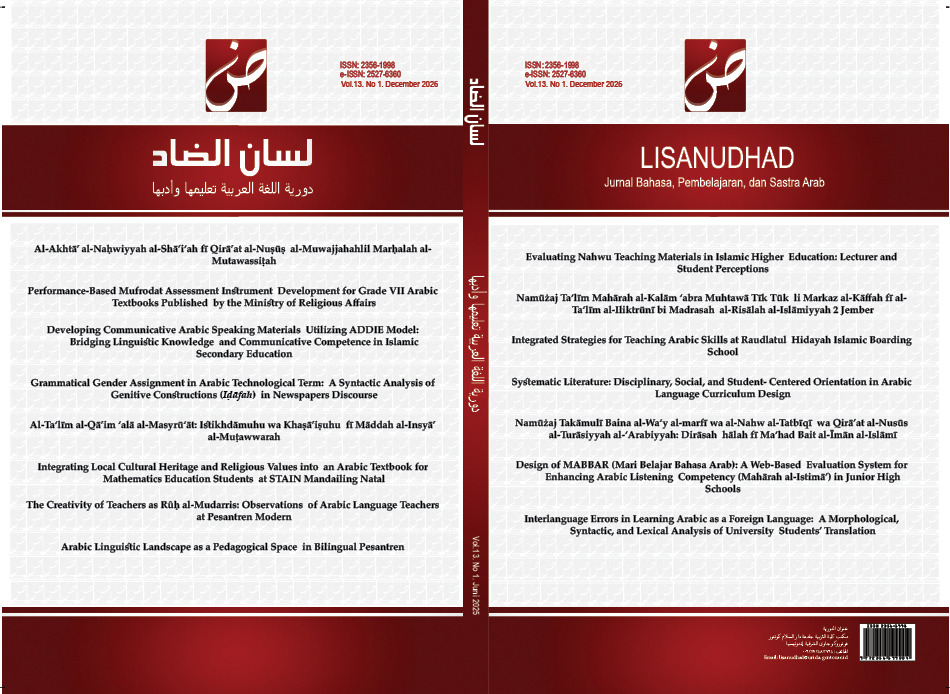
Integrating Local Cultural Heritage and Religious Values into an Arabic Textbook for Mathematics Education Students at STAIN Mandailing Natal
DOI:
https://doi.org/10.21111/lisanudhad.v13i1.34Keywords:
Arabic for Mathematics, Arabic for Specific Purposes, ADDIE Model, Textbook Development, Mandailing CultureAbstract
This study aimed to develop an Arabic textbook for specific purposes in mathematics (*Al-‘Arabiyah li ar-Riyāḍiyyāt*) for students of the Mathematics Education Program at STAIN Mandailing Natal. The study employed a Research and Development (R&D) approach using the ADDIE model, consisting of analysis, design, development, implementation, and evaluation stages. Participants included 26 undergraduate students, two Arabic language lecturers, two mathematics lecturers, and two experts in Mandailing culture and Islamic values. Data were collected through needs analysis questionnaires, expert validation sheets, student response questionnaires, interviews, and classroom observations, and analyzed using a mixed-methods approach. The findings revealed that the developed textbook adopts a specialized interdisciplinary approach integrating Arabic mathematical terminology with Mandailing ethnomathematics and Islamic theological values. Designed for academic purposes, it transforms abstract mathematical concepts into culturally contextual and religiously meaningful language tasks using local elements such as *Bagas Godang*, *Dalihan Na Tolu*, Quranic verses, and Hadith. Structurally, the textbook applies task-based learning to enhance students’ Arabic communicative competence, mathematical reasoning, and character development. Expert validation results indicated very high feasibility in content (91.2%), linguistic quality (89.5%), and integration of Mandailing cultural and Islamic values (92.8%). Field trials demonstrated that the textbook was practical, comprehensible, and effective in improving students’ engagement and understanding of mathematical terminology. This study highlights the importance of integrating Arabic for Specific Purposes (ASP), local wisdom, and Islamic values to strengthen communicative competence, cultural ownership, and appreciation of religious moderation in Islamic higher education.
References
Albantani, A. M., & Madkur, A. “Musyahadat Al-Fidiyu: Ict-Based Media in Arabic For Specific Purposes (Asp) Class.” Arabiyat: Jurnal Pendidikan Bahasa Arab Dan Kebahasaaraban, 5(2), 324- (2018). https://doi.org/DOI: https://doi.org/10.15408/a.v5i2.7441.
Aldahmash, Abdulwali H., and Naem M. Alamri. “An Analysis of the Inclusion of Mathematical Discourse Components in Arabic Mathematical Textbooks: The Case of Saudi Arabia.” Frontiers in Psychology 11, no. November (2020): 1–8. https://doi.org/10.3389/fpsyg.2020.534803.
Alfurochmatin, Anisa, and Ahmad Muhaimin Bin Mat Jusoh. “Tren Pengembangan Media Pembelajaran Bahasa Arab Di Indonesia Era 5.0.” Alsina : Journal of Arabic Studies 6, no. 1 (2024): 1–26. https://doi.org/10.21580/alsina.6.1.21278.
Bahasa, Lisanudhad Jurnal, and Sastra Arab. “Analysis on the Interference of Indonesian Morphology in the Translation of Classical Arabic Texts.” Lisanudhad 12, no. 2 (2025): 143–60.
Bahruddin, Uril, Fahrizal Winky Ghifari, and Najib Ahmad Shofiyullah. “Improving Arabic Language Skills by Integrating the Durusul Lugah Al-’Arabia and Silsilah Al-Azhar As-Syarif Textbooks for PPDU Malang Students.” Abjadia : International Journal of Education 7, no. 2 (2023): 160–73. https://doi.org/10.18860/abj.v7i2.17854.
Ibrahim Babakr Elhaj Abdelkader, Mohamed Hamed Mohamed Said, and Rijal Mahdi. “Digital Transformation: Characteristics and Advantages of Its Teaching and Learning.” Al-Jawhar : Journal of Arabic Language 2, no. 2 (2024): 131–41. https://doi.org/10.69493/ajoal.v2i2.57.
Jarrah, Adeeb M. “Elementary Schools Mathematics and Science Teachers’ Perspectives on Using English As a Medium of Instruction.” Humanities & Social Sciences Reviews 8, no. 4 (2020): 473–82. https://doi.org/10.18510/hssr.2020.8446.
Jaza Al-Sehli, Lujain, and Nadia Maroof. “Language Barriers in Teaching and Understanding Mathematics: Teachers’ and Students’ Perceptions.” Journal of Applied Linguistics and Language Research 7, no. 1 (2020): 125–34.
Nazhifa, Nadatul. “TRANSFORMASI PENDIDIKAN ERA DIGITAL: TANTANGAN DAN PELUANG BAGI GURU BAHASA ARAB MASA KINI.” Pendas : Jurnal Ilmiah Pendidikan Dasar, 10, no. 2 (2025): 438–53.
Pamessangi, Andi Arif. “Developing Arabic Language Textbooks Based on Religious Moderation in Madrasah.” AL-ISHLAH: Jurnal Pendidikan 14, no. 1 (2022): 147–56. https://doi.org/10.35445/alishlah.v14i1.1407.
Rahmah, Hania, Turmudi Turmudi, and Muhammad Tareq Ghifari. “Research and Development of Mathematics Teaching Material Integrated with Islamic Values: A Systematic Literature Review.” Prisma Sains : Jurnal Pengkajian Ilmu Dan Pembelajaran Matematika Dan IPA IKIP Mataram 12, no. 2 (2024): 306. https://doi.org/10.33394/j-ps.v12i2.9519.
Ramadhan, Muhammad Fadli, Suhayib, Abd Rofi Fathoni Nidhomillah, and Nikmatul Makfiro. “The Role of Arabic Language Learning Method and Its Relevance for Future Arabic Teachers: Ernest Nagel’s Perspective.” Izdihar : Journal of Arabic Language Teaching, Linguistics, and Literature 7, no. 3 (2024): 393–406. https://doi.org/10.22219/jiz.v7i3.34810.
Rusady, Achmad Tito, and Rizki Gumliar. “Development of an Arabic Writing Skills Textbook Based on Collocations.” Research and Development in Education (RaDEn) 4, no. 2 (2024): 1030–42. https://doi.org/10.22219/raden.v4i2.36229.
Sabra, Hussein, and Jehad Alshwaikh. “Combining Mathematical Arabic and the Textbook for Teaching the Sign of Quadratic Functions Hussein Sabra , Jehad Alshwaikh Language Lens,” no. July (2022). https://doi.org/: https://www.researchgate.net/publication/362425047 Combining.
Sarah, Sarah, Ana Sabila Rizqia, Lisna Lisna, and Mad Ali. “Technology Integration in Arabic Language Skills Development in the Digital Era.” Al-Fusha : Arabic Language Education Journal 6, no. 2 (2024): 74–81. https://doi.org/10.62097/alfusha.v6i2.1735.
Siregar, N., & Nur, M. “Etnomatematika Pada Arsitektur Rumah Adat Mandailing (Bagas Godang).” Jurnal Equation: Teori Dan Penelitian Pendidikan Matematika 3(2), 11 (2020): 8-132. doi: https://doi.org/10.29300/equation.v3i2.3482.
Sugiyono. Metode Penelitian Kuantatif, Kualitatif, Dan R&D. Bandung: Alfabeta. Hal.33-69, 2019.
Tajuddin, Shafruddin, Muhammad Kamal Abdul Hakim, and R.A. Barnabas. “Developing Arabic Textbook Material for Junior High School Students.” Alsinatuna 5, no. 2 (2020): 130–46. https://doi.org/10.28918/alsinatuna.v5i2.2322.
Turidho, Aisyah, Ratu Ilma Indra Putri, Ely Susanti, and Mery Johan. “Developing PISA-Like Math Tasks on Algebra Using Arabic Contexts.” Mathematics Education Journal 15, no. 2 (2021): 203–16. https://doi.org/10.22342/jpm.15.2.14847.203-216.
Yasin, Agus, Marheni Br Maha, Fahrurrozi, Ahmad Hidayatullah Zarkasyi, Siti Anne Barkah Nur Fauziah, and Ahmad Zalzuli. “Development of the ‘Al-Muhdastah Al-Yaumiyyah’ Textbook to Improve Arabic Speaking Skills at an Islamic Boarding School.” Izdihar : Journal of Arabic Language Teaching, Linguistics, and Literature 6, no. 2 (2023): 141–52. https://doi.org/10.22219/jiz.v6i2.22695.
Yusuf, Muhammad. “Development of Arabic Language Teaching Materials With 4D Model for the Second Semester at STAI Al-Furqan Makassar.” Bulletin of Science Education 3, no. 3 (2023): 152. https://doi.org/10.51278/bse.v3i3.662.
Downloads
Submitted
Accepted
Published
How to Cite
Issue
Section
License
Copyright (c) 2026 Tauhid, Suadi, Ayu Meita Puteri Siregar, Abdullah Umar Al-Haj Ibrahim

This work is licensed under a Creative Commons Attribution-NonCommercial 4.0 International License.
Authors who publish with this Journal agree to the following terms:
- Free to Share — copy and redistribute the material in any medium or format;
- Free to Adapt — remix, transform, and build upon the material,
The licensor cannot revoke these freedoms as long as you follow the license terms.
Under following terms:
- Attribution — You must give appropriate credit , provide a link to the license, and indicate if changes were made . You may do so in any reasonable manner, but not in any way that suggests the licensor endorses you or your use.
- NonCommercial — You may not use the material for commercial purposes .
No additional restrictions — You may not apply legal terms or technological measures that legally restrict others from doing anything the license permits.
Notices:
You do not have to comply with the license for elements of the material in the public domain or where your use is permitted by an applicable exception or limitation .
No warranties are given. The license may not give you all of the permissions necessary for your intended use. For example, other rights such as publicity, privacy, or moral rights may limit how you use the material.