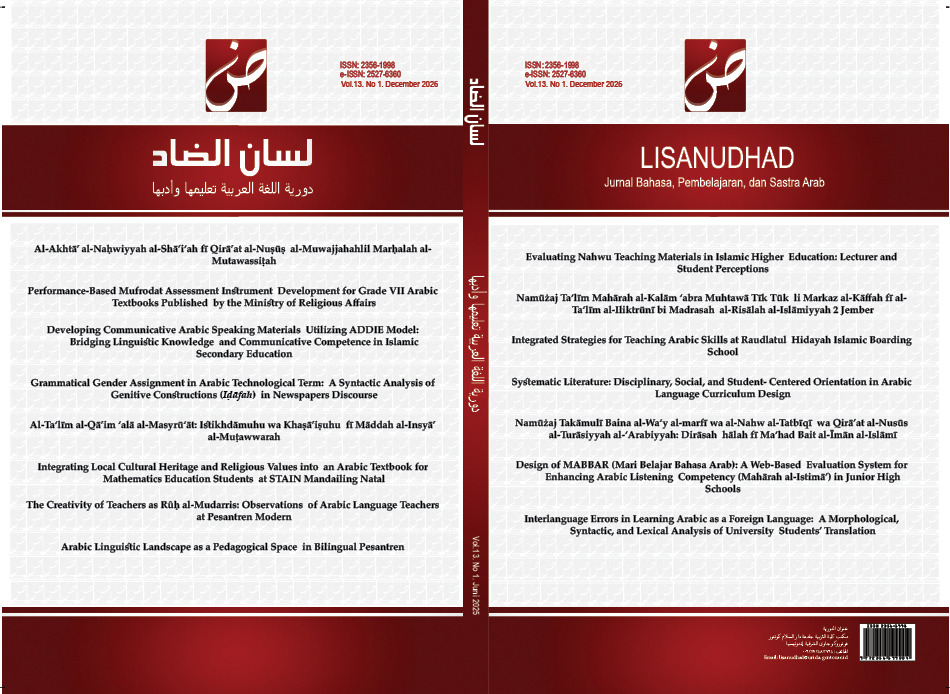
Grammatical Gender Assignment in Arabic Technological Term: A Syntactic Analysis of Genitive Constructions (Iḍāfah) in Newspapers Discourse
DOI:
https://doi.org/10.21111/lisanudhad.v13i1.27Keywords:
Genitive, Gender Grammatical, Technology, Ta’wīlī, HukmiAbstract
This research aims to explain the mechanism for determining grammatical gender in technological terms in modern Arabic, emphasizing the relationships among morphological forms, syntactic structures, and semantic contexts. This study is a descriptive, synchronic linguistic study using data on technology terms from the newspapers be explained solely by morphological forms, because most of these terms lack clear feminine markers. However, in syntactic usage, they can appear as either masculine or feminine. These findings affirm that the gender of borrowed terms is contextual and primarily determined by the syntactic-semantics relations surrounding them. Specifically, at the syntactic level, gender can be categorized into two forms, namely ḥukmī and ta’wīlī, both of which are influenced by the presence of the annexation (iḍāfah) construction in phrases or sentences containing technological terms. In this case, annexation (iḍāfah) functions affirmation, both through the explicitly present muḍāf and through the omitted muḍāf that is restored through the process of ta’wīl. Thus, this research expands the study of grammatical gender in Arabic by positioning annexation (iḍāfah) not only as a genitive construction but also as an active grammatical device in the integration of modern technological terms. However, the limitation of this study lies in the use of a newspaper corpus that does not fully reflect the full range of contemporary Arabic
References
Ahimsa-Putra, Shry Heddy, ‘Paradigma Penelitian Ilmu-Ilmu Humaniora. Makalah Kuliah Umum. Bandung: Program Studi Linguistik, Sekolah Pascasarjana, Universitas Pendidikan Indonesia’, Sekolah Pascasarjana, Universitas Pendidikan Indonesia, 2009
Al-’Asliliy, Hamid ’Aisiy Musthafa, Ta’nits al-Mudzkkar Fi al-Qur`an al-Karim Wa Kalam al-’Arab (Maktabatu al-Adab, 2018)
Alkohlani, Fatima A., ‘The Problematic Issue of Grammatical Gender in Arabic as a Foreign Language’, Journal of Language and Cultural Education, 4.1 (2016), pp. 17–28, doi:10.1515/jolace-2016-0002
AlSabbagh, Zainab Abdulaziz Abdulla, ‘Grammatical Gender & Linguistic Relativity: Does the Grammatical Gender Native Arabic Speakers Assign Neutral Nouns Affect How They Perceive Them?’, European Journal of Foreign Language Teaching, 7.1 (2023), doi:10.46827/ejfl.v7i1.4673
Arummi, Afnan, Eva Farhah, and Reza Nugraha, ‘Measuring Language Effectiveness In Arabic Expression Through Analysis of Ellipsis (Al-Hadzf)’, unpublished paper delivered at Proceedings of First International Conference on Culture, Education, Linguistics and Literature, CELL 2019, 5-6 August, Purwokerto, Central Java, Indonesia (2019), Proceedings of the Proceedings of First International Conference on Culture, Education, Linguistics and Literature, CELL 2019, 5-6 August, Purwokerto, Central Java, Indonesia, doi:10.4108/eai.5-8-2019.2289792
Astari, Rika, ‘Istilah Serapan Bahasa Inggris Pada Bidang Sains Dan Teknologi’ (unpublished PhD Thesis, Universitas Gadjah Mada, 2015)
Djajasudarma, Fatimah, Metode Linguistik: Ancangan Metode Penelitian Dan Kajian. (Refika Aditama, 2010)
Dragusin, Elena Denisa, ‘The “Grammar” of Gender. From a Robust Grammatical Category to a Fluid Discourse Construct’, Intertext, no. 1(65) (July 2025), pp. 26–42, doi:10.54481/intertext.2025.1.03
DROR, Yehudit, ‘Annexation ('iḍāfa) in Arabic Grammatical Thought’, Journal Asiatique (BE), no. 2 (2016), pp. 179–91, doi:10.2143/JA.304.2.3186087
Guellouz, Mariem, ‘Gender Marking and the Feminine Imaginary in Arabic’, in Gender, Language and the Periphery: Grammatical and Social Gender from the Margins, ed. by J. Abbou and F. Baider (John Benjamins Publishing Company, 2016), pp. 47–64, doi:10.1075/pbns.264.03gue
Habri, Habri, Khafid Roziki, and Abdul Muntaqim Al Anshory, ‘Al-Taʿrīb Fī al-Muṣṭalaḥāt al-Iliktruniyyah Wa al-Ṣiḥḥiyyah Bi Mauqiʿ Mawdoo3.Com al-ʿArabiy’, HuRuf Journal : International Journal of Arabic Applied Linguistic, 2.1 (2022), p. 96, doi:10.30983/huruf.v2i1.5186
Hadi, Syamsul, ‘Kata–Kata Serapan Dari Bahasa Arab Yang Terdapat Dalam Kamus Besar Bahasa Indonesia (KBBI)’ (unpublished PhD Thesis, Universitas Gadjah Mada, 2003)
——, ‘Pembentukan Kata Dan Istilah Baru Dalam Bahasa Arab Modern’, Arabiyat : Jurnal Pendidikan Bahasa Arab Dan Kebahasaaraban, 4.2 (2017), doi:10.15408/a.v4i2.5801
Hammad, Usama, ‘The Feminine in the Structure of the Arabic Language: An Analytical Semantic Study’, IJAS: Indonesian Journal of Arabic Studies, 4.2 (2022), p. 229, doi:10.24235/ijas.v4i2.10290
Khasanah, Alannisa Nur, Muchlisin Nawawi, and Mohamad Yusuf Ahmad Hasyim, ‘“Iḍāfah Dalam Surat Al-Anbiyā”(Analisis Sintaksis): Iḍāfah in Surah Al-Anbiyā’(Syntax Study)’, Lisanul Arab: Journal of Arabic Learning and Teaching, 13.1 (2024), pp. 112–19, doi:10.15294/laa.v13i1.8489
Kilgarriff, Adam, ‘Create and Search a Text Corpus | Sketch Engine’, 2003, p. 1 <https://www.sketchengine.eu/>
Lloret, Maria‐Rosa, ‘Gender and Its Morphological Effects’, in The Wiley Blackwell Companion to Morphology, ed. by Peter Ackema and others, 1st edn (Wiley, 2023), pp. 1–43, doi:10.1002/9781119693604.morphcom032
Mahmoud Fallaha, and Mustafa Agâh, Hadis Cümlelerde Hazf Belagatı ‘Müsned-i Darimi’den Seçilmiş Hadisler Örneği’, published online 31 March 2024, doi:10.5281/ZENODO.10900876
Mahsun, Mahsun, Metode Penelitian Bahasa (PT Raja Frafindo Persada, 2017)
Masyhadi, Anang Rikza, ‘Mudzakkar Dan Muannats Dalam Susunan Al-Quran: Tinjauan Morfo-Sintaksis Dan Semantik’ (unpublished PhD Thesis, Universitas Gadjah Mada, 2014)
Muassomah, Muassomah, and others, ‘The Portrayal of Gender in the Arabic Construction’, Academic Journal of Interdisciplinary Studies, 11.5 (2022), p. 255, doi:10.36941/ajis-2022-0140
Muslimakhon Azimova, Evolution of the Arabic Language’s Terminological System, published online 11 August 2025, doi:10.5281/ZENODO.16797216
Musthofa, Aufa Alfian, ‘Takwīn Al-Muṣṭalaḥāt al-ʿArabiyyah al-Ḥadīthah Fī al-Majāl al-Ṭibbī: Dirāsah Taḥlīliyyah Fī Muʿjam al-Mawrid al-Muzdawaj Wa-al-Muʿjam al-Ṭibbī Nūriyā’, LISANUDHAD, 4.1 (2017), p. 85, doi:10.21111/lisanudhad.v4i1.1291
Najib, Aan, and Ahmad Abdul Malik, ‘Semantic Change of Arabic Nouns in the Al-Qur’ān: Form, Process and Social Impact l Tagyīr al-Ma’nā Min Kalimah Ism al-Lugah al-’Arābiyyah Fī al-Qur’ān: Al-Syakl Wa al-‘Amaliyyah Wa al-Âŝar al-Ijtimā’Iyyah’, Jurnal Al Bayan: Jurnal Jurusan Pendidikan Bahasa Arab, 12.2 (2020), pp. 301–21, doi:10.24042/albayan.v12i2.6371
Owens, Jonathan, ‘Abdelkader Fassi Fehri, Constructing Feminine to Mean: Gender, Number, Numeral and Quantifier Extensions in Arabic. Lanham, MD: Lexington Books, 2018. Pp. Xiv + 233.’, Journal of Linguistics, 55.3 (2019), pp. 671–76, doi:10.1017/S0022226719000215
Rogers, Phillip G., and Stefan Th. Gries, ‘Grammatical Gender Disambiguates Syntactically Similar Nouns’, Entropy, 24.4 (2022), p. 520, doi:10.3390/e24040520
Sudaryanto, Sudaryanto, Metode Linguistik Ke Arah Memahami Linguistik, 3rd edn (Gadjah Mada Universitu Press, 1992)
Ya’qub, Imil Badi’, Al Mu’jam al-Mufasshal Fi al-Mudzakkar Wal Mu`annats (Dar al-Kutub al-Ilmiyyah, 1994)
Downloads
Submitted
Accepted
Published
How to Cite
Issue
Section
License
Copyright (c) 2026 aufa Alfian Musthofa, Sandidu Sangidu , Hendrokumoro Hendrokumoro

This work is licensed under a Creative Commons Attribution-NonCommercial 4.0 International License.
Authors who publish with this Journal agree to the following terms:
- Free to Share — copy and redistribute the material in any medium or format;
- Free to Adapt — remix, transform, and build upon the material,
The licensor cannot revoke these freedoms as long as you follow the license terms.
Under following terms:
- Attribution — You must give appropriate credit , provide a link to the license, and indicate if changes were made . You may do so in any reasonable manner, but not in any way that suggests the licensor endorses you or your use.
- NonCommercial — You may not use the material for commercial purposes .
No additional restrictions — You may not apply legal terms or technological measures that legally restrict others from doing anything the license permits.
Notices:
You do not have to comply with the license for elements of the material in the public domain or where your use is permitted by an applicable exception or limitation .
No warranties are given. The license may not give you all of the permissions necessary for your intended use. For example, other rights such as publicity, privacy, or moral rights may limit how you use the material.