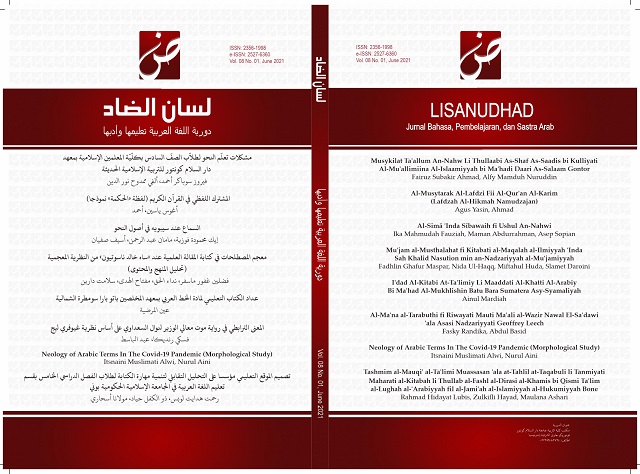
I’dad Al-Kitabi At-Ta’limiy Li Maaddati Al-Khatti Al-Arabiy Bi Ma’had Al-Mukhlishin Batu Bara Sumatera Asy-Syamaliyah
Keywords:
Textbook, Khat Naskhi, Learning Arabic CalligraphyAbstract
This study aims to develop an Arabic calligraphy textbook based on Khaṭṭ al-Naskh, evaluate its validity, and examine its effectiveness in improving students’ calligraphy skills at Al-Mukhlisin Islamic Boarding School, Batu Bara, North Sumatra. The study was motivated by the limited availability of instructional materials for Arabic calligraphy, which resulted in students’ low proficiency. In practice, teachers relied on scattered learning resources rather than a structured textbook, making the learning process less systematic and limiting students’ opportunities to practice independently outside the classroom.
To address this problem, the researcher developed a Khaṭṭ al-Naskh textbook as the primary learning resource. Khaṭṭ al-Naskh was selected because it is one of the most widely used Arabic scripts, recognized for its clarity, readability, and suitability for beginners. The study employed a Research and Development (R&D) approach using the Borg and Gall model. Data were collected through observation, interviews, questionnaires, tests, and documentation. The developed textbook was evaluated through expert validation, while its effectiveness was measured using a pre-test and post-test design involving female students at the Al-Mukhlisin Islamic Boarding School.
The findings indicate that the research successfully produced a textbook for teaching Arabic calligraphy based on Khaṭṭ al-Naskh. Expert validation demonstrated that the textbook was highly feasible for instructional use, achieving a validity score of 89.3%. Furthermore, the effectiveness test revealed a t-value of 7.863, which exceeded the critical t-table value of 2.000 at the 5% significance level. These results confirm that the developed textbook significantly improves students’ Arabic calligraphy skills and can serve as an effective instructional resource for Arabic calligraphy learning in Islamic boarding schools.
References
القرآن الكريم.
البجة، عبد الفتاح حسن. (د.ت.). أصول تدريس العربية: بين النظرية والممارسة. عمّان: دار الفكر.
الجبوري، محمود شكر. (1998). الخط العربي: قيم ومفاهيم والزخرفة الإسلامية. بغداد: دار الأمل.
حمودة، محمود عباس. (1981). دراسات في علم الكتابة العربية.
حمودة، محمود عباس. (د.ت.). تطور الكتابة الخطية العربية: دراسة لأنواع الخطوط ومجالات استخدامها (ط. 1). القاهرة: دار الوفاء.
الأغا، طاهر جعفر. (1998). المرشد في تعليم خط النسخ. دمشق: المكتبة الإسلامية للطباعة والنشر.
طعيمة، رشدي أحمد. (1989). تعليم العربية لغير الناطقين بها: مناهجه وأساليبه. الرياض: إيسيسكو.
طه، حسن. (د.ت.). قابلة التحوير كخاصية فنية في الخط العربي وكمدخل لإثراء التصميمات الزخرفية (رسالة ماجستير). جامعة طنطا، طنطا.
الكردي المكي، محمد طاهر بن عبد القادر. (1939). تاريخ الخط العربي وآدابه. القاهرة: مكتبة الهلال.
ليسوانطا، أريس. (2014). تعليم الخط العربي للمستوى المتوسط بجاوى الشرقية: دراسة حالة في مراكز تعليم الخط العربي بجاوى الشرقية (رسالة ماجستير). جامعة مولانا مالك إبراهيم الإسلامية الحكومية، مالانج.
محمود، محمد حي. (2016). إعداد كتاب الخط العربي لقسم تدريس اللغة العربية بجامعة علاء الدين الإسلامية الحكومية مكاسر (رسالة ماجستير). جامعة مولانا مالك إبراهيم الإسلامية الحكومية، مالانج.
الغالي، ناصر عبد الله، & عبد الله، عبد الحميد. (1991). أساس إعداد الكتاب التعليمي لغير الناطقين بالعربية. الرياض: دار الغالي.
Downloads
Submitted
Published
How to Cite
Issue
Section
License
Copyright (c) 2026 Ainul Mardiah

This work is licensed under a Creative Commons Attribution-NonCommercial 4.0 International License.
Authors who publish with this Journal agree to the following terms:
- Free to Share — copy and redistribute the material in any medium or format;
- Free to Adapt — remix, transform, and build upon the material,
The licensor cannot revoke these freedoms as long as you follow the license terms.
Under following terms:
- Attribution — You must give appropriate credit , provide a link to the license, and indicate if changes were made . You may do so in any reasonable manner, but not in any way that suggests the licensor endorses you or your use.
- NonCommercial — You may not use the material for commercial purposes .
No additional restrictions — You may not apply legal terms or technological measures that legally restrict others from doing anything the license permits.
Notices:
You do not have to comply with the license for elements of the material in the public domain or where your use is permitted by an applicable exception or limitation .
No warranties are given. The license may not give you all of the permissions necessary for your intended use. For example, other rights such as publicity, privacy, or moral rights may limit how you use the material.