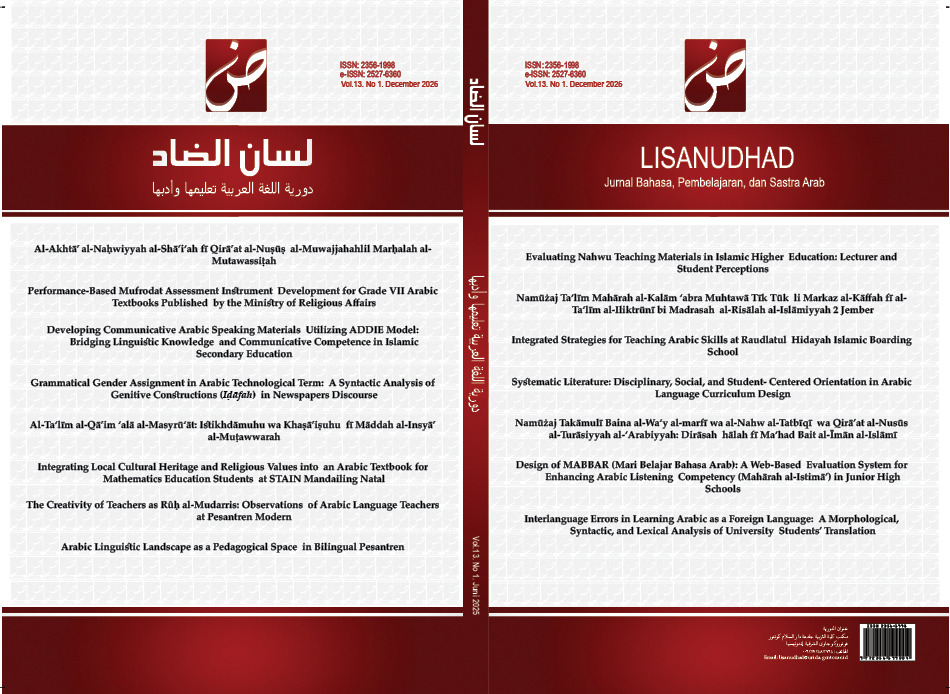
Developing Communicative Arabic Speaking Materials Utilizing ADDIE Model: Bridging Linguistic Knowledge and Communicative Competence in Islamic Secondary Education
DOI:
https://doi.org/10.21111/lisanudhad.v13i1.20Keywords:
Arabic speaking instruction, communicative language teaching, nstructional material development, ADDIE model, communicative competence, Islamic secondary educationAbstract
Arabic instruction in Islamic secondary schools often prioritizes grammatical accuracy over communicative use, creating a persistent gap between linguistic knowledge and actual speaking performance. Addressing this challenge, this study aimed to develop and validate communicative-based Arabic speaking (al-kalām) teaching materials that facilitate the transformation of grammatical competence into communicative competence. The study employed a Research and Development (R&D) approach using the ADDIE model, encompassing analysis, design, development, implementation, and evaluation stages. Data were collected through classroom observations, interviews, document analysis, and expert validation questionnaires in an Indonesian Islamic senior secondary school. The needs analysis revealed that students possessed sufficient vocabulary and grammatical knowledge but lacked meaningful opportunities for authentic interaction. Based on Communicative Language Teaching (CLT) principles, the developed materials integrated contextual dialogues, task-based activities, role-play exercises, and authentic assessment strategies. Expert evaluation demonstrated a high level of validity (93.5%), while classroom implementation indicated improvements in student participation, confidence, and speaking fluency. The findings extend second language acquisition theory by highlighting the role of contextual interaction in fostering communicative competence. The study contributes a systematic model for integrating communicative competence into Arabic instructional design and offers adaptable teaching materials for contexts characterized by limited target-language exposure
References
Abdul Hamid, M. F., M. S. Sahrir, A. Z. Amiruddin, M. F. Yahaya, and S. H. Sha’ari. “Evaluating Student Acceptance of Interactive Infographics Module for Arabic Grammar Learning Using the Technology Acceptance Model (TAM).” International Journal of Learning, Teaching and Educational Research 23, no. 9 (2024): 121–40. Scopus. https://doi.org/10.26803/ijlter.23.9.7.
Adam, Muhammad Zikran, and Laily Fitriani. “Implementation of the Drill Method in Learning Arabic with a Communicative Approach.” Journal of Arabic Language Learning and Teaching (JALLT) 1, no. 1 (2023): 1. https://doi.org/10.23971/jallt.v1i1.70.
Akbar, Sa’dun. Instrumen Perangkat Pembelajaran. 2013. https://scholar.google.com/scholar?cluster=591135122582155452&hl=en&oi=scholarr.
Al Khaldy, M., A. Shaheen, W. Alzyadat, and A. Alhroob. “Virtual Reality for Early Childhood Education: A Technology-Driven Approach to Learning Arabic Alphabets and Numbers.” International Journal of Information and Education Technology 15, no. 8 (2025): 1752–59. Scopus. https://doi.org/10.18178/ijiet.2025.15.8.2376.
Al Khateeb, A., and M. Hassan. “Initiating Intercultural Communicative Competence through Telecollaboration: A Case of Language-Exchange Classrooms of Arabic and English.” Journal of Ethnic and Cultural Studies 10, no. 4 (2023): 175–92. Scopus. https://doi.org/10.29333/ejecs/1718.
Alwaely, S. A. K., and H. Lahiani. “Assessing Argumentative Writing Skills in Online Environments among Arabic Language Teachers of Grades 5 to 7 in UAE Schools.” International Journal of Emerging Technologies in Learning 15, no. 18 (2020): 202–17. Scopus. https://doi.org/10.3991/ijet.v15i18.13581.
Azhar, Muhammad, Hakmi Wahyudi, and Promadi Promadi. “Arabic Language Learning with Communicative Method and Factors Affecting Student’s Speaking Ability.” Takuana: Jurnal Pendidikan, Sains, Dan Humaniora 1, no. 2 (2022): 92–101. https://doi.org/10.56113/takuana.v1i2.33.
Azizah, Nur Laila, Naifah Naifah, Baiq Intan Afrianingsih, Millatul Hamidah, and Muhammad Athif Audl Ramadlan. “Development of Arabic Language Learning in Indonesia at 19th – 21st Century.” Jurnal Al Bayan: Jurnal Jurusan Pendidikan Bahasa Arab 16, no. 1 (2024): 219–38. https://doi.org/10.24042/albayan.v16i1.22767.
Bila, Yashara Salsa, Elsa Oktarina, Rizka Zhafira Putri, and Kalayo Hasibuan. “The Implementation of Text-Based Approach within the Competency-Based Curriculum in Senior High School.” Jurnal Kajian Ilmu Pendidikan (JKIP) 5, no. 1 (2024): 63–73. https://doi.org/10.55583/jkip.v5i1.938.
Boone, Harry, and Deborah Boone. “Analyzing Likert Data.” Journal of Extension 50, no. 2 (2012). https://doi.org/10.34068/joe.50.02.48.
Bowen, Glenn A. “Document Analysis as a Qualitative Research Method.” Qualitative Research Journal 9, no. 2 (2009): 27–40. World. https://doi.org/10.3316/QRJ0902027.
Butler, Yuko Goto. “Communicative and Task-Based Language Teaching in the Asia-Pacific Region.” In Second and Foreign Language Education. Springer, Cham, 2016. https://doi.org/10.1007/978-3-319-02323-6_28-1.
Ellis, Timothy J., and Yair Levy. “A Guide for Novice Researchers: Design and Development Research Methods.” Proceedings of Informing Science & IT Education Conference (InSITE) 2010 10 (n.d.): 107–18.
Firmansyah, Haris, Nafisatul Izza R.U., Hani’atul Mabruroh, and Hanik Mahliatussikah. “Tahlil Al-Mufrādāt Fi Qarārāt Ad-Dirāsiyyah 2020 Lil Mustawā al-Ibtidāiyyah Fi Ḍau`I al-Iṭār al-Marja’ī al-Musytarak Lil Lughāt (CEFR): Vocabulary Analysis of 2020 Arabic Language Texbooks for Madrasah Ibtidaiyah Based on CEFR (Common European Framework of Reference).” Lisanudhad: Jurnal Bahasa, Pembelajaran, Dan Sastra Arab 11, no. 2 (2024): 145–63. https://doi.org/10.21111/lisanudhad.v11i2.12144.
Flick, Uwe, Ernst von Kardoff, and Ines Steinke. A Companion to Qualitative Research. SAGE, 2004.
Guba, Egon G. “Criteria for Assessing the Trustworthiness of Naturalistic Inquiries.” ECTJ 29, no. 2 (1981): 75–91. https://doi.org/10.1007/BF02766777.
Hamidah, Hamidah, Yulia Rahmah, Uswatun Hasanah, Selvianor Selvianor, and Ajahari Ajahari. “Developing Arabic Grammar Materials Based on Contextual Learning at Islamic Boarding School in Indonesia.” Al-Ta’rib : Jurnal Ilmiah Program Studi Pendidikan Bahasa Arab IAIN Palangka Raya 12, no. 1 (2024): 133–46. https://doi.org/10.23971/altarib.v12i1.8292.
Hidayat, Tatang, Sadiyah Ratnasari Sagala, Istianah Istianah, Husnul Khatimah, Muhammad Nanang Qosim, and Abdel Rahman Elsayed Elsayed Abdel Ghaffar Balah. “Effectiveness of Memorizing The Qur’an on Arabic Vocabulary Mastery Among Students at Ar-Rahmah Boarding School for Tahfīdz Qur’an Balikpapan.” Lisanudhad: Jurnal Bahasa, Pembelajaran, Dan Sastra Arab 11, no. 01 (2024): 129–52. https://doi.org/10.21111/lisanudhad.v11i01.11142.
Huberman, Michael, and Matthew B. Miles. The Qualitative Researcher’s Companion. SAGE, 2002.
Hymes, Dell, ed. Foundations in Sociolinguistics: An Ethnographic Approach. Routledge, 2013. https://doi.org/10.4324/9781315888835.
Jasiah, Jasiah. “Analisis Kebutuhan Pengembangan Bahan Ajar Mata Kuliah Budaya Lokal Di IAIN Palangka Raya: Analysis of Needs Development Material Learning Program Local Cultural in State Islamic Institute of Palangka Raya.” Anterior Jurnal 19, no. 1 (2019): 148–52. https://doi.org/10.33084/anterior.v19i1.1199.
Judilla, Gregian Carl, Reyna Mae Morre, Marven Cayanong, Joemar Miñoza, and M. Saleh Yahya Himni. “Improving Speaking Skills Through Communicative Language Teaching (CLT): A Literature Review.” Asshika: Journal of English Language Teaching and Learning 3, no. 1 (2025): 31–39. https://doi.org/10.65190/asshika.v3i1.441.
Krashen, Stephen D. Principles and Practice in Second Language Acquisition. Elsevier Science & Technology, 1982.
Kurt, Serhat. An Introduction to the Addie Model: Instructional Design: The Addie Approach. Amazon Digital Services LLC - KDP Print US, 2019.
Mubarak, Muhammad Zaki, Muassomah, and Leny Octriana. “Arabic Language Acquisition in Indonesia’s Muslim Minority Community: A Netnographic Study in the Arab Village.” Al-Ta’rib : Jurnal Ilmiah Program Studi Pendidikan Bahasa Arab IAIN Palangka Raya 13, no. 1 (2025): 97–112. https://doi.org/10.23971/altarib.v13i1.9743.
Muflihah, Muflihah, Sholehan Sholehan, and Muhammad Baihaqi. “Integration of Four Language Skills in Arabic Language Learning.” Jurnal Al Bayan: Jurnal Jurusan Pendidikan Bahasa Arab 16, no. 1 (2024): 69–87. https://doi.org/10.24042/albayan.v16i1.18381.
Namaziandost, Ehsan, Mina Homayouni, and Pegah Rahmani. “The Impact of Cooperative Learning Approach on the Development of EFL Learners’ Speaking Fluency.” Cogent Arts & Humanities 7, no. 1 (2020): 1780811. https://doi.org/10.1080/23311983.2020.1780811.
Nurcholis, Agung, Imam Asrori, Mark Daniel Shockley, and Yoke Suryadarma. “Tahlīlu Mustawā Al-Kafā`āt al-Asāsiyyah Fi Qarāri Wizārati Asy-Syu`ūn Ad-Dīniyyah 183, 2019 `An Manhaji al-Lughah al-Arabiyyh Li Aṣ-Ṣaf al-Ibtida`ī Fi Ḍau`i al-Iṭār al-Ūrūbī al-Musytarak Li al-Lughāt: Analysis of Core Competency Levels in the KMA No. 183, 2019 on the Arabic Language Curriculum for Elementary Level According to the CEFR.” Lisanudhad: Jurnal Bahasa, Pembelajaran, Dan Sastra Arab 11, no. 2 (2024): 1–22. https://doi.org/10.21111/lisanudhad.v11i2.11270.
Nurdianto, Talqis, Zainal Abidin Hajib, and Noor Azizi Bin Ismail. “Educational Objectives The Skill of Writing Arabic to Other Speakers at the Level of A1 and A2 in Perspective of the Common European Framework for Teaching Languages.” LISANUDHAD 6, no. 2 (2019): 1. https://doi.org/10.21111/lisanudhad.v6i2.3195.
Ramadhan, Sindegi Afsana Oktaviani, and Jasiah Jasiah. “Development of an Interactive Digital E-Module Based on the ADDIE Model with Thaharah Material for PAI Students at UIN Palangka Raya as MTs Level Learners.” ANWARUL 5, no. 6 (2025): 751–63. https://doi.org/10.58578/anwarul.v5i6.7876.
Rekan, Abd Aziz, Hafeezur Rahman Howell, Muhamad Nasir Mohamad Salleh, et al. “Arabic Language Curriculum as a Foundation for Strengthening Religious Education in Public Higher Education.” Jurnal Pendidikan Agama Islam 22, no. 1 (2025): 97–121. https://doi.org/10.14421/jpai.v22i1.11340.
Ritonga, M., R. Hakim, T. Nurdianto, and A. W. Ritonga. “Learning for Early Childhood Using the IcanDO Platform: Breakthroughs for Golden Age Education in Arabic Learning.” Education and Information Technologies 28, no. 7 (2023): 9171–88. Scopus. https://doi.org/10.1007/s10639-022-11575-7.
Ritonga, M., A. Mudinillah, W. Wasehudin, J. Julhadi, A. Amrina, and M. H. Shidqi. “The Effect of Technology on Arabic Language Learning in Higher Education.” Journal of Education and Learning 18, no. 1 (2024): 116–27. Scopus. https://doi.org/10.11591/edulearn.v18i1.20867.
Rudisunhaji, Muhamad Asngad, Intan Sari Dewi, Ahmad Nurcholis, and Syaikhu Ihsan Hidayatullah. “Competency-Based Arabic Language Learning In Madrasah Aliyah/ تعلم اللغة العربية القائم على الكفاءة فى المدرسة الثانوية.” Ijaz Arabi Journal of Arabic Learning 7, no. 1 (2024). https://doi.org/10.18860/ijazarabi.v7i1.20910.
Sahrir, Muhammad Sabri Bin. “Reading Comprehension as an Absolute Necessity in Teaching Arabic for Non-Native Learners.” LISANUDHAD 6, no. 1 (2019): 25. https://doi.org/10.21111/lisanudhad.v6i1.2692.
Simon, Anis Shalatin, Fatimah Azzahra Mutmainah, Suharia Sarif, and Isna Annisa. “COLLABORATIVE LEARNING IN ARABIC LANGUAGE LEARNING IN INDONESIA: A SYSTEMATIC LITERATURE REVIEW.” Thariqah Ilmiah: Jurnal Ilmu-Ilmu Kependidikan & Bahasa Arab 12, no. 2 (2025): 330–46. https://doi.org/10.24952/thariqahilmiah.v12i2.14107.
Taber, Keith S. “The Use of Cronbach’s Alpha When Developing and Reporting Research Instruments in Science Education.” Research in Science Education 48, no. 6 (2018): 1273–96. https://doi.org/10.1007/s11165-016-9602-2.
Waliyuddin, Waliyuddin, Ardani Ramdhan Thamimy, and Rahmat Linur. “Methods of Arabic Language Learning.” AL MA’ANY 3, no. 1 (2024): 11–20. https://doi.org/10.56874/almaany.v3i1.1974.
Wathawatthana, Pattharaporn, Narueta Hongsa, Purachai Phonchad, and Thaksin Thambunrueang. “Breaking the Silence: The Impact of the CLT Method on Grade 12 Students’ Speaking Skills.” International Journal of Education and Literacy Studies 13, no. 2 (2025): 612–21.
Zamanzadeh, Vahid, Akram Ghahramanian, Maryam Rassouli, Abbas Abbaszadeh, Hamid Alavi-Majd, and Ali-Reza Nikanfar. “Design and Implementation Content Validity Study: Development of an Instrument for Measuring Patient-Centered Communication.” Journal of Caring Sciences 4, no. 2 (2015): 165–78. https://doi.org/10.15171/jcs.2015.017.
Downloads
Submitted
Accepted
Published
How to Cite
Issue
Section
License
Copyright (c) 2026 Imam Mulhakim, Hamidah, Marsiah

This work is licensed under a Creative Commons Attribution-NonCommercial 4.0 International License.
Authors who publish with this Journal agree to the following terms:
- Free to Share — copy and redistribute the material in any medium or format;
- Free to Adapt — remix, transform, and build upon the material,
The licensor cannot revoke these freedoms as long as you follow the license terms.
Under following terms:
- Attribution — You must give appropriate credit , provide a link to the license, and indicate if changes were made . You may do so in any reasonable manner, but not in any way that suggests the licensor endorses you or your use.
- NonCommercial — You may not use the material for commercial purposes .
No additional restrictions — You may not apply legal terms or technological measures that legally restrict others from doing anything the license permits.
Notices:
You do not have to comply with the license for elements of the material in the public domain or where your use is permitted by an applicable exception or limitation .
No warranties are given. The license may not give you all of the permissions necessary for your intended use. For example, other rights such as publicity, privacy, or moral rights may limit how you use the material.