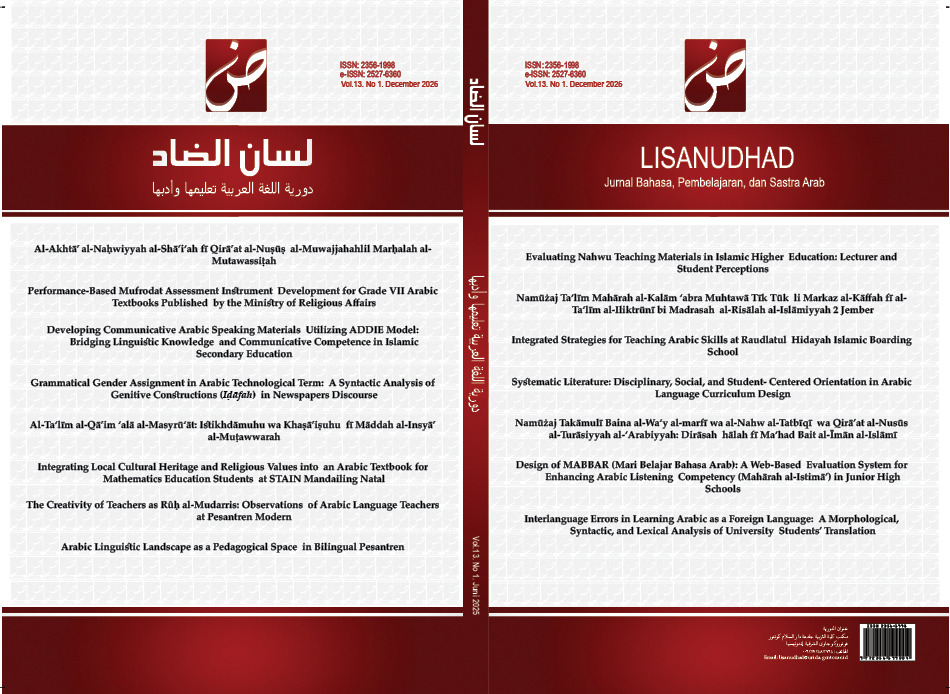
Performance-Based Mufrodat Assessment Instrument Development for Grade VII Arabic Textbooks Published by the Ministry of Religious Affairs
DOI:
https://doi.org/10.21111/lisanudhad.v13i1.11Keywords:
Assessment Instrument, Mufrodat, Performance Assessment, Arabic Language TextbookAbstract
The assessment of Mufrodat in the Arabic language book for class VII MTs published by the Ministry of Religion in 2020 is still dominated by objective tests, such as translation, matching, and choosing answers, which measure the ability to recognize word meanings rather than the use of Mufrodat in language practice. This indicates that the use of Mufrodat in language activities has not been widely measured. Previous research has focused primarily on learning Mufrodat and language skills, while studies on performance-based assessment of Mufrodat remain limited. This study aims to construct a conceptual model of the performance-based Mufrodat assessment published by the Ministry of Religion in 2020. The research uses a qualitative descriptive method with a literature review design, employing documentation techniques and content analysis. The results showed that the assessment of Mufrodat in textbooks remained oriented towards objective tests. In contrast, performance-based instruments assessed the use of Mufrodat through dialogue, verbal commands, and simple interactions and included rubrics, scoring criteria, and score interpretation. These findings show that performance-based assessment is better suited to measuring mastery of Mufrodat because it provides a clearer overview of students' ability to use vocabulary and offers teachers an alternative evaluation that more closely aligns with the goals of learning Arabic
References
Afifah, Nor, Sunarto Sunarto, Moh. Fery Fauzi, Irma Anindiati, and Talqis Nurdianto. “The Implementation of Mimicry Memorization Method for Novice Students in Learning Arabic Mufrodat .” Jurnal Al Bayan: Jurnal Jurusan Pendidikan Bahasa Arab 12, no. 2 (2020): 263–80. https://doi.org/10.24042/albayan.v12i2.5953.
Agustianti, R., S. Abyadati, L. Nussifera, A. I. Irvani, D. Y. Handayani, D. Hamdani, and R. R. Amarulloh. “Asesmen dan Evaluasi Pembelajaran,” 2022, 10–14. https://books.google.com/books
Alamsyah, F., Fitroh, R., & Baroroh, R. U. “Innovative Arabic Vocabulary Assessment Instruments to Enhance the Speaking Skills of Grade X Students at MA Science and Technology Al Marzuqiyyah Sumedang,” 2025.
Alsharhan, Eiman, and Allan Ramsay. “Investigating the Effects of Gender, Dialect, and Training Size on the Performance of Arabic Speech Recognition.” Language Resources and Evaluation 54, no. 4 (2020): 975–98. https://doi.org/10.1007/s10579-020-09505-5.
Amirudin, Noor, Khoirul Anwar, Ayunda Sayyidatul Ifadah, Mohammad Ahyan Yusuf Sya’bani, and Hasan Basri. “Analysis of Learning Evaluation Issues Affecting Educational Goal Achievement in Islamic Education.” International Research Journal of Multidisciplinary Scope 6, no. 4 (2025): 299–312. https://doi.org/10.47857/irjms.2025.v06i04.05800.
Castillo-Martínez, Isolda Margarita y María Soledad Ramírez-Montoya. “Research Competencies to Develop Academic Reading and Writing: A Systematic Literature Review.” Frontiers in Education 5 (2021). https://doi.org/10.3389/feduc.2020.576961.
CHASANAH, NURUL. “Upaya Peningkatan Penguasaan Mufrodat Baru Dengan Metode Menyanyi Pada Siswa Kelas Viii Madrasah Tsanawiyah Negeri 2 Semarang.” SECONDARY: Jurnal Inovasi Pendidikan Menengah 3, no. 3 (2023): 219–26. https://doi.org/10.51878/secondary.v3i3.2397.
Choirotunnisa, Y, A Al-Shammari, and N Cania. “Comparison of Arabic Learning Models in Mufrodat Learning.” Qaul’Arabiy, 2025. https://journal.zmsadra.or.id/index.php/jqa/article/view/29%0Ahttps://journal.zmsadra.or.id/index.php/jqa/article/download/29/4.
Diantoro, Fery, Amalia Fitri Ristyana, Eka Aprilia, and Fahira Alhamdila Anshori. “Standar Pengelolaan Penilaian Peserta Didik di Madrasah Aliyah Ma’arif Balong.” Southeast Asian Journal of Islamic Education Management 5, no. 1 (2024): 77–90. https://doi.org/10.21154/sajiem.v5i1.298.
Fadilah, Rahma, Wiena Safitri, and Ahmad Asrof Fitri. “Analisis Buku Teks Bahasa Arab Kelas Vii Madrasah Tsanawiyah Kurikulum 2013 (Terbitan Kementerian Agama Republik Indonesia).” Journal of Islamic Studies 1, no. 3 (2023): 342–55. https://doi.org/10.61341/jis/v1i3.027.
Fauzi, Ahmad, and Siti Rahmawati. “Evaluation of Speaking Competence in Arabic Language Learning: A Performance Assessment Approach.” Arabic Teaching Innovation and Arabic Literature 2, no. 1 (2025): 12–22. https://ojs.bustanilmu.com/index.php/IJAS.
Fuad Hasim, Muhamad, Muhammad Baihaqi, Nelly Sakinah, Ulil Irzaqotul Humaidah, and Adi Surya Utama. “Bridging Assessment and Proficiency: Developing Speaking Skill Test Instruments for Arabic Learners.” Tsaqofiya : Jurnal Pendidikan Bahasa Dan Sastra Arab 7, no. 2 (2025): 526–37. https://doi.org/10.21154/zk6nbg28.
Gupta, Samir, Rosalind Tang, Kadia Petricca, Ivan D. Florez, and Monika Kastner. “The Guideline Language and Format Instrument (GLAFI): Development Process and International Needs Assessment Survey.” Implementation Science 17, no. 1 (2022). https://doi.org/10.1186/s13012-022-01219-2.
Habibi, Roni, and Artha Glory Romey Manurung. “SLR (Systematic Literature Review): Metode Penilaian Kinerja Karyawan Menggunakan Human Performance Technology.” Journal of Applied Computer Science and Technology 4, no. 2 (2023): 100–107. https://doi.org/10.52158/jacost.v4i2.511.
Hermiwat, Muhammad Thahilal Jahidul Hasyib, Umi Machmudah, Meidias Abror Wicaksono. “Enhancing Arabic Vocabulary Acquisition: Development of Learning Apps Based on Interactive Learning Media.” Lisanudhad: Jurnal Bahasa, Pembelajaran dan Sastra Arab 12, no. 2 (2025): 51–80. https://doi.org/10.21111/lisanudhad.v12i2.30.
Hidayah, I. “… Nomor 20 Tahun 2007, Peraturan Menteri Pendidikan Dan Kebudayaan Nomor 66 Tahun 2013, Dan Peraturan Menteri Pendidikan Dan Kebudayaan Nomor 23 Tahun ….” Al Iman: Jurnal Keislaman Dan Kemasyarakatan, 2020. https://ejournal.stidar.ac.id/index.php/aliman/article/view/3851%0Ahttps://ejournal.stidar.ac.id/index.php/aliman/article/download/3851/2802.
Husein, Muhamad Fadhil, R Umi Baroroh, Rianda Ayu Ritnaning Tias, and Ade Satria Fauzi Nasution. “Innovation of Assessment Instruments Based on a Pragmatics Approach on the Mufrodat Tests.” Jurnal Inovasi dan Teknologi Pembelajaran 12, no. 2 (2025): 85–99. https://doi.org/10.17977/um031v12i22025p085.
Irawan, Andri, Bambang Samsul Arifin, and Mulyawan Safwandy Nugraha. “Non-Test Evaluation Techniques in Islamic Religious Education Learning.” Al-Afkar, Journal For Islamic Studies 8, no. 2 (2025): 682–701.
Jannah, Mawaddahtul, Rodli al Anshori, Istiadah Istiadah, and Miftahul Huda. “Arabic Language Learning in The Merdeka Curriculum From the Perspective of Progressivism Philosophy.” Lisanudhad: Jurnal Bahasa, Pembelajaran, dan Sastra Arab 11, no. 01 (2024): 32–51. https://doi.org/10.21111/lisanudhad.v11i01.10787.
LaForme Fiss, Alyssa, Lisa A. Chiarello, Lin Ya Hsu, and Sarah Westcott McCoy. “Adaptive Behavior and Mastery Motivation in Children with Physical Disabilities.” Physiotherapy Theory and Practice 40, no. 7 (2024): 1616–27. https://doi.org/10.1080/09593985.2023.2181118.
Lindgren, Britt Marie, Berit Lundman, and Ulla H. Graneheim. “Abstraction and Interpretation during the Qualitative Content Analysis Process.” International Journal of Nursing Studies 108 (2020). https://doi.org/10.1016/j.ijnurstu.2020.103632.
Linura Tuada, Kamal Yusuf, Mahjatin Nabilah Syarofina, Nur Aqilah L.R.O. “Deconstructing Arabic Language Learning: A Bridge between Philosophical Analysis and Pedagogical Innovation.” Lisanudhad: Jurnal Bahasa, Pembelajaran dan Sastra Arab 12, no. 2 (2025): 81–100.
Mohan, Radha. “Measurement, Evaluation and Assessment in Education,” 2023, 314.
Munib, Abdul. Penilaian Pembelajaran Bahasa Arab. Fakultas Ilmu Tarbiyah dan Keguruan UIN Sunan Kalijaga Yogyakarta, 2020.
Musanna, Syarifah, Jamaluddin, and M. Duskri. “Test and Non-Test Evaluation Methods in Islamic Religious Education Learning in Senior High School: A Critical Analysis Based on Literature Review to Strengthen Student-Centered Learning.” DARUSSALAM: Scientific Journal of Islamic Education 2, no. 1 (2025): 8–13. https://doi.org/10.62945/darussalam.v2i1.752.
Muslimah, Maziyyatul, and Siti Zumrotun Nisaul Mutiatul Karimah. “Asesmen Kinerja dalam Pembelajaran Kalam Bahasa Arab Siswa MTs Tahun 2023: Penelitian Pustaka melalui Google Scholar.” Muslimah, Maziyyatul Karimah, Siti Zumrotun Nisaul Mutiatul 4, no. 1 (2024): 4. https://doi.org/10.30739/arabiyat.v1i01.2473.
Pahlefi, M. Riza. “Pengembangan Instrumen Penilaian Keterampilan Menyimak (Mahārah Al-Istima’) Dalam Pembelajaran Bahasa Arab.” Uktub: Journal of Arabic Studies 2, no. 2 (2022): 68–84. https://doi.org/10.32678/uktub.v2i2.6458.
Rizal, Muhamad, Alim Hardiansyah, and Oki Kusmawan. “Sistem Penilaian Kinerja Pengajar Menggunakan Metode Ahp dan Tsukamoto (Studi Kasus : Lembaga Bahasa dan Ilmu Al-Qur’an).” Infotech: Journal of Technology Information 9, no. 1 (2023): 9–18. https://doi.org/10.37365/jti.v9i1.152.
Rober, Sandra, Nurfarhanah, and Zadrian Ardi. “Utilization of Test and Non-Test Instruments in Guidance and Counseling.” Journal of Psychology, Counseling and Education 3, no. 2 (2025): 176–88.
S, Febry Ramadani and R Umi Baroroh. “Strategies And Methods Of Learning Arabic Vocabulary / Strategi Dan Metode Pembelajaran Kosakata Bahasa Arab.” Ijaz Arabi Journal of Arabic Learning 3, no. 2 (2020): 291–312. https://doi.org/10.18860/ijazarabi.v3i2.10062.
Sanusi, Rosyidah Nur Ainy, and Furqanul Aziez. “Analisis Butir Soal Tes Objektif dan Subjektif untuk Keterampilan Membaca Pemahaman pada Kelas VII SMP N 3 Kalibagor.” Metafora: Jurnal Pembelajaran Bahasa dan Sastra 8, no. 1 (2021): 99. https://doi.org/10.30595/mtf.v8i1.8501.
Silvia, Reka, and Cindy. “An Analysis of Implementation of Performance-Based Assessment on Students' Speaking Skill in the Twelfth Grade of SMAN 1 Kotagajah.” Doctoral Dissertation, IAIN Metro, 2025, 90–92. http://digilib.unimed.ac.id/id/eprint/39356.
T., Heydarnejad, Tagavipour F., Patra I., and Khafaga A. “The Impacts of Performance-Based Assessment on Reading Comprehension Achievement, Academic Motivation, Foreign Language Anxiety, and Students? Self-Efficacy.” Language Testing in Asia, 2022.
Tadzkia, Syifa. “Validity and Reliability Test on Non-Test Instruments of Learning Motivation of Grade IV Students.” JURNAL HURRIAH: Jurnal Evaluasi Pendidikan dan Penelitian 4, no. 2 (2023). https://doi.org/10.56806/jh.v4i2.132.
Wibowo, H. S. “Pengembangan Sistem Evaluasi PAI: Menuju Peningkatan Mutu Pembelajaran Agama Islam,” 2023. https://books.google.com/books
mad Nanang Qosim. “Penilaian Kinerja Pada Pembelajaran Maharah Al-Kalam Level 1 Di Kursus Bahasa Arab Al-Arobiya Surakarta.” Uktub: Journal of Arabic Studies 1, no. 2 (2021): 84–101. https://doi.org/10.32678/uktub.v1i2.5814.
Wohlin, Claes, Marcos Kalinowski, Katia Romero Felizardo, and Emilia Mendes. “Successful Combination of Database Search and Snowballing for Identification of Primary Studies in Systematic Literature Studies.” Information and Software Technology 147 (2022). https://doi.org/10.1016/j.infsof.2022.106908
Downloads
Submitted
Accepted
Published
How to Cite
Issue
Section
License
Copyright (c) 2026 Fahrurrozi. S , Aprilya Azizah , Ahmad Riyadissolihin , Oktavia Dwi Lestari , Arya Yudiawan

This work is licensed under a Creative Commons Attribution-NonCommercial 4.0 International License.
Authors who publish with this Journal agree to the following terms:
- Free to Share — copy and redistribute the material in any medium or format;
- Free to Adapt — remix, transform, and build upon the material,
The licensor cannot revoke these freedoms as long as you follow the license terms.
Under following terms:
- Attribution — You must give appropriate credit , provide a link to the license, and indicate if changes were made . You may do so in any reasonable manner, but not in any way that suggests the licensor endorses you or your use.
- NonCommercial — You may not use the material for commercial purposes .
No additional restrictions — You may not apply legal terms or technological measures that legally restrict others from doing anything the license permits.
Notices:
You do not have to comply with the license for elements of the material in the public domain or where your use is permitted by an applicable exception or limitation .
No warranties are given. The license may not give you all of the permissions necessary for your intended use. For example, other rights such as publicity, privacy, or moral rights may limit how you use the material.